Review: Ballet Under the Stars – 15 years of dance at Hatch House

Graham Watts sees Ballet Under the Stars at Hatch House with “outstanding mix of established and emerging talent”.
| Title | Ballet Under the Stars |
| Company | The Covent Garden Dance Company |
| Venue | Hatch House, Wiltshire, UK |
| Date | 26 July 2024 |
| Reviewer | Graham Watts |
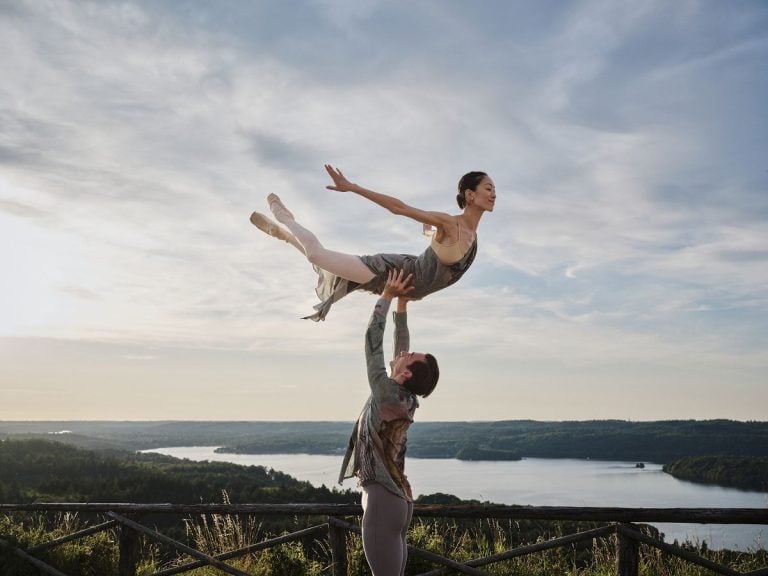
This was the fifteenth anniversary of Ballet Under the Stars at Hatch House, set in the heart of the Wiltshire countryside with enchanting views across the Vale of Wardour. It sounds a little Middle Earth and, with the rain staying away, this sultry evening approached a Tolkienesque realm of reverie.
We have long been accustomed to country house opera in the United Kingdom, with Glyndebourne and Garsington leading the way and Hatch House is carving a niche for country house ballet (Dorset’s Athelhampton House made a brief post-Covid attempt at achieving something similar, led for three years by The Royal Ballet‘s Meaghan Grace Hinkis).
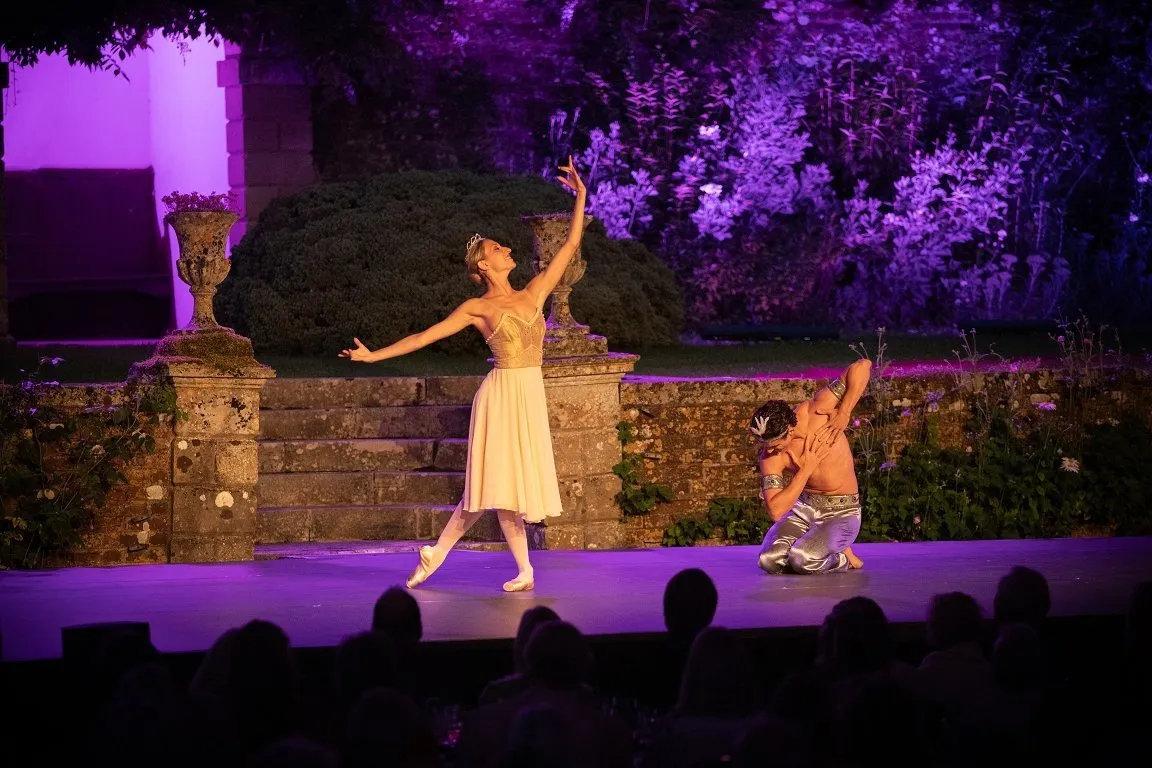
The Hatch House formula is to provide a gourmet dinner – replacing last year’s experiment with a boxed picnic – this year created by a pair of experienced chefs, Alexander Bailleiu and Fiona Dodd Noble. The audience of around 430 sits between the picturesque Hatch House façade and an exquisite 17th Century walled Dutch garden, experiencing a quartet of dance works between each dinner course. The performances began in fading daylight and continued into late evening darkness, the lighting picking out the vibrant colours of the garden, which gradually took on the appearance of a flourishing coral reef. For the hardier souls, the evening continued into the small hours with a French-themed after-party!


Following an entrée of beetroot infused gravlax with pea and broad bean bruschetta, Staatsballett Berlin principal, Ksenia Ovsyanick opened the dance proceedings with the quicksilver pointe-shoe solo, Limelight, performed in a halter-neck yellow tunic over black shorts, exemplifying the toned muscularity of her bare legs in a variety of arabesques and lightning-fast footwork. Limelight was choreographed by Katarzyna Kozielska, initially as a prize-winning showpiece for Elisa Badenes at the 2015 gala for the German Dance Prize.
Ovsyanick’s appearance was a celebration in itself since it marked the beginning of her tenth year at Hatch House, having danced in the very first gala, back in 2009 when she was with English National Ballet. She is leaving Berlin at the end of this season and, on this evidence, is still very much at peak performance levels.
Live music makes such a difference and this year’s Ballet Under the Stars was considerably enlivened by the cello playing of Arne-Christian Pelz who travelled from Deutsche Oper Berlin to accompany Ovsyanick in this and a subsequent solo: Folia (the penultimate work) was an exciting live improvisation between the dancer and the cellist. Ovsyanick created her movement in the moment, drawing inspiration and energy from the music. It was a highlight of the evening. As the first-ever live musician at the Hatch House gala, we got full value from Pelz as he opened each of the three “acts” with an absorbing cello solo.

The dance critic, Richard Buckle (1916-2001) lived a few miles from Hatch House and his memory is honoured through the Dicky Buckle Fund, which commissions a new work for each year’s Ballet Under the Stars. This year’s recipient was James Bamford of Project Dance Company who used the opportunity to create Masterpiece, a transdisciplinary work for two dancers (Grace Noelle and Andrew Parfitt) performing in front of a screen that gradually animated a painting by Hannah Fowler (digitised by John Ruddy), expressing the power of movement in a series of swirls that surrounded a pair of dancers captured in a partnered duet; the artwork on the screen reflected in dark splashes and squiggles on the dancers’ white trouser-suits.
The choreography, artwork and performances were all individually excellent, but – for once – the setting didn’t seem right. The beauty of this event is the natural backdrop of the walled garden, and the screen became an unwanted intrusion. It’s a work that will sit more naturally when taken indoors.


These contemporary works were interlaced with three classical pas de deux, two of which involved Xander Parish, like Ovsyanick, another émigré from a British dance company. Now a principal with Norwegian National Ballet (having left the Mariinsky Ballet of St Petersburg after the Russian invasion of Ukraine), Parish partnered Ukrainian dancer, Kateryna Chebykina (of Béjart Ballet Lausanne) in the Zobeide/Golden Slave duet from Michel Fokine‘s Scheherazade and then the Diamonds pas de deux from George Balanchine’s Jewels, which closed the programme. Both were performed with a fine mix of mannered and exquisite poses, excellent partnering and finely honed musicality; the dancers using the small stage expertly to give the impression of more space than there was.
Parish and Ovsyanick confirmed their star billing by joining together in the middle section (after the main course of “Norma Farrelly’s Famous Lamb Tagine with Couscous”) to perform a modern duet, entitled Closure, by Juliano Nunes, danced to music by Schubert, wearing minimal sportswear. It’s a luscious partnered neoclassical duet that Parish has danced several times before but not – so far as I’m aware – with Ovsyanick. Since he had recently arrived in Wiltshire from Oslo, and she, from Berlin, one can only marvel at how quickly Parish passed on this complex choreography replete with countless lifts.
Sir Frederick Ashton was represented in a pair of pas de deux by Birmingham Royal Ballet’s Beatrice Parma (celebrating her recent elevation to principal) and Max Maslen. They opened in “Act 1” with the Wedding pas de deux from Act 3 of La Fille mal gardée and returned to close “Act 2” with a scintillating account of the duet from Rhapsody.


The Royal Ballet was also represented by a pair of dancers in Viola Pantuso and Marco Masciari, who also danced two pieces, closing “Act 1” with The Lighthouse by their Royal Ballet contemporary, Calvin Richardson. One of my table companions referred to it as being “danced in judo outfits”, an apt description of their unisex, loose-fitting, white jackets and skirts (the uniformity of their outfits being slightly spoiled by Masciari’s white socks). They reappeared to open “Act 3” with a performance of Sonata (to Rachmaninoff’s Sonata for Piano and Cello) by the late Uwe Scholz; a delicious classical pas de deux that was delightfully performed by this young couple still in their corps de ballet days.
Nine Seropian and Andrea Sarri – both from Paris Opera Ballet – also contributed a pair of dances. Firstly, in a workmanlike pas de deux from Le Corsaire and then in a much more interesting and sensual modern piece by Yvon Demol, entitled Blue Sunday, danced to recorded piano music by Ravel.

The director of Covent Garden Dance, Matt Brady, acted as host and compère for the evening and he should be justifiably proud of having developed this event from a small affair for just over 100 guests in the upper garden of Hatch House to a four-night, sold-out season for over 1,700 guests, many of whom have no other opportunity to see live ballet in the locality.
The only other information remaining is to reveal the dessert, which was passion fruit coulis & raspberries. Brady needs no advice about the dancers he selects, since this was an outstanding mix of established and emerging talent, but I would advise not returning to the picnic box!