
Review: Ballet BC double bill – Frontier and PASSING… we’re a universe in ourselves
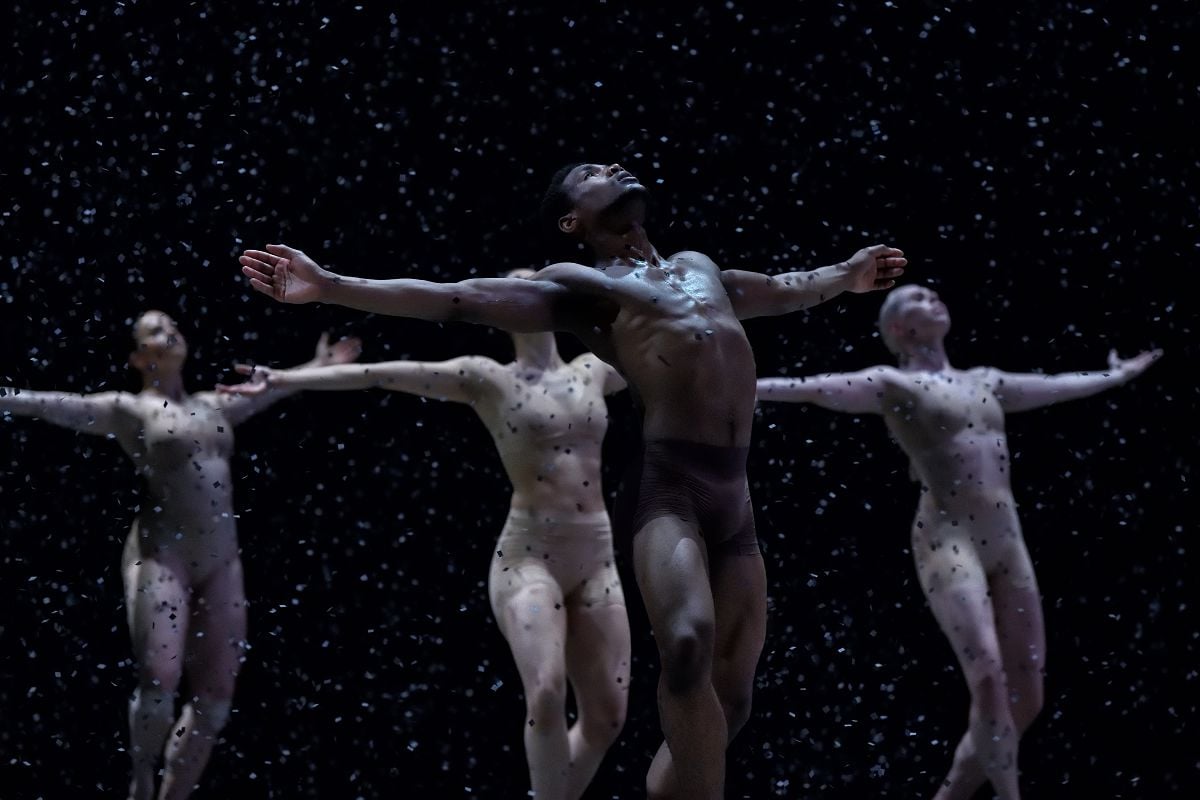
Lucía Piquero sees Crystal Pite’s Frontier and Johan Inger’s work PASSING with Canada’s Ballet BC, on tour – dance that gives a sense of life.
| Title | Crystal Pite‘s Frontier – Johan Inger’s PASSING |
| Company | Ballet BC |
| Venue | Sadler’s Wells, London |
| Date | 20 May 2025 |
| Reviewer | Lucía Piquero |
Ballet BC, under the artistic direction of Medhi Walerski, presented a double bill at Sadler’s Wells, which they are also taking on tour across the UK.
The company looks great in Pite’s Frontier, 20 dancers joined in this work by four Rambert students. Pite is her usual master of mass movement, and especially towards the end of the piece, we get a sense of this power of the ensemble, moving and moving us, almost hypnotising. The piece starts with the dancers coming up rolling from downstage, from the audience, and ever since that first moment it brings up a sense of existential dread, of doubt. Although some of the dancers appear dressed in white, most of the company is fully clad in black, like shadows. But these are shadows that resist, then mobilise… shadows that are scary but hesitate. With the ever-wonderful lighting by Tom Visser, the dancers and the shadows explore the questions Pite raises in the programme notes about what we don’t know about the universe and our consciousness.
The dimensions of the dancers switch with the play of light and dark: they are giants, they are a tiny spec, they are fully in the light and then suddenly disappear. The music accompanies these moments, sometimes too forcefully, and together with the set, which dismantles at points, all the elements create this sense of a strange universe we are not very welcome in. At points, the work is reminiscent of Dark Matters, Pite’s full-length for her company, Kidd Pivot. The first iteration of Frontier, for Nederland Dans Theatre, was created just one year before Dark Matters, and it is possible that some of the questions embedded in Pite’s process were bubbling already from before. What we get, anyway, is a fantastic piece that, although not as gripping as some of her other works, makes for a fantastic opportunity to see the dancers stunningly reaching their bodies, changing dynamics, holding eternal off-balance movement. The work is simply beautiful to watch, and a testament to Pite’s choreographic power.

After the interval, we are treated to a completely different piece, and if the dancers looked amazing in Pite’s work, they really are a joy to watch, exploding with energy and raw nerve, in Johan Inger’s work, PASSING. Inger’s work is less known, perhaps, but it made for a great surprise in the evening. PASSING is apparently a work about, kind of, the life cycle: from birth to death and everything in between. If with Pite we explore the universe within and without our consciousness, with Inger we are the universe, each one of us moving and erupting in life and in pain and in joy. The work uses humour, perhaps a little bit exaggerated at points, but it held the audience, and it made us laugh, unlike a lot of the work we usually see in these contexts. PASSING is irreverent and awkward, and it makes light of very dark things. Sarcasm is flagrant; occasionally, I even felt that we were laughing at contemporary dance itself and at what it does. The work does suffer from a narrative that isn’t completely clear, and it did stretch a bit longer perhaps than it should have, but we are hypnotised again by the intrigue at random bursts of life, at cracks of reality showing through the dancers’ energy and prowess.
With this double bill, Ballet BC holds a mirror up to us, to tell us that life can spring from a slow song, from a bit of soil, from shadows, but overall from the universe that each of us holds inside. There might be some technical or choreographic issues to improve, but when dance is able to give us this sense of life, there is still hope.


Lucía Piquero Álvarez was born in Asturias, Spain, where she trained in Classical Ballet and read for a BSc in Psychology. She moved to London where she trained in contemporary dance (LCDS), also getting an MA in Choreography (Middlesex University). Lucía has been an independent dancer and choreographer since 2007, her choreographies have been presented internationally and she has been commissioned by choreographic centres, national companies and festivals.
She was lecturer and head of the Dance Studies Department at the University of Malta, and Senior Lecturer at Dance City (Newcastle), and is currently lecturing at Trinity Laban and English National Ballet School. She completed her PhD at the University of Roehampton. Her main research interest is on embodied emotion and cognition in dance, she has presented in conferences and directed workshops and practice research projects internationally, and published articles and chapters in diverse platforms as well as her own monograph.



Dear Ms. Piquero, thank you for your interesting review! I’ve been sorry that nothing was said about the music or if there is no music, of some soundtrack for these two certainly impressive pieces.
Dear Nina, thank you for your kind words and comment! You raise a very good point, I tend to embed the music into my thinking/feeling/experience of the whole work, but also not to mention it explicitly in my writing, which is not completely fair to the work. Sometimes it is also difficult to put everything in words and not write very very long 🙂 I take your point though, and will make sure to express it more clearly in the future 🙂