Review: Noé Soulier’s Close Up, part of Dance Reflections by Van Cleef & Arpels Festival

Graham Watts sees Close Up by Noé Soulier – a heady mix of eighteenth-century music (beautifully played) and twenty-first-century dance (superbly performed).
| Title | Close Up |
| Company | Noé Soulier Il Convito ensemble |
| Venue | Linbury Theatre, Royal Opera House, London |
| Date | 20 March 2025 |
| Reviewer | Graham Watts |
In its second week, Dance Reflections by Van Cleef & Arpels moved to the Linbury Theatre in the basement of The Royal Ballet and Opera, with Close Up by Noé Soulier, following hard on the heels of In the Fall, his homage to Trisha Brown, which opened the festival a week previously, at Sadler’s Wells.
Where In the Fall was an abstract work focused on balance and athleticism, fitting stylistically into the repertoire of the Trisha Brown Dance Company, Close Up is a continuation of Soulier’s inventive choreography juxtaposed with his own use of video from a fixed camera to accentuate the movement of his dancers. The programme note informed me that this live work, which premiered at the Avignon Festival last July, continues his exploration of the relationship between film and live action that is present in his 2022 movie entitled Fragments.
Close Up also continues Soulier’s emphasis on the small-scale concert link between dance and live music, here represented by Johan Sebastian Bach’s Art of Fugue and extracts from his Violin Sonata No. 2, performed onstage by the Il Convito ensemble of five musicians (violin, viola da gamba, harpsichord, traverso and cello). The visual connection between the musicians (directed by Maude Gratton) and the six dancers on the relatively small stage was especially powerful in its intimacy. Incidentally, each dancer is also credited by Soulier as being co-responsible for both concept and choreography. Soulier has been director of the Cndc (Centre national de danse contemporaine) in Angers since 2020 and under his leadership, Cndc has become a creative and collaborative open house.
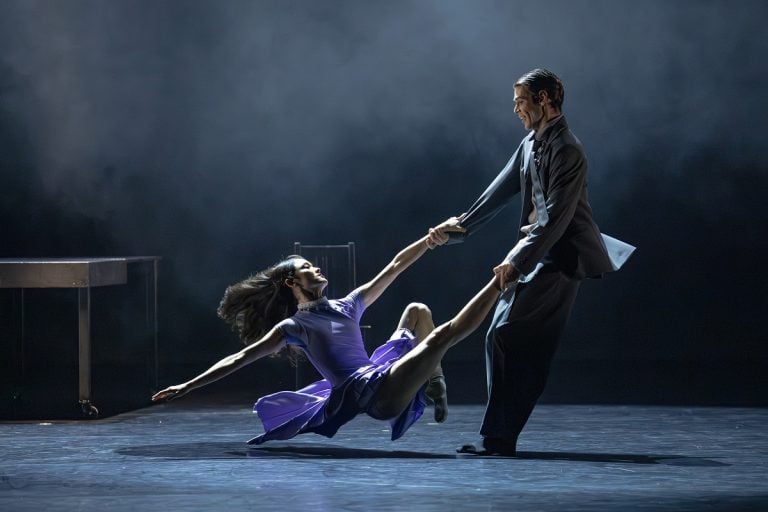
The work began with dancers entering the stage individually, five women and one man, each barefoot and dressed in subtle variations of everyday casualwear. Initially, there was very little connection between them, but they remained constantly within the eyelines of the musicians occupying the right side of the stage. As the work progressed, so did the association between the dancers. There were brief periods when the music stopped, and that silence threw close attention to the dancers’ heavy breathing.


The first part of the work ended when all dancers were absent from the stage, allowing some exclusivity for the musicians. The middle section was the most memorable. The black backdrop was dramatically replaced by a small area of a pure white background extending through the floor (like in a photographer’s studio). And appropriately, this is where the camera, fixed on a tripod, came into use, filming the dancers (mostly in solos and duos) in real time, which was simultaneously shown behind them in vivid close-up on a large screen, hence the title. It was a fascinating juxtaposition, which required a continuing but pleasing readjustment of one’s focus.
There was a strong contrast between the anonymity of the opening (and closing) sections where the individuality of dancers appeared to be subsumed into the group and this mid-section where the intimacy of the limitations of space and the close-up camera work brought each dancer’s body into a more forensic examination. The sensual closeness in one female duet was especially memorable.
After the strength of this vibrant middle section, the finale opened out the stage space and repeated the layering of the six dancers in solos, duos and trios as a kind of reprise of the opening section. However, it suffered in terms of retaining my attentiveness because of the vitality of the centrepiece it superseded.
The use of film was interesting but the overarching feeling engendered by the work was being arrested by the heady mix of eighteenth-century music (beautifully played) and twenty-first century dance (superbly performed). There might have been three centuries between the creation of the music and the dance, but it was an ideal match.

Graham Watts is a freelance writer and dance critic. He writes for The Spectator, Tanz, Shinshokan Dance Magazine (Japan), Ballet Magazine (Romania), BachTrack and the Hong Kong International Arts Festival and has previously written for the Sunday Express, Dancing Times, Dance Europe, DanceTabs, London Dance, the Edinburgh International Festival and Pointe magazine (USA). He has also written the biography of Daria Klimentová (The Agony and the Ecstasy) and contributed chapters about the work of Akram Khan to the Oxford Handbook of Contemporary Ballet and on Shobana Jeyasingh for the third edition of Routledge’s Fifty Contemporary Choreographers.
He is Chairman of the Dance Section of The Critics’ Circle and of the UK National Dance Awards and regularly lectures on dance writing and criticism at The Royal Academy of Dance, The Place and (until the war) for Balletristic in Kyiv. He was a nominee for the Dance Writing Award in the 2018 One Dance UK Awards and was appointed OBE in 2008.