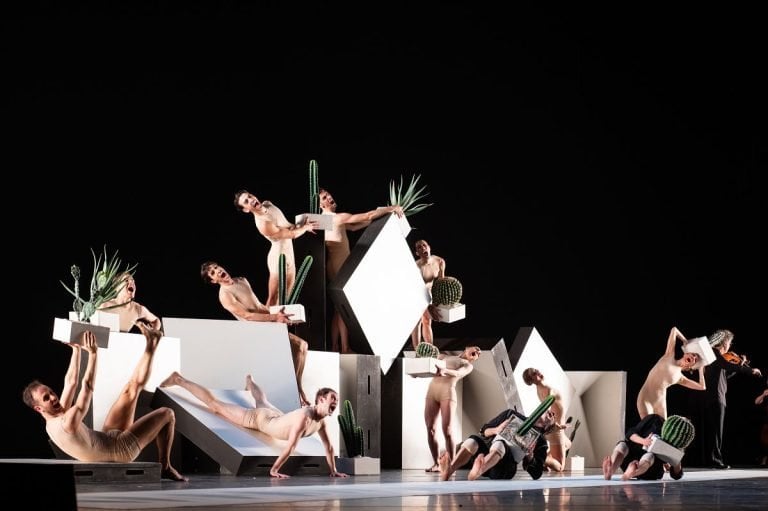
Review: ‘In C’ with Sasha Waltz and Guests – discovering Lego set democracy
Graham Watts sees ‘In C’ with Sasha Waltz and Guests – an arresting and stamina-sapping performance.
| Title | In C |
| Company | Sasha Waltz and Guests |
| Venue | Queen Elizabeth Hall, London |
| Date | 29 April 2025 |
| Reviewer | Graham Watts |
“Did you enjoy it?”, a friend asked on leaving the Queen Elizabeth Hall for a much-needed drink. Unusually, it was a difficult question to answer for this hour-long fusion of minimalist music and dance was generally fascinating; it was certainly mentally challenging; it held my attention; and the performers’ endurance was astonishing. But, despite all this I would be hard pressed to say that I enjoyed it.
The In C of Sasha Waltz and Guests is rooted in the exact same concept of Terry Riley’s eponymous musical work, composed in 1964 in the vanguard of minimalism. Since Riley is fast approaching his 90th birthday (on 24th June), there are to be sundry celebrations, one of which is this inclusion in the Southbank Centre‘s cross-artform festival, Multitudes.


Riley’s trailblazing work is like giving a group of musicians a Lego set to play with, their fragments being 53 brief phrases which they play improvisationally within a structured framework to create a spiralling cloud of polyphonic sound.
The eleven musicians of London Sinfonietta (surprisingly uncredited individually in the programme) joined the same number of dancers in a dark opening, silhouetted against the backdrop of a red sunset, crossing each other’s paths as they walked in lines across the stage, which is wide but not deep. Eventually, the performers separated into two groups with the musicians joining their instruments on the right-hand side of the stage. Throughout the work, individual dancers crossed the boundaries, both by moving into the orchestral area and silently confronting the musicians and breaching the fourth wall by coming down into the audience.
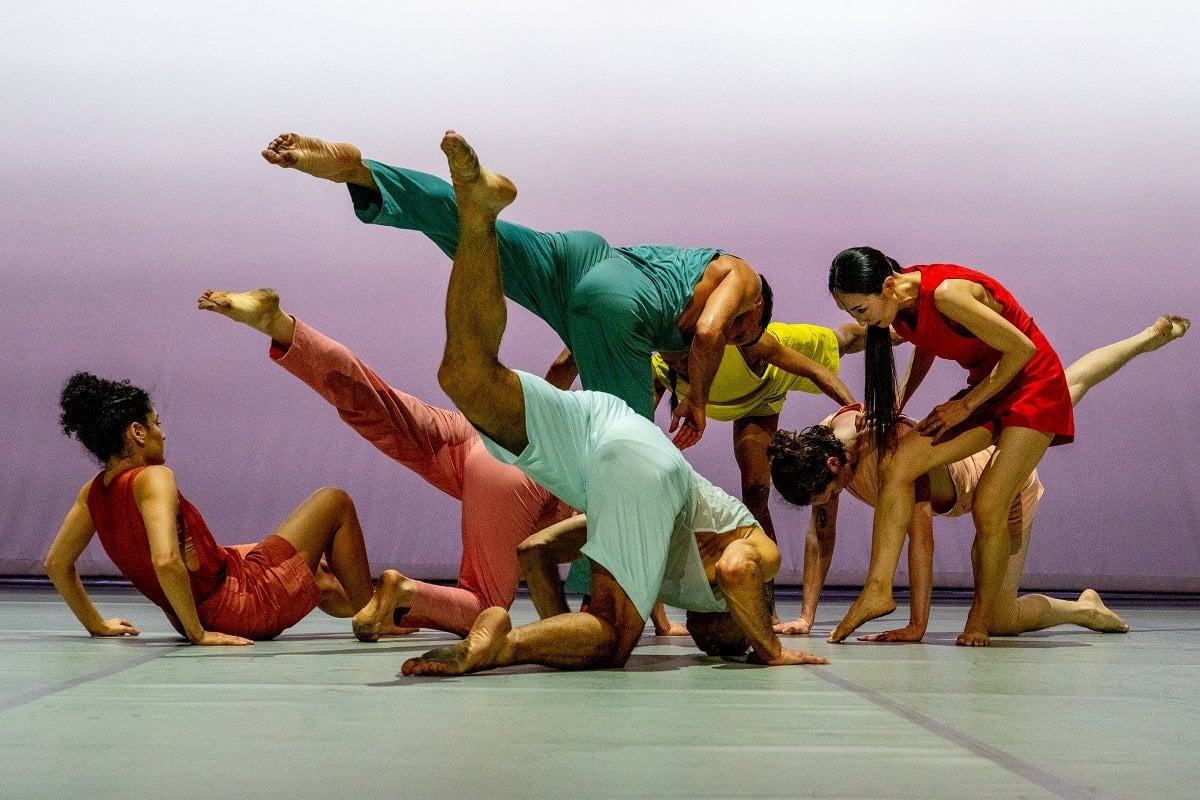
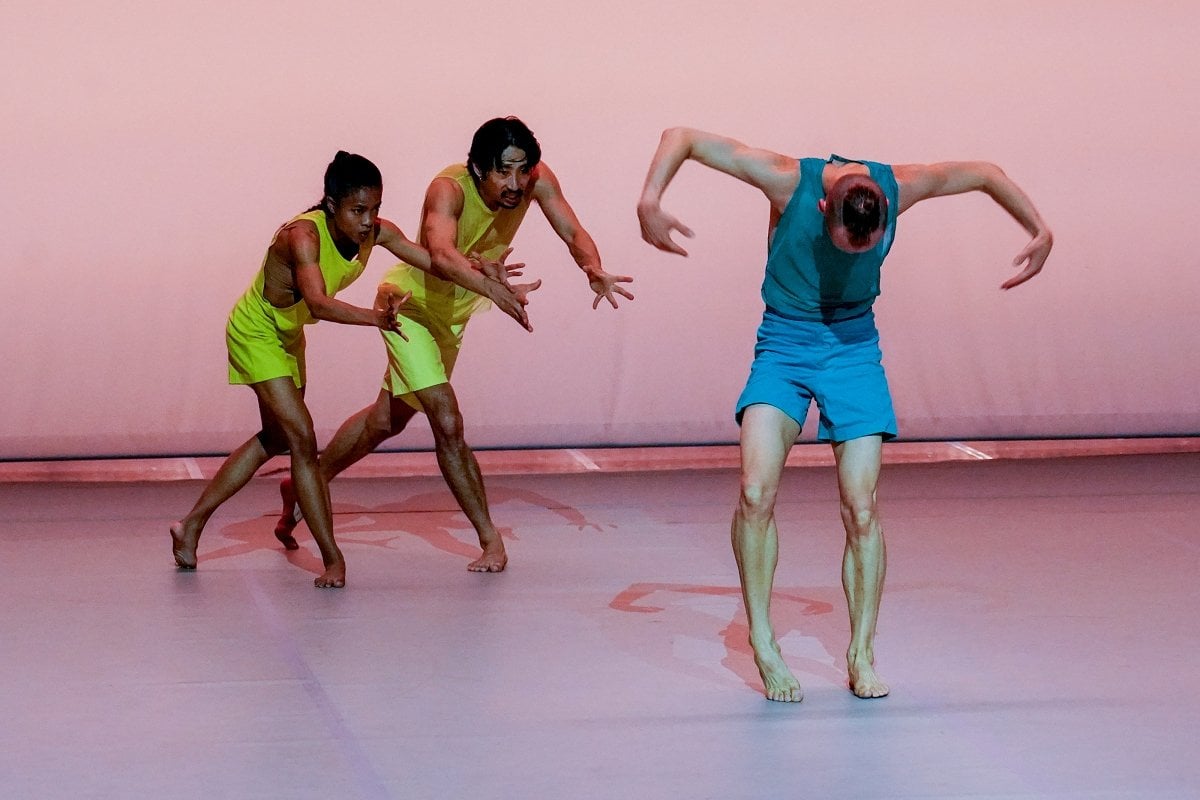
Waltz’s choreography – created during the coronavirus crisis and initially performed as a livestream in 2021 – mirrors Riley’s concept through being formed of 53 brief movement phrases, mostly lasting no more than a few seconds but repeated by dancers, individually and in small groups and occasionally by the whole eleven-strong, barefooted ensemble. One phrase would involve raising the arms high, moving to the right and using the arms as a lever to spin around before placing hands on thighs; another involves stepping forward raising the right leg and then hooking it behind the left, pulling the instep up and down, before turning a full circle and running forward; while another is performed running backwards, bending from the hip, continuing the reverse movement in a little backwards jump with the right leg extended in arabesque. Some involved lying on the floor, while one had the sexual suggestion of rapid up and down wrist movements.

The first thing one notices is how diverse this dance ensemble is in terms of age, ethnicity and physique. They wear different shades of pastel-coloured clothing – lemon, green, turquoise, red etc – in costumes designed by Jasmin Lepore. In a continuation of the theme of unevenness – 53 fragments of music and dance, 11 musicians and 11 dancers, seven of the latter wore shorts, with four in long trousers. As the remarkable non-stop stamina of the dance continued, sweat patches increasingly discoloured their costumes.
To begin with there appears to be very little interaction between the dancers, and one supposes that the power of concentration required to fit the improvisation within the structured framework is a limiting factor, but what initially appeared as a tedious and characterless exercise gradually absorbed charisma like ink soaking into blotting paper. Subtle smiles and not-so-subtle grins were exchanged between dancers as they came face-to-face, either indicative of the common theme of this meeting or that this was their first such encounter after many performances.
Riley’s composition had a monumental impact on the musical world not just because of its influence on the minimalist genre but because it introduced a form of democracy to the musicians that played it, allowing them to make decisions that would mean every performance would be subtly different. Waltz has given her excellent dancers the same rights to choose when and how they construct their phrases and the combination of these two democratic processes (music and dance) adds another layer to this community.
In concluding this review of a single live performance of In C, it is important to acknowledge that it is experiencing only the tip of the artistic iceberg of the In C universe. By utilising innovations of flexible artistic production and exchange to transfer video tutorials explaining the creation of each piece of the choreographic material across the world, the company has already engaged with a global dance community of some 30,000 people.
The work’s manifesto declares that “it strives against all forms of discrimination, violence and ideology and stands up for the democratic values of an open and diverse society”. It’s a noble aim and it was certainly an arresting and stamina-sapping performance. Although I recognise and empathise with the rhetoric, I must still stop short of saying that I enjoyed it.