Review: From Cacti to Angelic Forms, an Evening of Contemporary Authors at the Rome Opera
Marta Mele sees Dawson / León-Lightoot / Ekman at the Rome Opera House, a choreographic journey that seems to go backwards in time, asking us to question the ultimate nature of dance.
| Title | Dawson / León-Lightfoot / Ekman |
| Company | Rome Opera Ballet |
| Venue | Teatro dell’Opera di Roma |
| Date | 23 May 2025 |
| Reviewer | Marta Mele |
Alexander Ekman most likely does not like reviews. In describing his work Cacti, he recalls how it was composed during a period of his life in which he was deeply disturbed by reviews of his own works. He did not think it was right that a person could simply sit and express an opinion on the value of his art. So how to react?
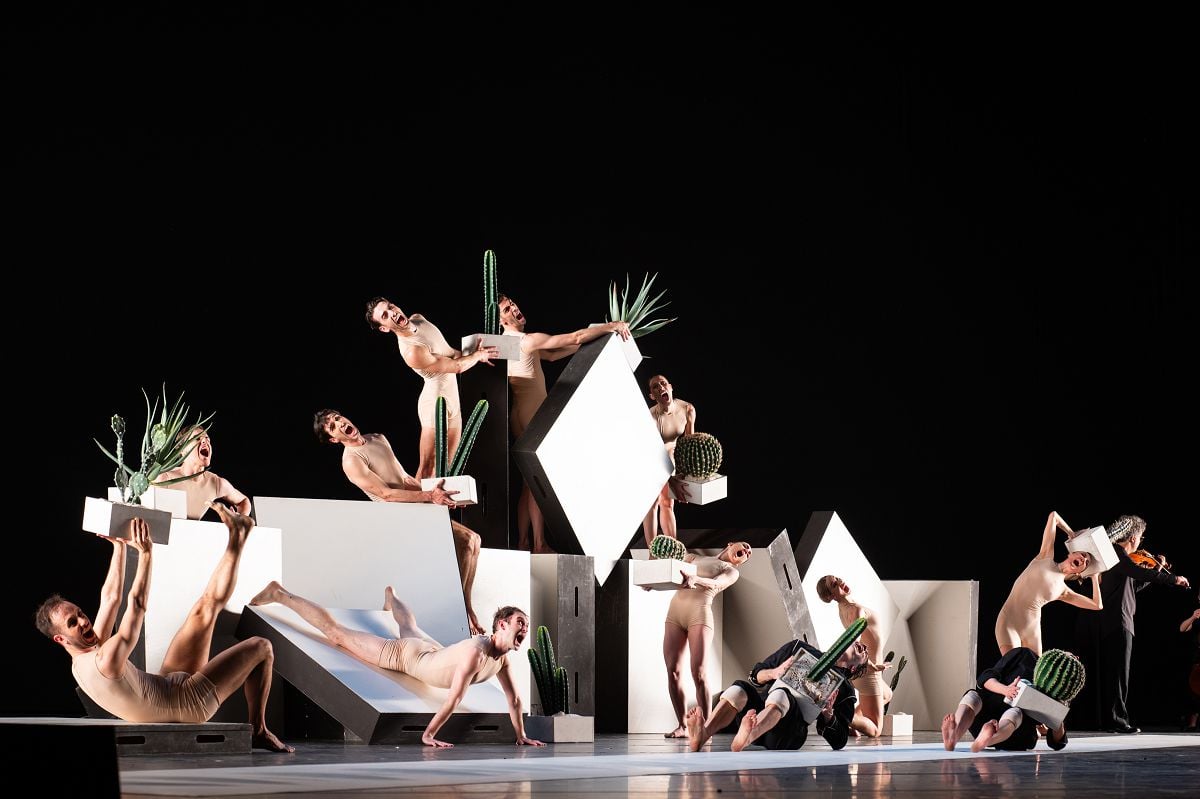
In the piece created for the Netherlands Dance Theater 2 in 2010, the Swedish choreographer dismantles and reassembles all the components of a dance production. The first thing to be called into question is the narrative aspect of this theatrical genre. A voice-over suggests to the spectator apparently insoluble questions about the modality of existence of an artistic form deriving from ritual in a contemporary civilisation oriented almost entirely towards the technological dimension.
A dancer crosses the stage horizontally in a profile pose that evokes ancient Egypt, while in a blank space the abstraction of white squares that compose themselves in a changing chessboard resonates scenically. After deconstructing the linear nature of space and time, the fundamental relationship with music is also investigated – on stage, the Sincronie Quartet performs music by Haydn, Beethoven and Schubert. The accompaniment transforms into pure tribal rhythm, executed by the dancers with the clapping of their hands on the floor made up of the white squares.
And then, we are confronted with movement, with body language directed towards an emblematic simplicity. The dancers are neither more nor less than athletes, and in some of their positions, as well as in their tight costumes, the reference becomes explicit. Of course, even from a historical perspective, there were theatrical directors like Meyerhold at the beginning of the twentieth century who insisted on the biomechanical aspect of the actor’s interpretation.


As lights come down from above, the stage space shrinks, leading more and to a laboratory dimension. Here, however, a postmodern irony prevails that takes away emphasis from any enchantment for modernity. While the dancers seem to want to hypnotise us with their movements, we hear their panting, the verbalised games… an infatuation for some spectator; a duo explaining their moves, the lifts, their mutual trust… while a cat suddenly falls from the ceiling.
Finally, the cacti make their appearance. Sometimes they take on erotic connotations, and other times are associated with the hardships of life.
The artistic composition of a piece is difficult, taking on a precise identity only after it is staged before an audience and establishes a relationship with that audience. Here we have the mysterious viewpoint of the choreographer and the performers who don’t even know what the right end of a piece is… “Is this the end? Should this end here? I don’t know… I don’t know…”
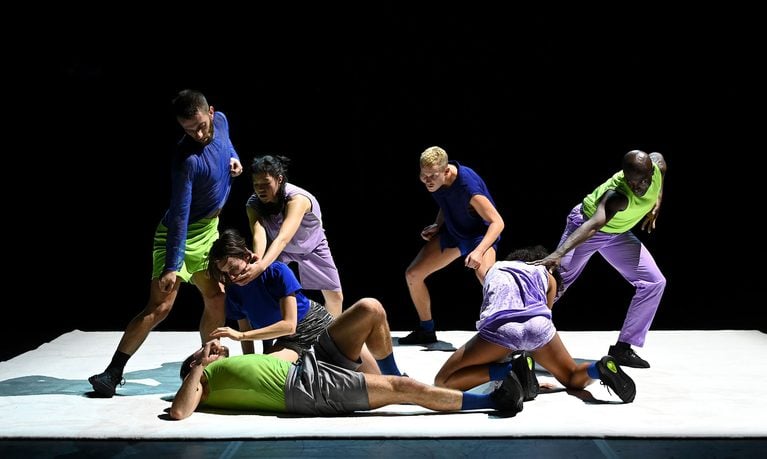
Less intellectual and decidedly more emotional is the piece Subject to Change by Sol León and Paul Lightfoot. Through the use of a main couple, Rebecca Bianchi and Jacopo Giarda, four dancers in black, with a red carpet, remind us of the dark unpredictability of life and its sorrows, which can envelop us and overwhelm us at any moment. The main exploration here takes place at a choreographic level. The movements are extreme, off-axis, tense as blades and full of suspensions. In their angular expressiveness, they resonate with the energy given to them by the music of the string quartet no. 14 in D minor, Der Tod und das Mädchen, by Schubert, in the arrangement by Gustav Mahler.


The evening closed with Four Last Songs by English choreographer David Dawson, set to Richard Strauss‘s Lieder, whose songs about the seasons of life is performed on stage by soprano Madeleine Pierard. Sculptural pas de deux – that sees Alice Mariani, prima ballerina of La Scala, join the Rome ballet corps – aim to take us to a world of angelic purity inspired by what we might call Lifarian neoclassicism. But perhaps the most suitable reference is the unfinished work of Michelangelo, here transmitted to us by the tension towards an ideal that seems absolutely unattainable, but that can be dreamed of on stage thanks to the beautiful forms derived from dance heritage. A choreographic journey that seems to go backwards in time, asking us to question ourselves on the ultimate nature of dance.


Graduating with honours in “Literary and Linguistic Studies” at La Sapienza University of Rome with a thesis on ballets inspired by Alexander Pushkin’s works, Marta Mele subsequently specialised in “History and Theory of Choreographic Art” at the Vaganova Academy in St Petersburg.
She translated from Russian the autobiography of the dancer Natalia Makarova for Gremese publishing house, and edited the Italian edition of the book Swans of the Kremlin by the scholar Christina Ezrahi.
After participating in two conferences dedicated to the bicentenary of the birth of Marius Petipa, she won the La Sapienza University’s PhD competition in Music and Performing Arts, and in 2022 received her doctorate with ‘eccellente’, her thesis entitled Ballet in Leningrad between avant-garde and ideology.
Marta participates in national and international conferences in performing arts research and writes for scientific reviews such as Danza e Ricerca, Biblioteca Teatrale and SigMa. As a dance journalist, she began by collaborating with the Russian dance magazine PROTanec, and she also writes for GBOpera.