Review: Andrea Peña & Artists in Bogotá – dozing off was an instinctive temptation

Graham Watts sees Andrea Peña & Artists opening the Dance Umbrella Festival with Bogotá – “If the work wasn’t enjoyable, it was certainly intellectually challenging.”
| Title | Bogotá |
| Company | Andrea Peña & Artists |
| Venue | Sadler’s Wells East, London |
| Date | 2 October 2025 |
| Reviewer | Graham Watts |
As a cure for insomnia, this production would be hard to beat. The soporific influences of darkness, nondescript music and oh-so-slow movement were tough challenges to overcome and a near neighbour most certainly dozed off, as evidenced by that quick telltale upward jerk of a hitherto slowly descending head.
Sadler’s Wells East, whilst a welcome addition to the London dance scene, is hardly an intimate venue: 800 seats in a highly elevated and large auditorium face onto a stage floor that is both wide and deep. It would not normally be the venue for a nap, but once the house lights dimmed there seemed such an absence of excitement on view that dozing off was an instinctive temptation.
A couple of performers had been in situ, albeit cloaked in darkness, as the audience arrived, and they started with slow, minuscule movements in that dusky dim light, initially in silence and then with a soundscape that sometimes seemed a cross between a distant storm and the gurgling of wastewater swirling down a plughole.
The choreographer, Andrea Peña, was born in Bogotá, and her grandmother was an indigenous Columbian, although Peña moved to Montreal at an early age and has been based in Canada as an artist. Her early career as an industrial designer is evident in a spartan set that was dominated by two structural units of scaffolding, one large and static, the other a smaller skeletal mobile cube; a black platform shaped in the manner of the podium for an Olympic medal ceremony; and large plastic sheets hanging from the flies, which seemed to serve no purpose. At a midpoint in the ninety-minute performance (it seemed twice as long) a strange object, apparently made of papers and rags, swung well above head height while one performer hacked at it with a metal bar until it was destroyed.
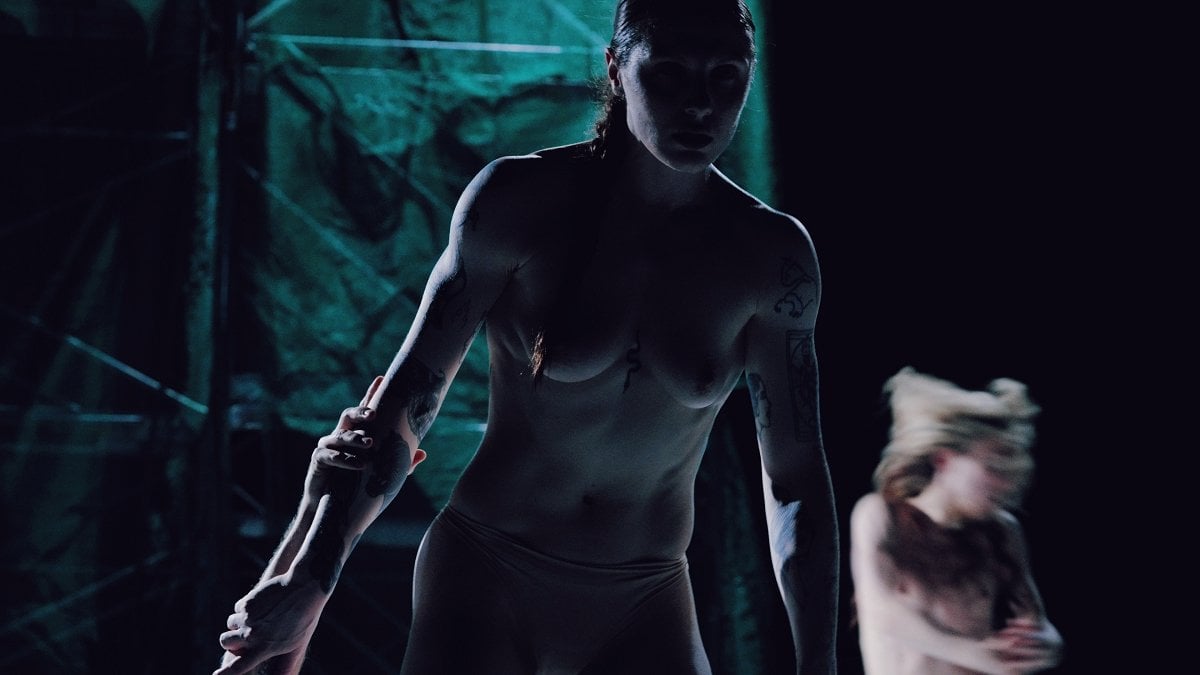
Bogotá was performed by a multi-national cast of nine diverse and interesting dancers who moved in and out of the central space in varying multiples and with a determined intensity. They all had their moments, but I was especially drawn to the silky movement skills of Jo Laïny Trozzo-Mounet. She wore loose cargo pants and was otherwise mostly topless, as were other performers, while wearing an odd assortment of thongs, shorts and items of casual, modern clothing.
If the work wasn’t enjoyable, it was certainly intellectually challenging. The performance process was clearly structured in formal choreographed sections but with what also seemed like a certain amount of improvisational freedom. A lot of movement was writhing, slithering and rolling over on the floor, while dancers also used the scaffolds to perform at height, and on a few occasions, daringly. From time to time, small groups would suddenly switch from doing their own thing to moving fleetingly in unison and this evidence of formal choreography was the best of it. The dancers were excellent, and I wanted to see much more dance rather than them hitting objects with metal bars and walking about while screaming (there was quite a bit of that).
Bogotá provided a challenging start to this year’s Dance Umbrella Festival, which will continue at several venues around London throughout October. Now fast approaching its 50th anniversary, Dance Umbrella has consistently been a showcase for innovative contemporary and alternative dance and, as such, it’s bound to have its hits and misses. While Bogotá was disappointing (at least to this writer), there is eager anticipation of what is yet to come.
In discussing her work, Peña has talked about Bogotá as a hybrid piece that is informed by her ancestry and the indigenous culture of Columbia, of birth and rebirth, ritualism, the country’s political and spiritual heritage and of looking at these events and issues through a queer lens. To be frank, I struggled to be able to make any of these associations with clarity. Semi-naked people may have suggested an ancient indigenous people, but the modern clothing argued against that interpretation. I’m guessing that being Columbian (or, at least, Latin American) may have helped assimilate some of these otherwise nefarious associations, which clearly eluded this English writer. But at least I didn’t fall asleep.

Graham Watts is a freelance writer and dance critic. He writes for The Spectator, Tanz, Shinshokan Dance Magazine (Japan), Ballet Magazine (Romania), BachTrack and the Hong Kong International Arts Festival and has previously written for the Sunday Express, Dancing Times, Dance Europe, DanceTabs, London Dance, the Edinburgh International Festival and Pointe magazine (USA). He has also written the biography of Daria Klimentová (The Agony and the Ecstasy) and contributed chapters about the work of Akram Khan to the Oxford Handbook of Contemporary Ballet and on Shobana Jeyasingh for the third edition of Routledge’s Fifty Contemporary Choreographers.
He is Chairman of the Dance Section of The Critics’ Circle and of the UK National Dance Awards and regularly lectures on dance writing and criticism at The Royal Academy of Dance, The Place and (until the war) for Balletristic in Kyiv. He was a nominee for the Dance Writing Award in the 2018 One Dance UK Awards and was appointed OBE in 2008.