[Review] Ballet Nights presents New Voices – 10 new works at London’s ‘legendary’ Ministry of Sound

Matthew Paluch sees Jamiel Devernay-Laurence’s latest Ballet Nights adventure – New Voices – at London’s Ministry of Sound
| Title | New Voices |
| Company | Ballet Nights |
| Venue | Ministry of Sound |
| Date | 31 May 2024 |
| Reviewer | Matthew Paluch |
Big fish, little fish
Cardboard box!
Big fish, little fish
Glissade jeté…?
Ballet goes clubbing, or more specifically, Jamiel Devernay-Laurence’s Ballet Nights goes to the Ministry of Sound (“The home of dance culture since 1991. London’s legendary dancefloor and sound system.”)
Ballet Nights is offering a pre-club event ‘New Voices’ at the iconic location, with a jam-packed programme lasting 90 mins. Devernay-Laurence has his troupe of sorts, so there are familiar names within the 10-strong bill, but also some new additions for this innovative strand.
But before we go any further; I’ve been here already in a way. Let’s go back to 1998 and Visualantix, the brainchild of ballet world stalwart Gary Harris. I remember frequenting Bagley’s Warehouse in King’s Cross (before gentrification) to see a dynamic group of dancers whipping up a storm on a platform stage including en pointe.
The company didn’t last for long, and veered towards more commercial enterprises almost immediately, but Harris had the vision and bravery to give it a go regardless. He’d wanted to take “ballet out of its usual rarefied atmosphere” and he did. So how does Devernay-Laurence’s (re)attempt sit in 2024? And is it needed?
It’s a weird experience going to a nightclub at 7pm, but Ministry of Sound don’t view this as a problem. The music is playing, dry ice swirls, drinks flow etc. The first 30 minutes of the show takes place in the 103 bar. There’s a sectioned off stage in the middle of the floor space, hightech light installations and the rest is history.
The performance starts with Show Opener by Seirian Griffiths. Griffiths worked the space with his idiosyncratic language – a mix between release technique and tumbling. He’s an intoxicating performer, and the right man to open, but the experience was too short to make any serious impact.
Your Ghost choreographed and performed by Watson & Woodvine followed and highlighted the issue with site specific work. The 103 bar has a raised level walkway, and Woodvine performed from there for the duration. If you couldn’t see him, which was my experience, you saw half a piece. This needs a rethink.
Closing the first section was Gathering Rhythms choreographed and danced by Manon Servage and Sophie Quay, who were joined by fellow dancers Zach Parkin and Ivan Merino Gaspar. JDL – compering as usual – said the piece was developed over a two-week period, and if this is the case, Ballet Nights should take Servage and Quay very seriously. The content was fresh and original with a sophisticated structure, executed extremely well, and featured intelligent use of the space (dancing on the bar) and ingenious use of costuming as an additional choreographic layer. Simply it took the evening where it needed to be – the crowd was pumped and properly engaged by the end.
Next we moved into the Box space, which is the main clubroom of the venue. There was a stage in front of the DJ booth, the audience all gathered, and personally my feet and back started to ache at this point – I do love a theatre with seats… especially at the end of a working week.


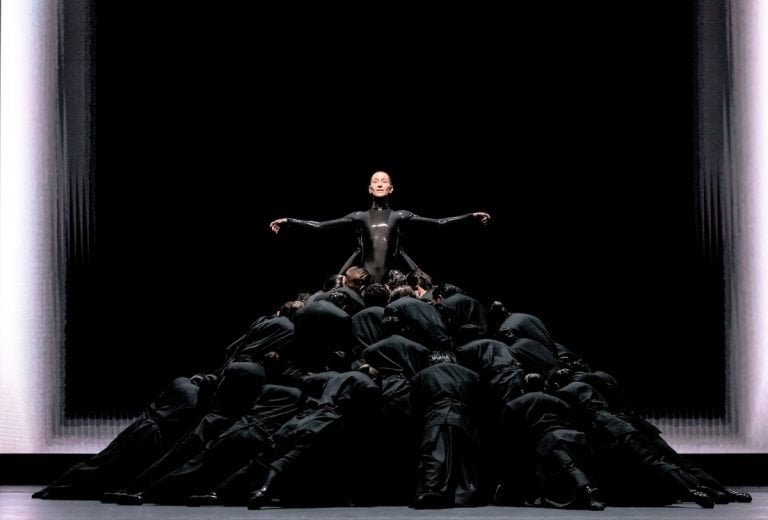
Opening was Spirit Of The Machine, an excerpt from Read-Only Memory choreographed by Jamiel Devernay-Laurence. The work considers memory as a weapon, and the themed all-in-ones definitely emitted dystopian chic. But movement wise I wasn’t transported anywhere.
Jealousy by James Cousins is a skilled, one-dimensional duo of intricate partnering. Brenda Lee Grecht barely touches the floor as she’s lifted and wound by Tom Davis Dunn. A costuming mishap meant that the experience was a fleshy one. Call me a prude but I felt uncomfortable. My mind was less on the content with a proposed affair-laden narrative, and more on how the malfunction could’ve been foreseen and dealt with. Soz.
Splice by Ekleido (choreographed and danced by duo Hannah Ekholm & Faye Steoser) was another strong moment. Offering both floor, and travelling work, the piece is like an ongoing puzzle executed by two inquisitive insects. The movement language is precise and frenzied, like a creepy-crawly evolution of Voguing, via a Rubik’s Cube, and engaging throughout. The end tapers off a little but Ekholm and Steoser made their presence felt, as did the fab costumes by George H Wale.
Insomnia by Nicholas Shoesmith, performed by Felicity Chadwick followed and didn’t rock my world. Insomnia is a personal experience, and Shoesmith’s reading doesn’t connect. Regardless, Chadwick is a powerful performer and showed no reticence during the short interlude.
Following was 324a, choreographed and performed by Joshua Junker, of the Royal Ballet, to Bach. The piece was devised during lockdown so is a personal venture, and Junker weaves his magic with an understated, enigmatic, powerful performance. The content isn’t earth shattering, but the execution gives it an undeniable gravitas. Focused eyes, grounded aplomb and aesthetic suspension meant that Junker held his crowd for the duration.
One by Kennedy Junior Muntanga, featured the only live music of the night, and Guy Salim played the drums like three men rather than one. Muntanga brought the drama and explored the space with verve, but the piece dives in at the deep end with no build or explanation, which doesn’t do it any favours. It needs an anchor.
Closing the night was Nerve Wire, choreographed and performed by James Pett and Travis Clausen-Knight. Devernay-Laurence mentioned something about anxiety in the intro, and that was the main flavour, supported by Sean Pett’s industrial style music. Pett and Clausen-Knight are stunning dancers, and seeing them up close allows for even more insight into their accomplished, committed execution. But I’m ready for a different proposition – alternative music, varied dynamic, someone choreographing on them. Where could a momentary, off-piste exploration take them and their work…?
I left the club sharpish after the show, eager for a sit down, but nonetheless impressed by Devernay-Laurence’s new venture, continuing to support his Ballet Nights key mission – “a choreographic platform for those voices heard less, seen less and represented less in the struggling independent dance sector”.
Amen to that, but the time has also come to double down. Make the ten pieces five, allow them to be longer, give the artists elongated creative periods, and let’s start to see serious, art form developing work as the main agenda. The brand is in place, the crowds are building, now the proof’s gotta be in the pudding. And hopefully with more ballet, whatever that means, on the menu.