Review: Jo Strømgren Kompani’s The Substitute at Oslo Opera House

Graham Watts sees Jo Strømgren Kompani’s The Substitute at Oslo Opera House, a work aimed at ‘children of all ages’.
| Title | The Substitute |
| Company | Jo Strømgren Kompani |
| Venue | National Opera House, Scene 2, Oslo |
| Date | 7 September 2024 |
| Reviewer | Graham Watts |
Reviewing a work aimed at ‘children of all ages’, with most of the considerable spoken text in Norwegian, was a unique experience for me! Although spatial awareness and movement was a key part of this one-man show, it was pure theatre with just the merest soupçon of dance. And, to make life just a tad more complicated The Substitute was a sequel to an earlier piece, The Tired Man, which I hadn’t seen.
Despite the language barrier, I laughed out loud countless times, principally due to the physical humour and clarity of expression from Anders Sanzén, the Swedish actor who personified Jo Strømgren’s superb tragi-comic character of Clas Göran with such fine sensitivity and exceptional timing.
The creative side was also virtually a one-man effort since Strømgren is responsible for direction, choreography, spoken text, lighting, and set design; and unsurprisingly the integration of all these elements was excellent. The whole production threw a light on a bygone era of Norwegian childhood but much of that evocation was also recognisable in any European context.
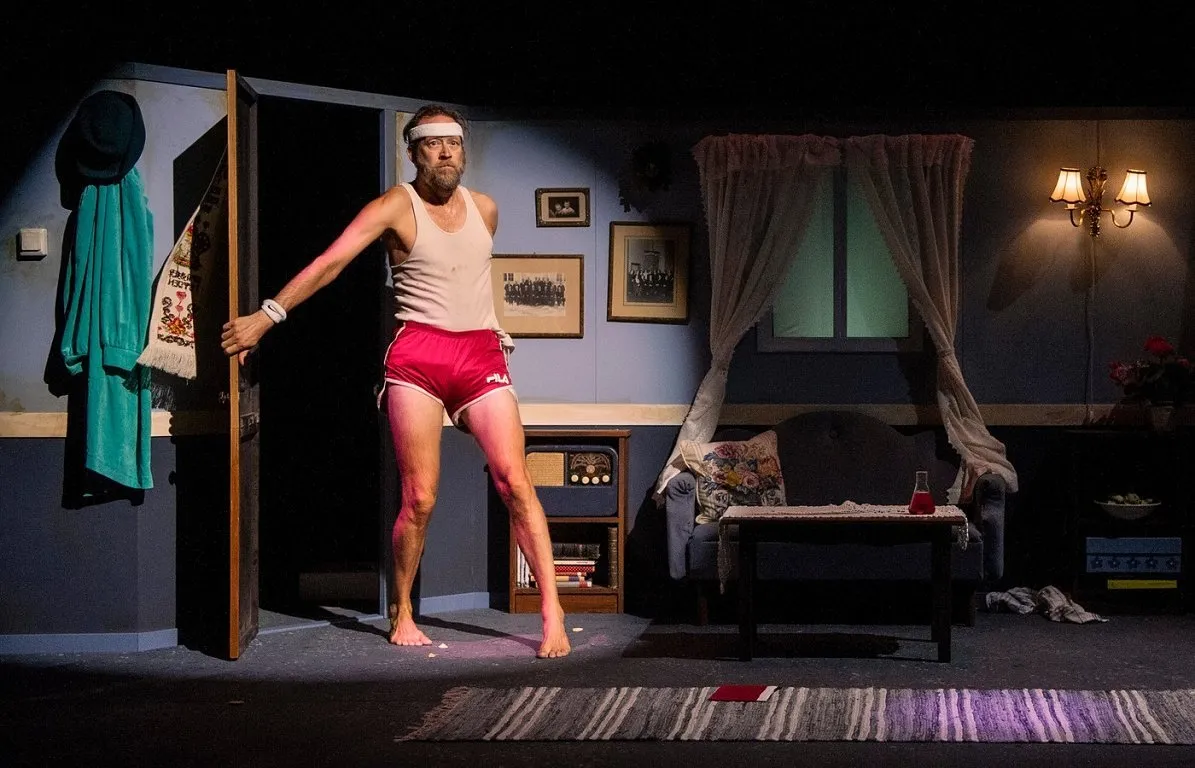
In The Tired Man, Göran oversleeps every day and, despite all his efforts to find a strategy for waking, he ends up losing his job. One assumes that he also lost his apartment because The Substitute opens with Göran occupying his grandmother’s living room where the presence of a sleeping bag indicates that he now sleeps on the sofa. The grandmother is portrayed by a tired voice offstage, apparently answering Göran’s various questions from upstairs.
Göran receives a letter offering him a job as a substitute teacher, which is quickly followed by a ‘phone call from the head teacher telling Göran that he is to start promptly at 7am the next day (a particular problem, one imagines, for a man who has difficulty in waking up)! The word for head teacher in Norwegian is Rector but Göran thinks he is speaking to a man called Hector, a running gag that continues throughout the piece.
Göran seeks advice from his bedridden gran, and she advises him to practice every lesson. To add some realism, he creates a class from a bag of toy animals, including a plastic gorilla, and various dolls, which are lined up facing him. A cat is clearly earmarked as the naughty one and placed away from the others.
Some of Göran’s efforts to make a lesson out of every subject are hilarious, others poignant or very dark! For mathematics, he gets in a mess trying to use his fingers and toes to count and the grandmother advises him to use fruit. But the fruit is all different shapes, and he first tries to squash a banana to resemble an apple and then chops it all up into a messy fruit salad!

For history, he decides to inveigle an elderly neighbour to describe his lived experiences but the old man (also played by Sanzén) hates children and talks about hunting and eating them before collapsing with a heart attack! For science, Göran dusts off a childhood chemistry set and foolishly drinks the product of his experiment, temporarily collapsing with some kind of seizure.
During the gym class, one of the dolls wants to go to the toilet. Göran asks if it is Bimelim or Bomelon (Norwegian children’s slang for what English kids might politely call “number 1” or “number 2”) before walking the doll to the toilet offstage: other classmates have problems ranging from stomach-ache to worrying if the school has spiders and an increasingly impatient Göran tries to deal with them all.
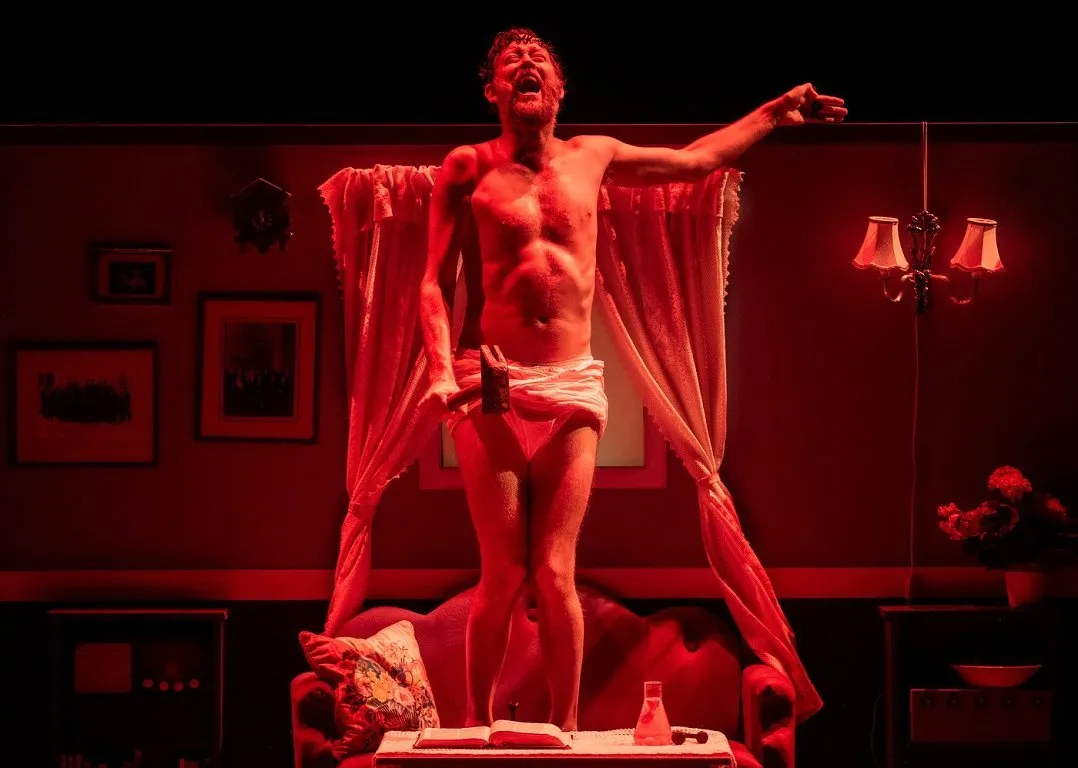
The next lesson is religious education and provides the darkest sequence as Göran – wearing a loincloth and crown of thorns – attempts a painful self-crucifixion against the living room wall. Following the preceding comedy, this shocking sequence was especially harrowing. Interrupting the crucifixion, “Hector the Rector” calls again to tell Göran, much to the latter’s relief, that he no longer has to teach religion.
And so it goes on with Göran inventing bizarre ways in which to teach each lesson, including singing a mash-up of lyrics from well-known pop songs and beat-boxing for the music class and a long sci-fi sequence that represents a story he once wrote for a school competition, which was stolen by another boy who then won the prize. One sensed that this wrong was the key to Göran’s subsequent downward path. Eventually, Göran tells the Rector that he will take the job, but he’s too late, and it has been given to someone else. The grandmother says that he can stay on the sofa for a while longer!
In Clas Göran, Strømgren has created a marvellous and durable character, a man whose supposed indolence masks a strange sense of heroism as he attempts to create strategies that will allow him to meet life’s little challenges. I sense many more adventures for him in years to come, especially if Göran continues to be brought into vivid reality by Sanzén’s outstanding portrayal of this unsung hero, hovering on the verge of narcolepsy.

Graham Watts is a freelance writer and dance critic. He writes for The Spectator, Tanz, Shinshokan Dance Magazine (Japan), Ballet Magazine (Romania), BachTrack and the Hong Kong International Arts Festival and has previously written for the Sunday Express, Dancing Times, Dance Europe, DanceTabs, London Dance, the Edinburgh International Festival and Pointe magazine (USA). He has also written the biography of Daria Klimentová (The Agony and the Ecstasy) and contributed chapters about the work of Akram Khan to the Oxford Handbook of Contemporary Ballet and on Shobana Jeyasingh for the third edition of Routledge’s Fifty Contemporary Choreographers.
He is Chairman of the Dance Section of The Critics’ Circle and of the UK National Dance Awards and regularly lectures on dance writing and criticism at The Royal Academy of Dance, The Place and (until the war) for Balletristic in Kyiv. He was a nominee for the Dance Writing Award in the 2018 One Dance UK Awards and was appointed OBE in 2008.