Review: Gecko’s The Wedding – a feeling of randomness and surprise… and tedium
Graham Watts sees The Wedding by Gecko physical theatre company, but “could not have cared less for any of the diverse characters”.
| Title | The Wedding |
| Company | Gecko |
| Venue | Sadler’s Wells East, London |
| Date | 21 January 2026 |
| Reviewer | Graham Watts |
I first saw Gecko’s The Wedding as the culminating work of the International Mime Festival at The Barbican, almost exactly seven years ago. This revival – as part of MimeLondon 2026 – seemed different and revisiting my review from that earlier show, there were clearly some elements that have been stripped out of this current version (one obvious change was the loss of a performer, nine now becoming eight).
Nonetheless, the memorable beginning was the same. A flashing warning light and an alarm signalled the arrival of a man in underwear, sliding unseen through an old-fashioned chute to land on what first appeared to be a cushion of rags, but on closer inspection turned out to be a mound of teddy bears. Apparently, this arrival represents a transition from birth through adolescence to adulthood, the latter symbolised by the handing over of a teddy bear to a clipboard-wielding official, in return for a wedding dress, which the man climbed into. As the work progressed, more people – men and women – entered in their undies via the chute and exchanged a soft toy for a wedding gown.
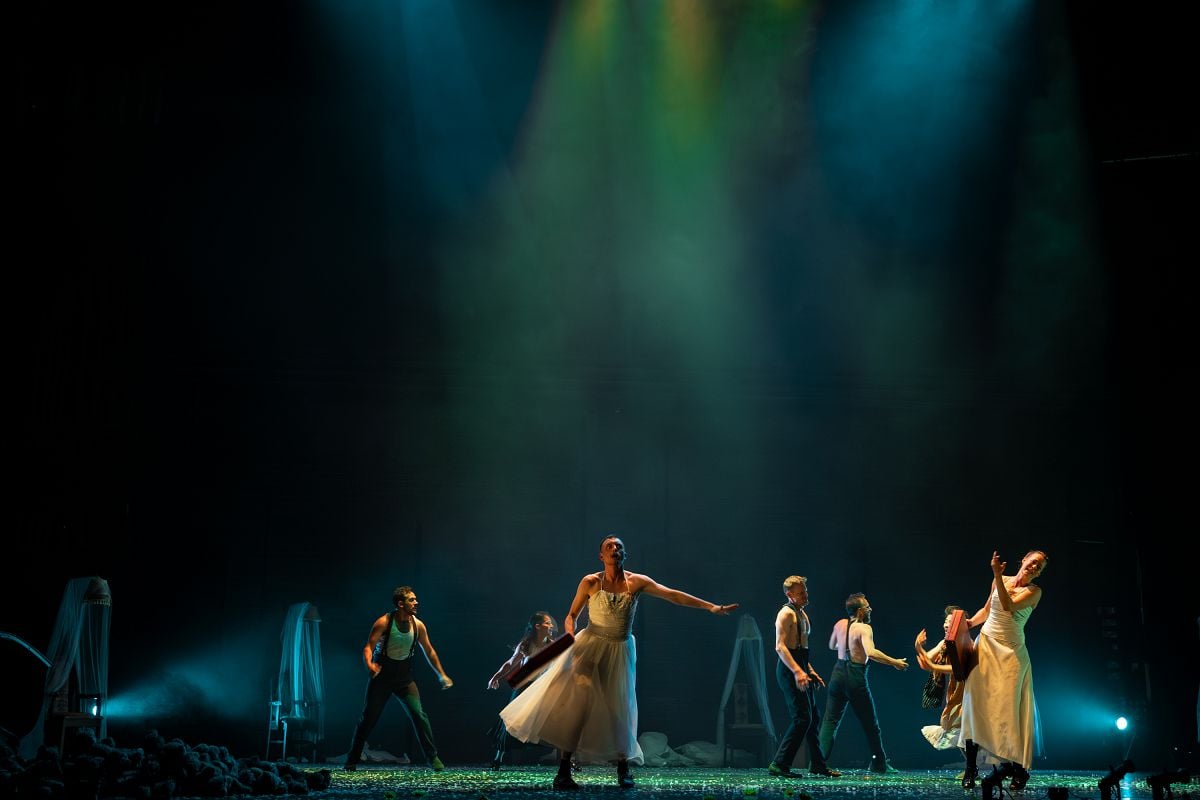
Apart from donning the dresses, there seemed very little other imagery to suggest the wedding thematic and the performers in the dresses often just disappeared before reappearing in other guises. But The Wedding doesn’t seem to be about marriage in any literal sense, more a polemic against contracts that modern society requires people to enter into with or without their true consent.
One recurring element of this dystopian potpourri was a claustrophobic room with people talking animatedly, suggesting some kind of committee meeting in something approximating a telephone booth with one of the participants so desperate to exclude himself that he escaped by crawling through the ‘ceiling’. How many times have I wanted to do that! Another reference to the business element of a contract were the attaché cases routinely carried by performers (even those in their wedding dresses).
It is clear that the audience is not meant to understand The Wedding in any straightforward or narrative sense, largely since the spoken text is given in a dozen languages (both the indigenous languages of the performers and other text that they have learned specifically for the show), and it is therefore improbable that anyone can understand most of what is said. As someone who understands only English and Spanish (and some of that text was incoherent), I discerned less than 10% of the words spoken.
There are several dull periods in the work, time when the activity onstage was unremarkable, perhaps even bordering on tedium – a factor that I did not note from seven years’ ago – and I wonder to what extent the paring back of the piece has perhaps diminished it?
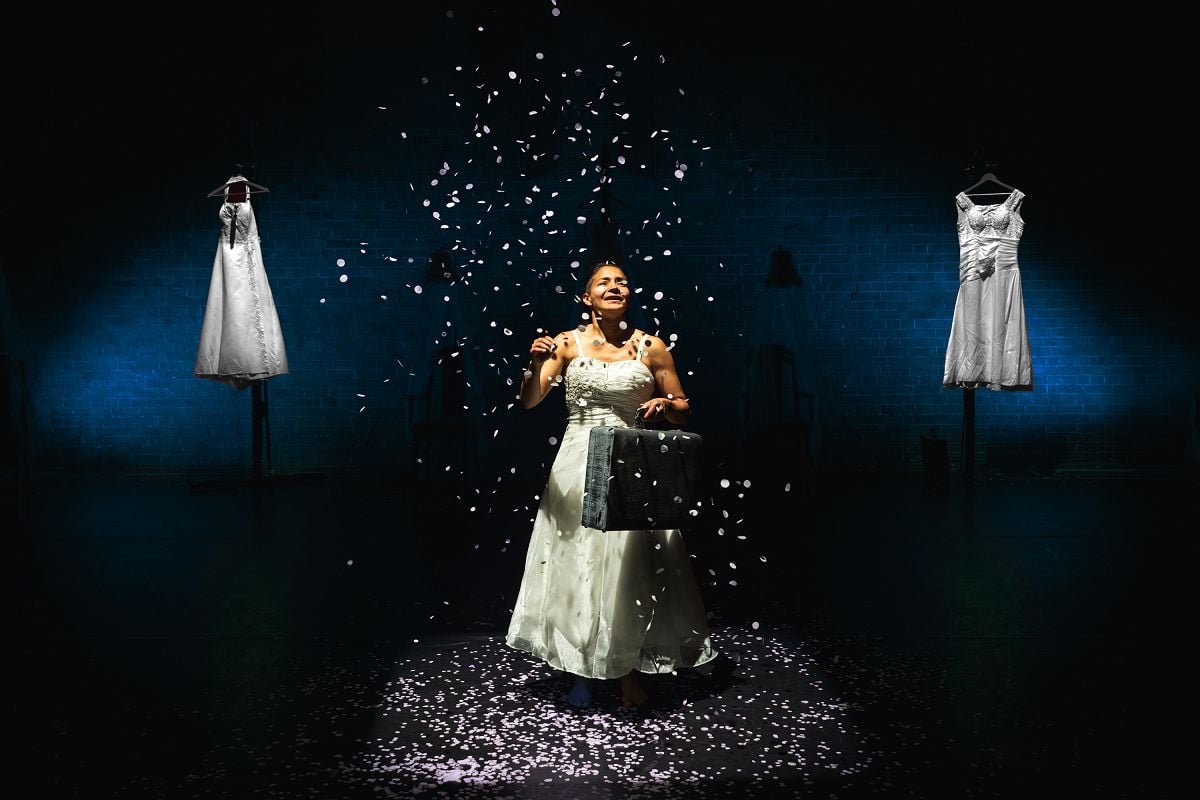
There is still, however, two stand-out aspects to the performance. Firstly, in the thought-provoking sequences where an immigrant family appeared to be living in a suitcase. The ‘father’ figure was the first to emerge through the zipped-up front, producing an empty takeaway coffee cup to beg for money from the front-row audience. A ‘wife’ was next to climb through the case followed by adult ‘children’. Later, the father figure – while living in the suitcase – was viciously beaten by the first man to come through the shute, still wearing his wedding dress. It’s hard to fully decipher this imagery but the bluntness of the central message was clear.
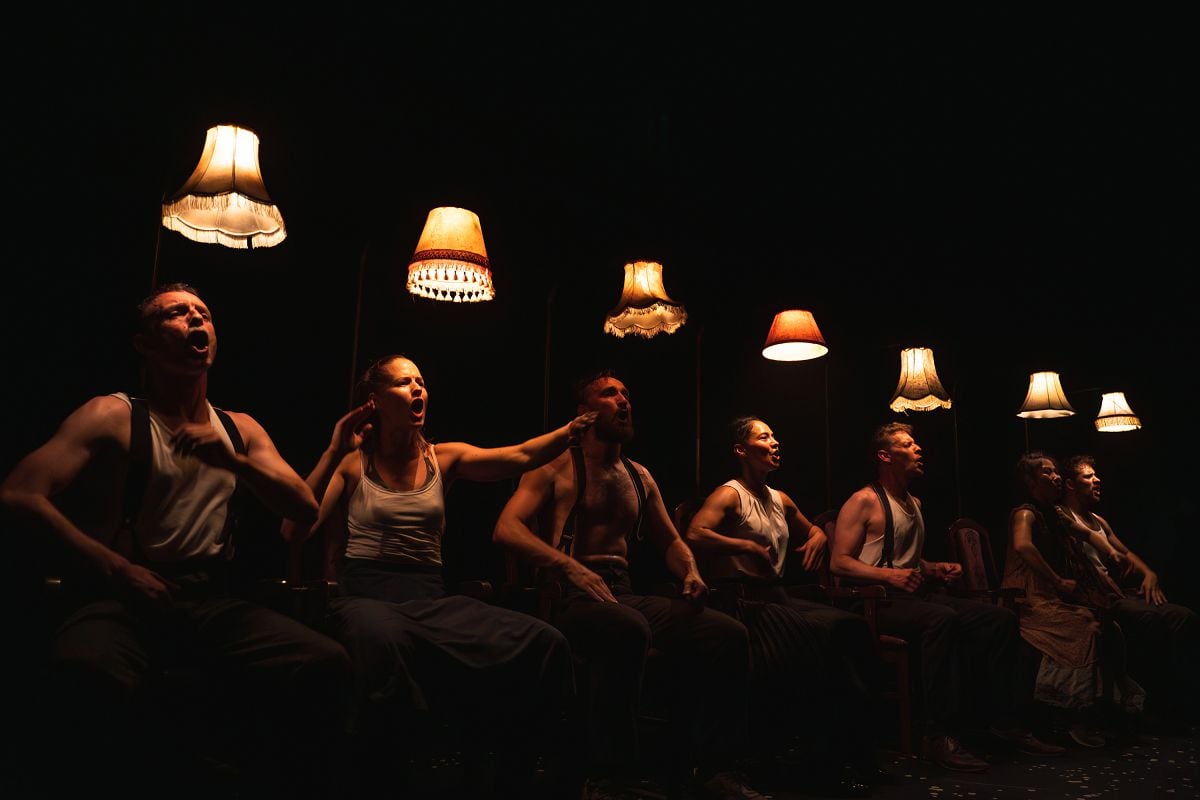
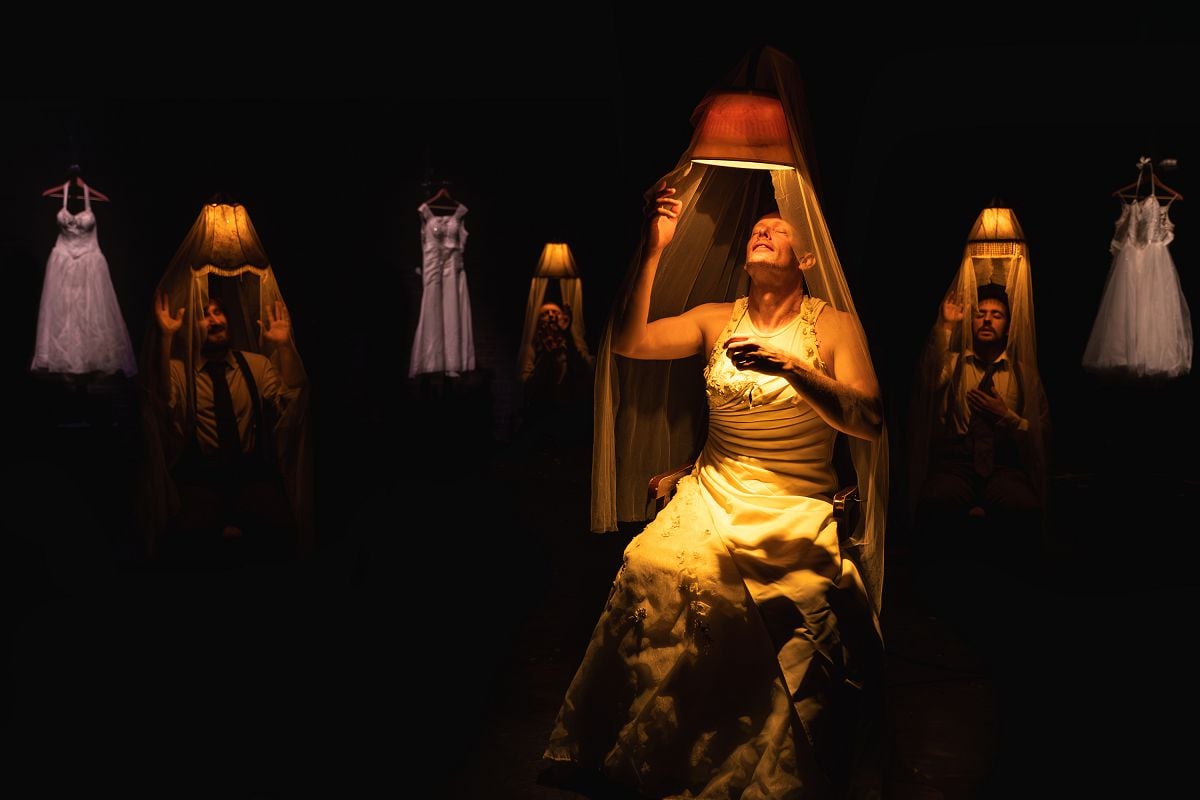
The second amazing sequence was the finale. All eight performers took their places in armchairs lined across the front of the stage – with old-fashioned lampshades suspended above their heads – and they joined in a coruscating and uplifting end song, building in its rhythmic intensity through patterns of percussive clapping, stamping and shouting that brought The Wedding to a very powerful concluding crescendo. Gecko’s founder and artistic director, Amit Lahav, has suggested that The Wedding is about anger and hope and while the former had its moments (there was comedy, too) the work ended in this upbeat and hopeful place.
The mix of physical theatre and contemporary dance has a feeling of randomness and surprise that keeps the audience in anticipation of the next vignette, even if the changes are not always building momentum or excitement. And frankly – immigrant husband and wife excluded – I could not have cared less for any of the diverse characters.
This is the Ipswich-based company’s 25th year and Gecko seems to produce new work rarely, perhaps because in the case of The Wedding, which premiered in 2017, it took three years of workshops to get it to the stage!

Graham Watts is a freelance writer and dance critic. He writes for The Spectator, Tanz, Shinshokan Dance Magazine (Japan), Ballet Magazine (Romania), BachTrack and the Hong Kong International Arts Festival and has previously written for the Sunday Express, Dancing Times, Dance Europe, DanceTabs, London Dance, the Edinburgh International Festival and Pointe magazine (USA). He has also written the biography of Daria Klimentová (The Agony and the Ecstasy) and contributed chapters about the work of Akram Khan to the Oxford Handbook of Contemporary Ballet and on Shobana Jeyasingh for the third edition of Routledge’s Fifty Contemporary Choreographers.
He is Chairman of the Dance Section of The Critics’ Circle and of the UK National Dance Awards and regularly lectures on dance writing and criticism at The Royal Academy of Dance, The Place and (until the war) for Balletristic in Kyiv. He was a nominee for the Dance Writing Award in the 2018 One Dance UK Awards and was appointed OBE in 2008.