Review: The Rose International Dance Prize. Lia Rodrigues’ Encantado
Graham Watts sees Lia Rodrigues’ Encantado, a contender for The Rose Prize, which “lacked depth and variety”
| Title | Encantado |
| Company | Lia Rodrigues’ company |
| Venue | Sadler’s Wells, London |
| Date | 8 February 2025 |
| Reviewer | Graham Watts |
The last of the four finalists in the Rose International Dance Prize was yet another work that introduced a single interesting idea but otherwise lacked depth and variety.
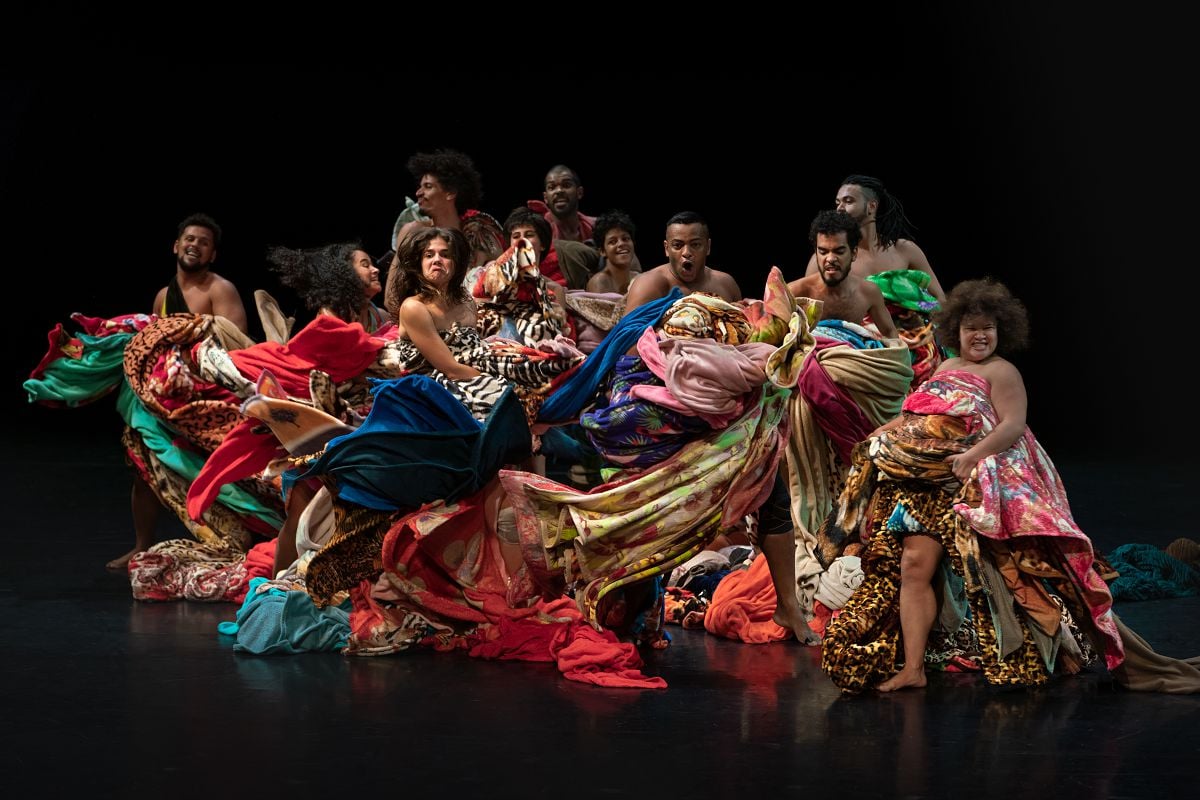
The single concept in Lia Rodrigues’ Encantado was to have naked bodies playing with bolts of fabric. The nudity was (mostly) tastefully observed with low lighting on the bodies and their manipulation of many pieces of material into self-made costumes was a simple and unusual concept. The various manifestations included ultra-long hair extensions, bulky bikinis and even the assimilation of a pantomime horse.
This was yet another work that started so slowly that I wondered if a sleep therapist had been co-opted to the panel that chose the finalists. In this case dim light barely illuminated an initial group of performers kneeling in a row upstage and over a period of several minutes they (very) gradually edged forwards, unrolling what at first appeared to be a dance floor but turned out to be those pieces of material. It was excruciatingly slow with the long silence being regularly punctuated by nervous coughing from the audience.
Frankly, how anyone could have regarded a work with an opening so far removed from dance as deserving of being amongst the four best dance works of the last two years is beyond my comprehension! My same opinion applied to the two previous finalists – Marco da Silva Ferreira’s CARCAÇA and Christos Papadopoulos’ LARSEN C.
One by one, Lia Rodrigues’ nine naked performers slowly came onto stage from either wing and crawled into or under the fabrics, gradually winding them around their bodies to create skirts, shirts and hair pieces before standing or sitting – living sculptures engulfed in their printed fabric, as if a work of visual art. The dance was minimal and the heavy beat in the indigenous Brazilian music gradually intensified during the hour-long work (it seemed longer). The music was apparently recorded during a live demonstration about indigenous, ancestral lands being under threat.
The motley and diverse crew of performers exhibited engaging personalities as they played out this mayhem in a dressing-up box. There were a couple of occasions where a bare belly was obviously distended as if to mimic a pregnancy and it transpires that Rodrigues created the work in Rio de Janeiro during the pandemic when her first grandson was born.

The results of the Rose International Dance Prize were announced at a brief ceremony immediately after this performance and it came as no surprise to me that a piece I did not enjoy – Christos Papadopolous’ LARSEN C – won the main prize of £40,000 and a trophy designed by Es Devlin. The problem with such subjective arts contests is that separate groups of any five people from the dance world would have chosen different winners.
For me, Kyle Abraham’s An Untitled Love was the best of the four finalists by a considerable margin, mainly because of its strong dance content. All the finalists had merits and drawbacks: the strength of LARSEN C lay in a mysterious opening sequence and a slow movement quality; but the drawbacks were that same slowness, continual repetition, and a lack of visibility that kept the mechanics of the movement skill hidden.
This is supposed to be an award for all genres of dance (which must include ballet, flamenco and South Asian dance) but in introducing the award presentation, Sadler’s Wells‘ supremo Sir Alistair Spalding referred to it as the award for ‘contemporary dance‘. The selection of the four finalists was heavily biased to cutting-edge contemporary, modern and post-modern work, and dance that was closely aligned with visual art. Frankly, this dichotomy needs to be resolved: is it just for contemporary dance (as this year’s event implied) or is it for all dance (as the blurb indicated)?
Excepting Dame Arlene Phillips, the composition of the nomination and judging panels seemed to suggest a bias towards the idea of dance as visual art, rather than choreography. Also, basing the event permanently at Sadler’s Wells suggests a longer-term conflict of interests (although in his introduction to the presentation Sir Alistair was keen to stress the independence of the theatre from the competition).
The Rose Prize aspires to be the dance equivalent of the Turner Prize, which is now seen to be a prize for arts curators rather than the public. There is already a danger of the Rose Prize becoming an award only of interest to those involved at an elite level in the dance sector. It doesn’t feel to be a contest that the public will relate to.
Finally, is there a place for anonymous sponsorship in the arts today? One would hope that Sadler’s Wells has done proper due diligence on the sponsor, and it won’t be a gun dealer or a gas-guzzler, but how does anyone know about wider conflicts of interest? Any national or international sponsorship of this magnitude should be declared for the sake of transparency and good order.


Graham Watts is a freelance writer and dance critic. He writes for The Spectator, Tanz, Shinshokan Dance Magazine (Japan), Ballet Magazine (Romania), BachTrack and the Hong Kong International Arts Festival and has previously written for the Sunday Express, Dancing Times, Dance Europe, DanceTabs, London Dance, the Edinburgh International Festival and Pointe magazine (USA). He has also written the biography of Daria Klimentová (The Agony and the Ecstasy) and contributed chapters about the work of Akram Khan to the Oxford Handbook of Contemporary Ballet and on Shobana Jeyasingh for the third edition of Routledge’s Fifty Contemporary Choreographers.
He is Chairman of the Dance Section of The Critics’ Circle and of the UK National Dance Awards and regularly lectures on dance writing and criticism at The Royal Academy of Dance, The Place and (until the war) for Balletristic in Kyiv. He was a nominee for the Dance Writing Award in the 2018 One Dance UK Awards and was appointed OBE in 2008.