Review: The Rose Prize – Christos Papadopoulos’ LARSEN C – a work of overall dullness and dimness
Graham Watts sees Rose Prize contender LARSEN C from Christos Papadopoulos – “dance for dancers and dance academics to appreciate”
| Title | LARSEN C |
| Company | Christos Papadopoulos company |
| Venue | Sadler’s Wells, London |
| Date | 4 February 2025 |
| Reviewer | Graham Watts |
The Rose International Dance Prize is for a work of dance in any genre but on the evidence of this and the previous “finalist” (Marco da Silva Ferreira’s CARCAÇA) it seems that the selection process has shown a bias towards abstract thematic work. It’s hardly surprising since, inevitably, the list of nominators is stacked with people from the world of contemporary dance. If the intention is to cover all forms of dance, then – in future – those involved in the nomination of works should reflect that breadth.
Excepting friends and family, there are essentially two tribes that watch contemporary dance: one is the general public; and the other is comprised of dancers, former dancers and those involved in the dance industry (such as academics). This latter group was very much in evidence here at Sadler’s Wells. The two expressed opinions I heard outside the theatre following this performance of LARSEN C were “it lost my attention very early on” and “wasn’t that brilliant”! I leave you to guess which of these opinions was expressed by a dancer, and which by a non-dancer.
The title of LARSEN C (like CARCAÇA, the title is emphasised in major case) comes from the largest of four Larsen ice shelves – named after a Norwegian whaling ship captain – that extend along the east coast of the Antarctic Peninsula. Larsen C is reputedly 10,000 years old but continued global warming is thinning the ice to the point that it may break up altogether over the next decade.
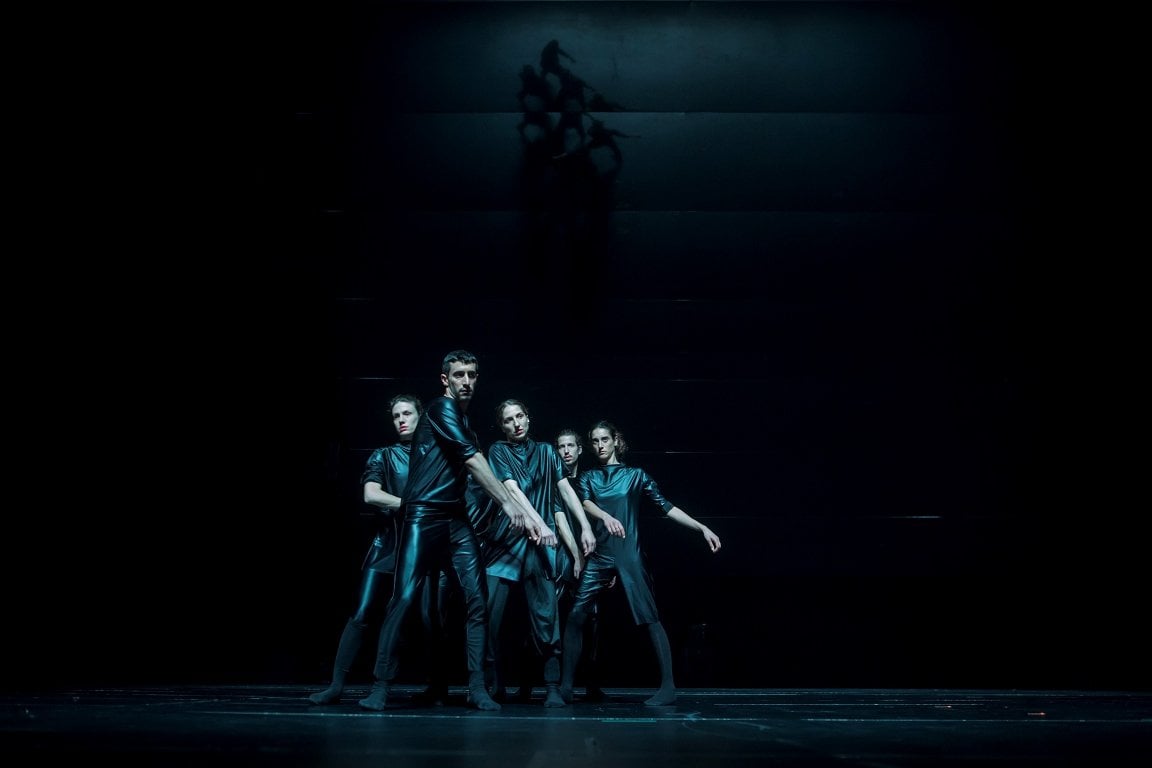
So, Christos Papadopoulos has chosen a massively important subject for his work and, to his credit, the combination of his choreography, the low-level lighting and exceptional skills of his seven performers articulates a form of glacial dance. Opening with the gradual appearance, through the gloom, of one dancer, his concept moves through varying combinations of the performers but retaining the same extremely slow landscape of minimalist movement in low lighting. It appears from the choreographer’s brief programme note that the dancers are free to interpret and bring ‘their own flavour to the choreography’. This may explain why the work was longer than the hour that it was scheduled for. Frankly, it seemed much longer.
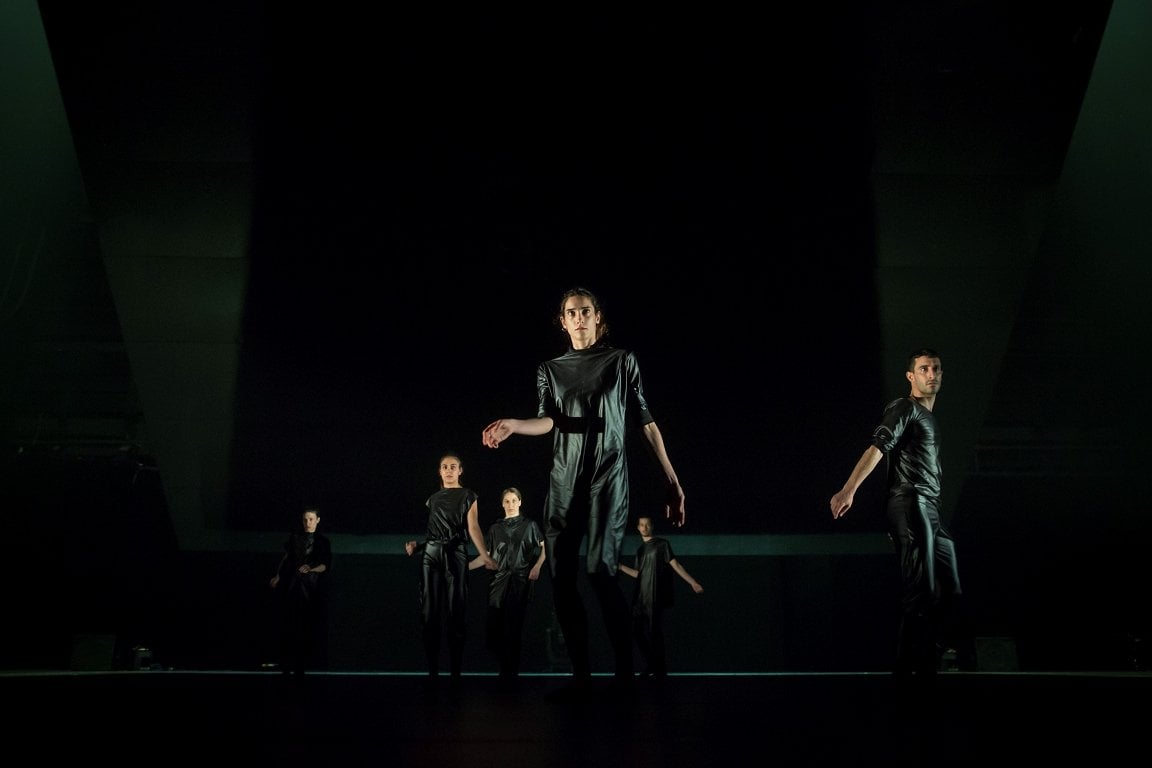
This was a work characterised by pure movement, dim lighting and shadow, a soundscape that moved from white noise to running water and what seemed like an accordion stuck on a single chord. Design was narrowed to dark clothing and a burst of dry ice, pumped into the audience, covering a dark void on the stage that lasted for two or three minutes, When Eliza Alexandropoulou’s lighting returned it came with the nifty illusion of cutting performers in half, their apparently disembodied legs possessing strange elongated but featureless top halves. This momentary interest was nothing like enough to compensate for an overall dullness and dimness in the work.
The presentation of the dancers’ movement quality was nonetheless outstanding, their legs flowed in perpetual slow motion as if on castors, an effect exaggerated by the side lighting which obscured their feet, while the upper bodies undulated like shards of ice blown in the Antarctic breeze. It was elite virtuosity on a minimalist scale; but all too repetitive to retain my attention for long enough.
The work premiered in France, in September 2021, and clearly someone felt it significant enough to be put forward for this international prize and a selection jury agreed. It’s tough enough to watch live, so how a group sat through a film of it to make that decision is especially perplexing. I have the same problem with both this and CARCAÇA. They seem to be dances made especially for dancers and dance academics to appreciate. The loud booing at the conclusion of this over-long work suggests that it was certainly not appreciated by everyone. But, if dancing like a slow-moving, free-flowing ice shelf is your thing, then this might be regarded as unique, or even as a masterpiece.
The Rose Prize has aspirations to do for dance what the Turner Prize has done for art and when one considers the controversy that has dogged that annual award for modern art (winners have included light bulbs over an empty space, a shed converted into a boat and back into a shed and a sound installation, and how about that pile of bricks) I suppose that one should not be surprised at the controversial cutting edge nature of this year’s first flowering.

Graham Watts is a freelance writer and dance critic. He writes for The Spectator, Tanz, Shinshokan Dance Magazine (Japan), Ballet Magazine (Romania), BachTrack and the Hong Kong International Arts Festival and has previously written for the Sunday Express, Dancing Times, Dance Europe, DanceTabs, London Dance, the Edinburgh International Festival and Pointe magazine (USA). He has also written the biography of Daria Klimentová (The Agony and the Ecstasy) and contributed chapters about the work of Akram Khan to the Oxford Handbook of Contemporary Ballet and on Shobana Jeyasingh for the third edition of Routledge’s Fifty Contemporary Choreographers.
He is Chairman of the Dance Section of The Critics’ Circle and of the UK National Dance Awards and regularly lectures on dance writing and criticism at The Royal Academy of Dance, The Place and (until the war) for Balletristic in Kyiv. He was a nominee for the Dance Writing Award in the 2018 One Dance UK Awards and was appointed OBE in 2008.