
Review: Prometheus – Krzysztof Pastor’s genius new work for the Polish National Ballet

Graham Watts sees the Polish National Ballet in Krzysztof Pastor’s Prometheus – a thoughtful, spectacular, epic ballet with richness of detail and structure.
| Title | Prometheus |
| Company | Polish National Ballet |
| Venue | Teatr Wielki, Warsaw |
| Date | 21 June 2025 |
| Reviewer | Graham Watts |
In response to America’s recent bombing raids on Iran’s nuclear facilities, the Russian ambassador to the United Nations accused Donald Trump of ‘opening up Pandora’s Box of catastrophes,’ a timely and precise realisation of Krzysztof Pastor’s allegory of the relevance of Greek Mythology to the modern world in his new work, Prometheus. The courageous Titan may have taken the title, but Pastor’s ballet interweaves his story with that of Pandora and her infamous box.
Prometheus stole fire from the Gods to give it to humanity and the vengeful Zeus punished him by having his liver chewed daily by an eagle (only to regenerate each night to suffer the same agony again every day). Zeus also presented Pandora as a gift to Prometheus’ brother, Epimetheus, with the wedding present of a jar (which has become a “box” in popular mythology) and an instruction that it should never be opened; but, as we know, Pandora’s curiosity prevailed, thus releasing every evil into the world, closing it just in time to hold a spark of hope inside.
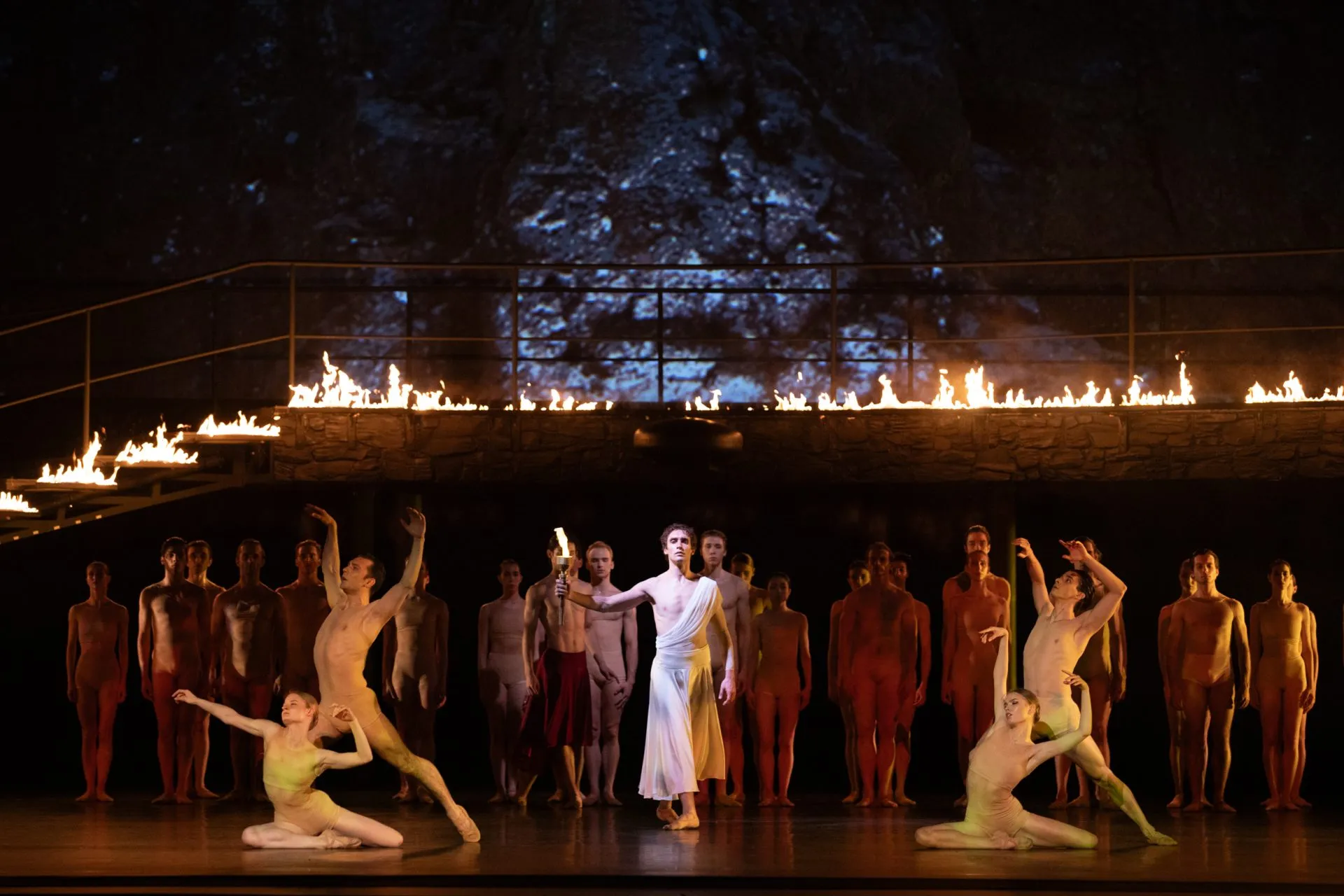
One doesn’t need genius to relate these stories of human courage and failings, of evil and hope, to today’s events around the world; but one does need the genius of Krzysztof Pastor to turn it into a thoughtful, spectacular, epic ballet with richness of detail and structure.
This excellence is quite apart from the adventurous and winning choice of music. The first act is devoted to Philip Glass with the first and second movements of his beautiful Eleventh Symphony as bookends around the Mad Rush piano solo; and the second being a marvellous rendition of Mozart’s Requiem in D Minor. The orchestral performance, conducted by Patrick Fournillier, was superb, with special kudos to the athletic pianism of Kuba Matuszczyk and the wonderful choir, arranged high on either side of the pit so as to be visible to the audience but not interfering with the dance, led by four expressive soloists: Justyna Khil (soprano); Piotr Maciejowski (tenor); Emilia Rabczak (Mezzosoprano); and a very fine deep bass, Filip Rutkowski. One could have just listened to this Olympian music, allowing the imagination to run free, and it would have been a wonderful experience.
However, the imagination of Pastor and his creative team, working within this emotional musical envelope, turned the performance into an unforgettable experience that grows in enrichment with each viewing. I saw two casts on successive nights and picked up so many fascinating nuances at that second opportunity.
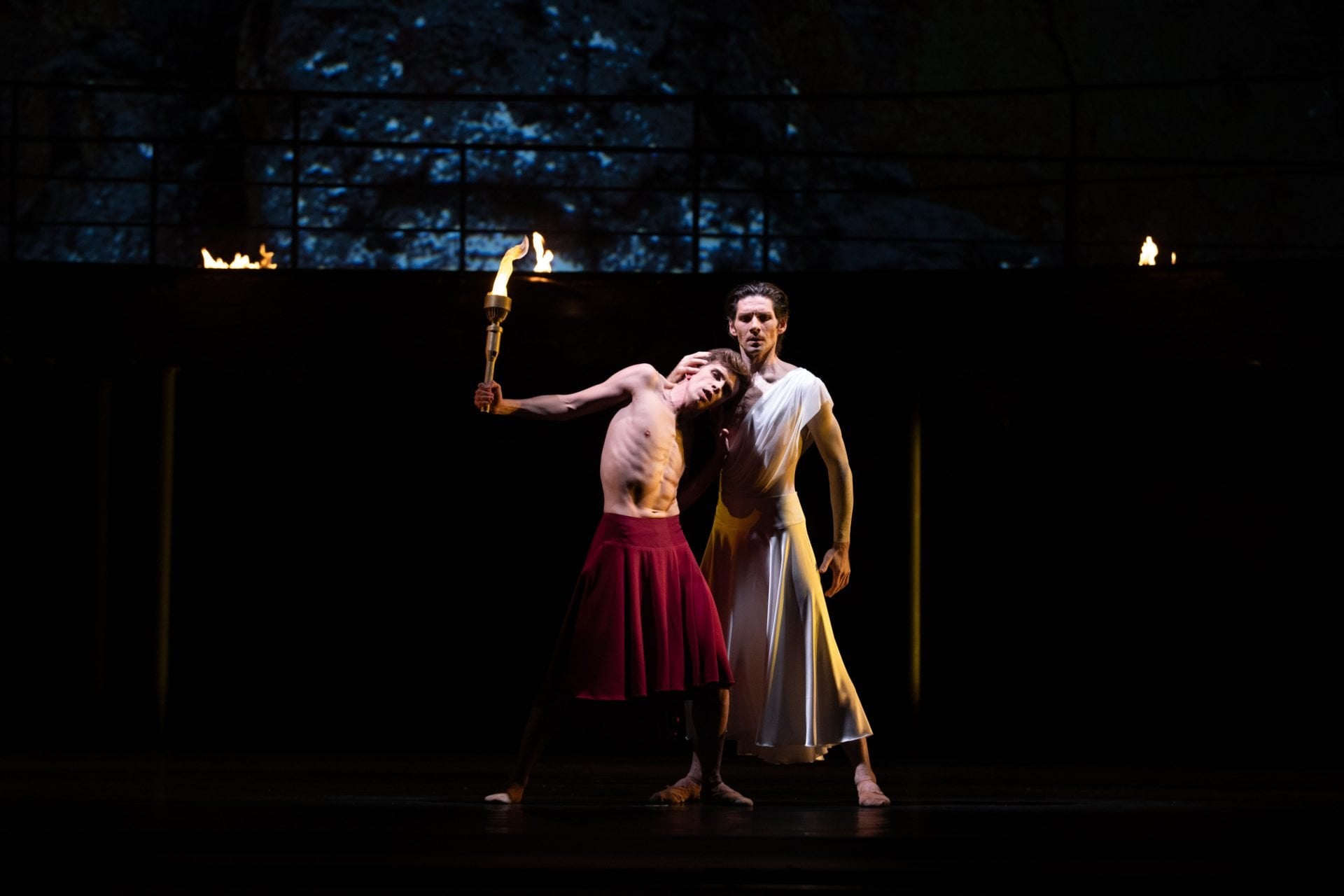
Pastor makes full use of the theatre’s enormous stage (reputedly the biggest in Europe) by often having several movement sequences happening simultaneously. Tatyana Van Walsum’s set design encourages this multiplicity with a curved staircase leading to a long platform above the stage (Mount Olympus) and a dark recess upstage for entrances and exits. Huge projections behind the platform (by Bartek Macias) range from a celestial sky through Grecian statuary and onto ancient rock formations. One spectacular coup de théâtre is to have the staircase and platform erupt into fire (real fire!) in a way that I suspect would not be possible in most theatres around the world. The torch by which Prometheus takes fire from the gods is ‘lit’ by an artificial flame, but was so realistic that one could have been forgiven for believing it to be real.
The quality of the Polish ensemble is excellent, and Pastor split his corps of 32 dancers into various groups of 8, 16 and all 32. One androgynous group has the dancers dressed identically (an equal split of men and women) in tight white bodices and flowing white skirts; they are aligned with another group representing “terracotta” people (costumes also by Van Walsum) who are rolled onto the stage before their “terracotta” masks are removed. The second act corps is dressed in black, eventually neatly removing and folding trousers and shirts to reveal nude-coloured, tight-fitting costumes. The structure of the ensemble choreography was always intriguing, groups criss-crossing through each other in diagonal lines, shoulders rolling and bodies spiralling, to create the epic feel that resonated through the ballet.


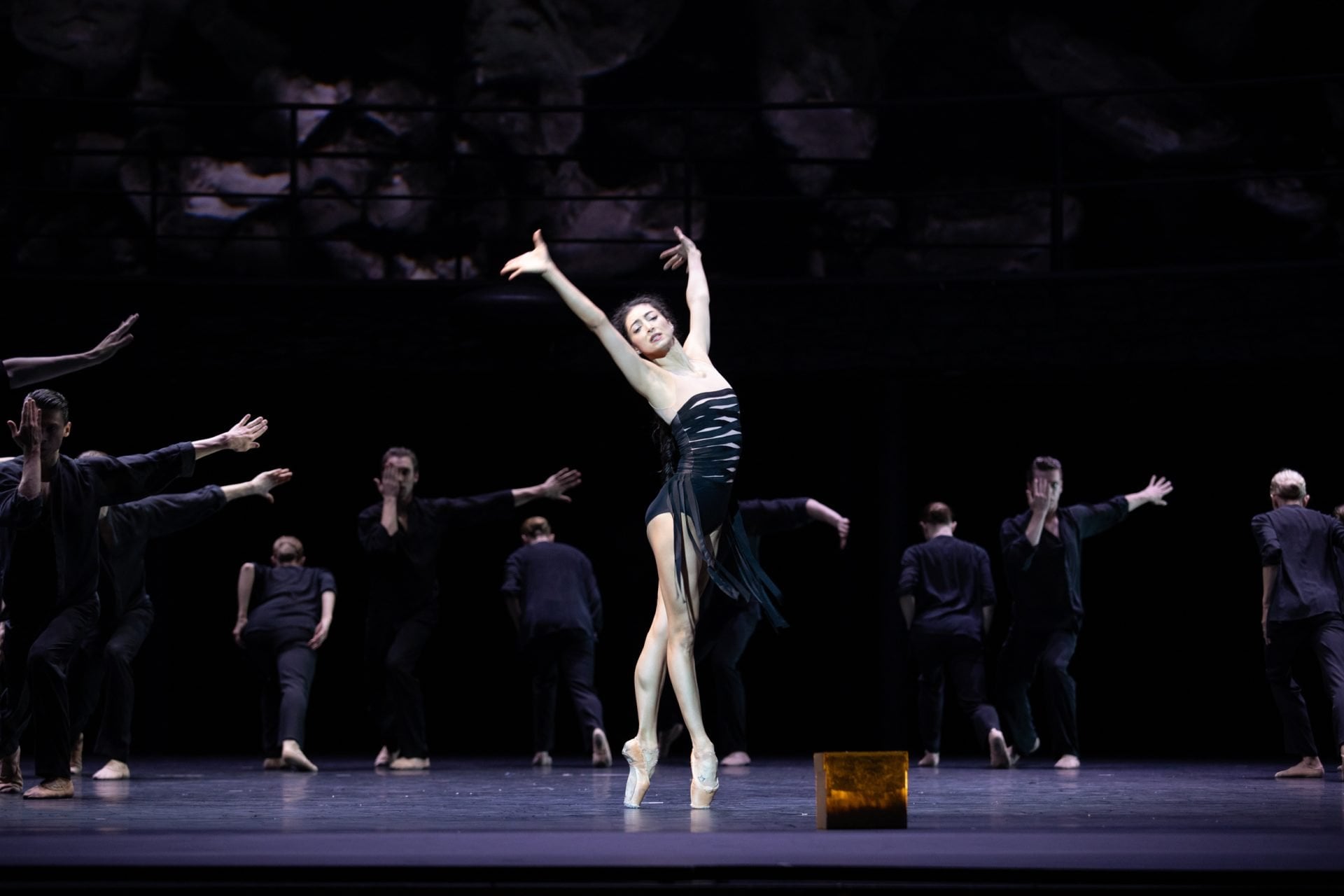
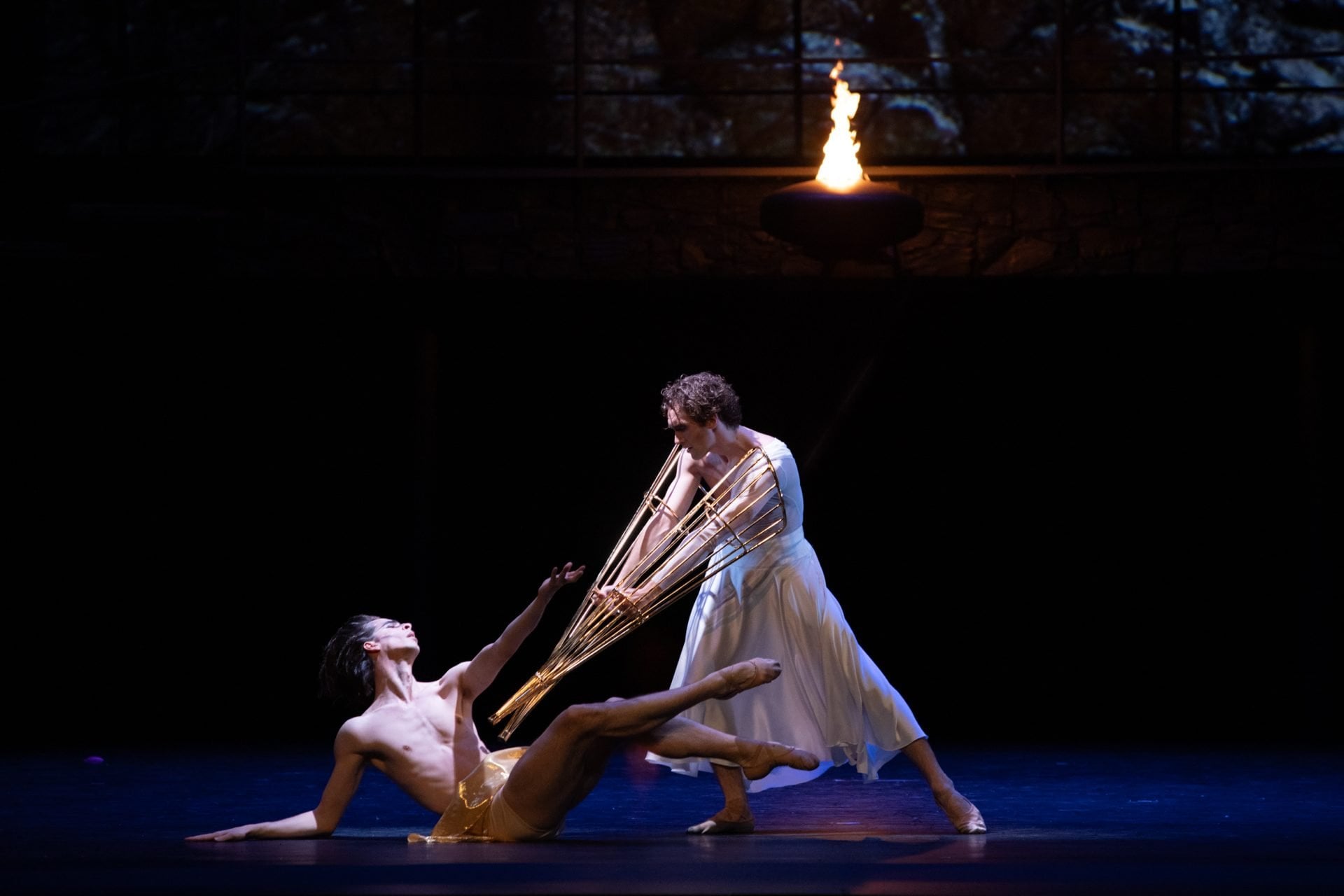
In his final performances before retirement at the end of the season, Patryk Walczak brought shades of dignity, courage and torment to the title role; Chinara Alizade essayed palpable feelings of temptation and curiosity in her sensual essay on Pandora; Paweł Koncewoj brought a palpable aura of positivity to the brother/husband role of Epimetheus; and Vladimir Yaroshenko was a suitably powerful and enigmatic Zeus. The most difficult role is that of the Eagle (Orzeł in Polish) since Kristóf Szabó performed with two long metal “wings” attached to his arms, appearing like a cross between brass crutches and trombones! Spinning with those arm extensions and not whacking fellow dancers was a new skill that he accomplished deftly! Joanna Drabik was an imposing Gaia, the primordial deity, spreading her huge cloak over the world (on the following evening, Marta Fiedler said an emotional goodbye to the stage in this role after a career of over 25 years with the company).
Pastor has been artistic director of the Polish National Ballet for 16 years, during which time he has held his own creativity in check to allow other choreographers the opportunity to make new work on the company (especially promoting Polish choreographers such as Izadora Weiss, Anna Hop and – next season – Robert Bondara). I heard rumours that Prometheus may be Pastor’s last work for the company. I sincerely hope not because there is clearly much more to come. But I couldn’t imagine a finer work with which to sign off.


Graham Watts is a freelance writer and dance critic. He writes for The Spectator, Tanz, Shinshokan Dance Magazine (Japan), Ballet Magazine (Romania), BachTrack and the Hong Kong International Arts Festival and has previously written for the Sunday Express, Dancing Times, Dance Europe, DanceTabs, London Dance, the Edinburgh International Festival and Pointe magazine (USA). He has also written the biography of Daria Klimentová (The Agony and the Ecstasy) and contributed chapters about the work of Akram Khan to the Oxford Handbook of Contemporary Ballet and on Shobana Jeyasingh for the third edition of Routledge’s Fifty Contemporary Choreographers.
He is Chairman of the Dance Section of The Critics’ Circle and of the UK National Dance Awards and regularly lectures on dance writing and criticism at The Royal Academy of Dance, The Place and (until the war) for Balletristic in Kyiv. He was a nominee for the Dance Writing Award in the 2018 One Dance UK Awards and was appointed OBE in 2008.



Thank you Graham Watts for such a vivd and knowledgeable review. It told me so much about the work that I felt I was in the audience.