
Interview: English ballerina Georgie Rose, dancing on top of Rome
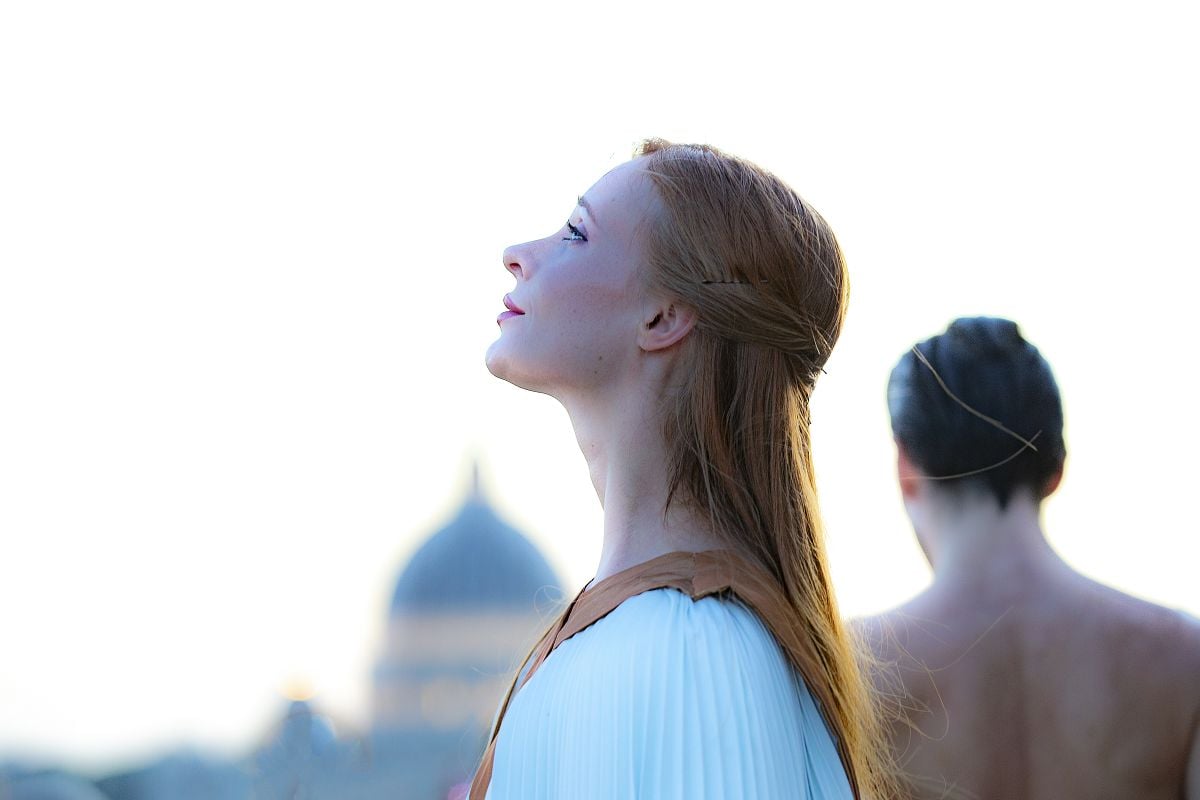
Royal Ballet School-trained ballerina Georgie Rose discusses dancing at Castel Sant’Angelo in Rome, her choreographer Sergio Bernal, and living with Tourette’s syndrome.
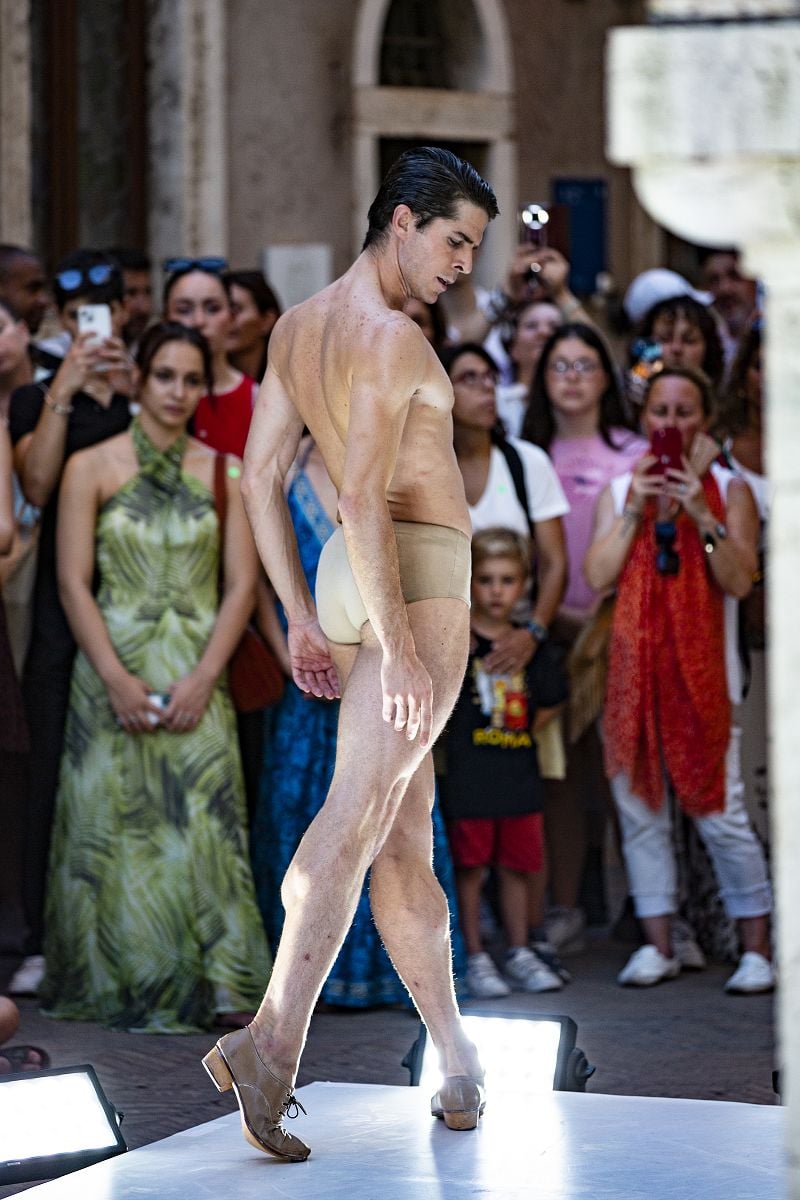
Every 25 years, the Catholic Church celebrates a Jubilee, a special year of “forgiveness, reconciliation and spiritual renewal”. To coincide with this year’s Jubilee, Rome’s Castel Sant’Angelo hosted a performance called Madonna della Farfalla by Roberto Capucci, an idea from producer Daniele Cipriani. The itinerant performance involves singers and dancers, including Sergio Bernal (who also choreographed the event) and English dancer Georgie Rose.
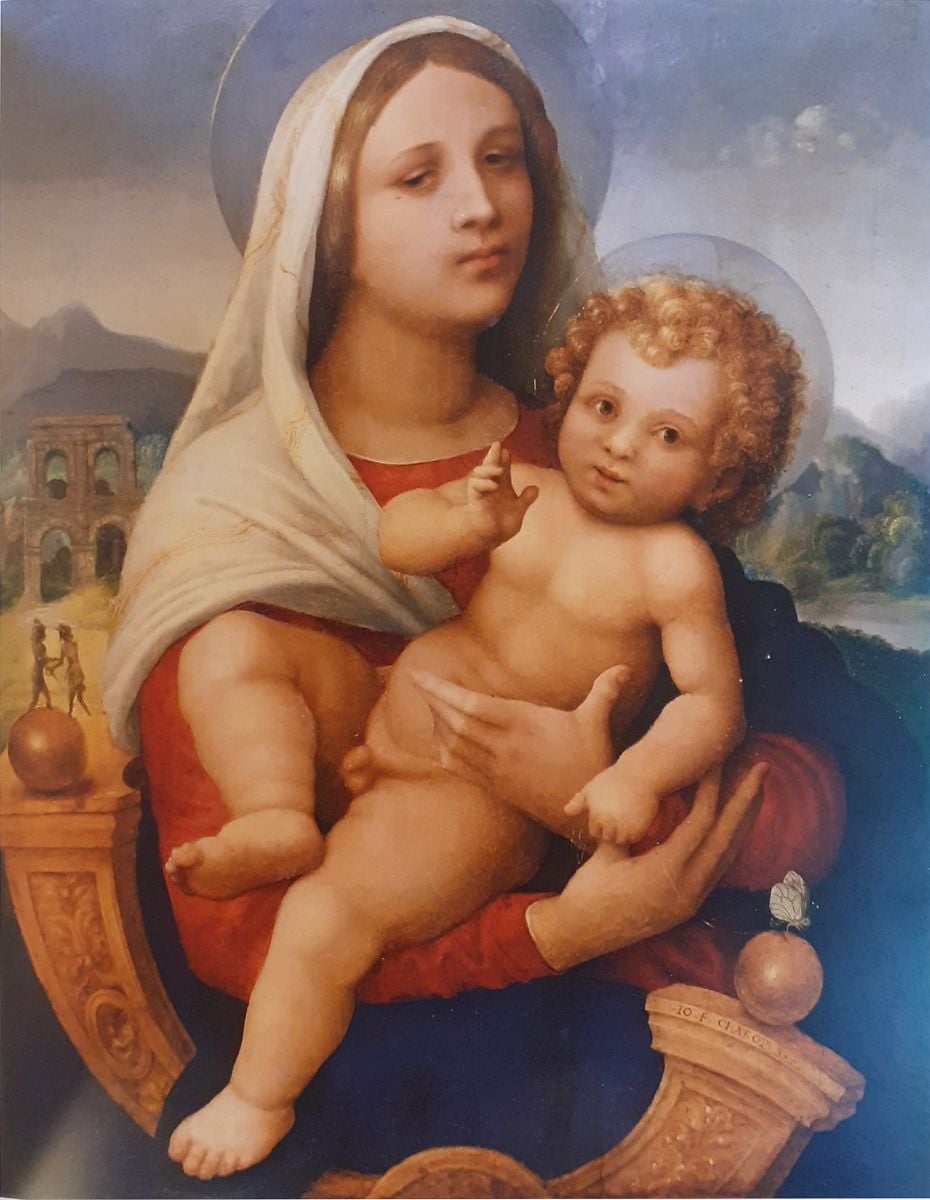
“Contemplating the marvellous Madonna della farfalla (Madonna of the Butterfly) by Giovan Francesco Caroto, painted around 1510-15 and which I saw exhibited a few years ago in Verona, I was struck by the profound spiritual afflatus of this painting and, in particular, by the impalpability of the small winged insect delicately resting on the armrest of the chair, by that lightness that in our imagination we associate with angels,” writes Cipriani. “This is how the idea of this itinerant performance came about and why, at a certain point, we will see the Madonna carried on a litter by four ‘angelic’ butterflies.”
Georgie Rose interprets the Madonna, and I talked with her on the eve of the performances, which end this evening.
In Jubilee year, you will be playing the Madonna, the Virgin Mary, at one of the world’s most famous landmarks.
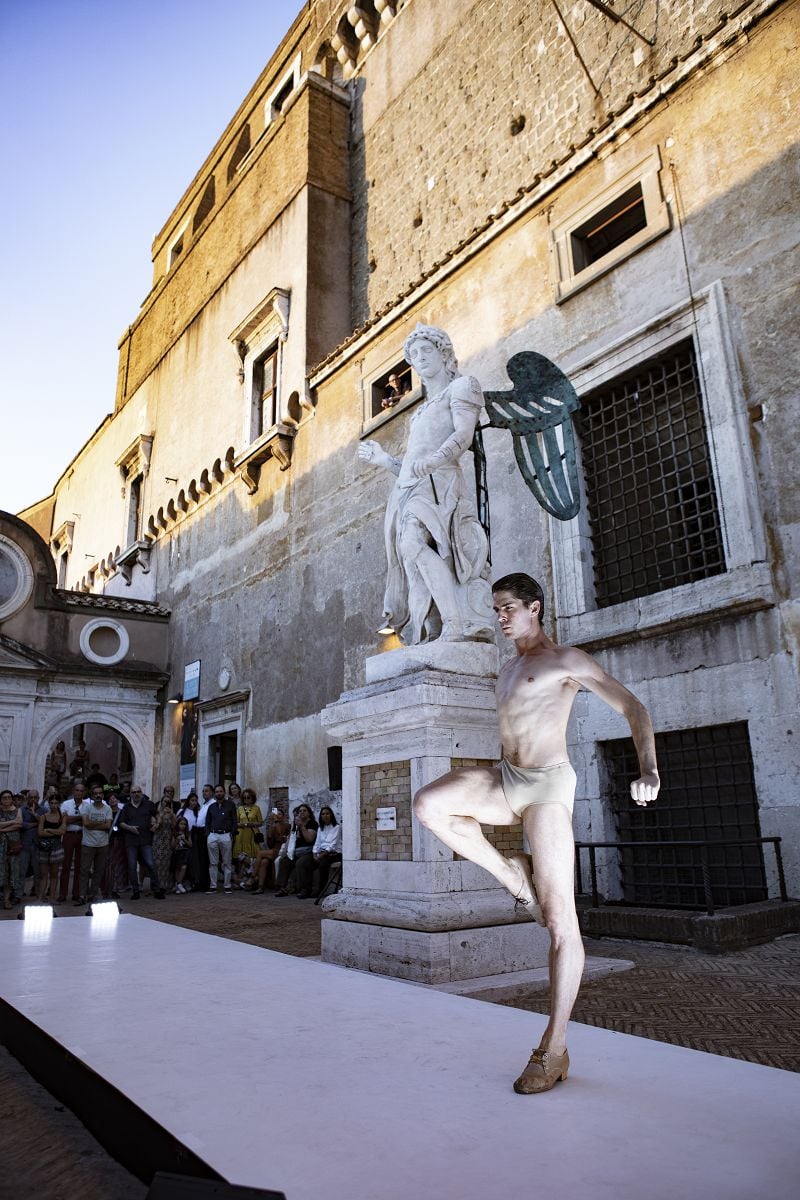
I feel a great honour and responsibility in this role. My part is a collection of simply constructed but undeniably powerful symbolic moments occurring in different locations within Castel Sant’Angelo. I finish with a solo on the rooftop terrace, right below the statue of Archangel Michael. Performing with that presence, hovering overhead, is a spectacular feeling – I’m so small and insignificant, below this immense statue. During a solo with the candles, with the silence, the public with me in the moment, and the wind flowing through my phenomenal costume giving it a life of its own, the air below those expansive wings has a sort of safety about it, powerful and protective. It’s a unique moment and place to perform – my words can’t do it justice.
It’s not just the location that makes this so wonderful for me as a dancer, but I fell in love with this idea, the painting by Giovan Francesco Caroto of the Madonna della Farfalla. It’s such a particular symbol with the strength of the Madonna combined with the fragility of life, represented by the butterfly in the painting. To embody these almost contradictory ideas in choreography is not simple, but the wonderful work of Sergio Bernal has captured this beauty. Castle Sant’Angelo acts as a kind of sanctuary for the Madonna. I feel like I’ve really been able to connect with these emotions, and I hope to it justice for this wonderful artistic team and for everybody who comes to watch. It’s really been special, a gift that I’ve been trusted with.

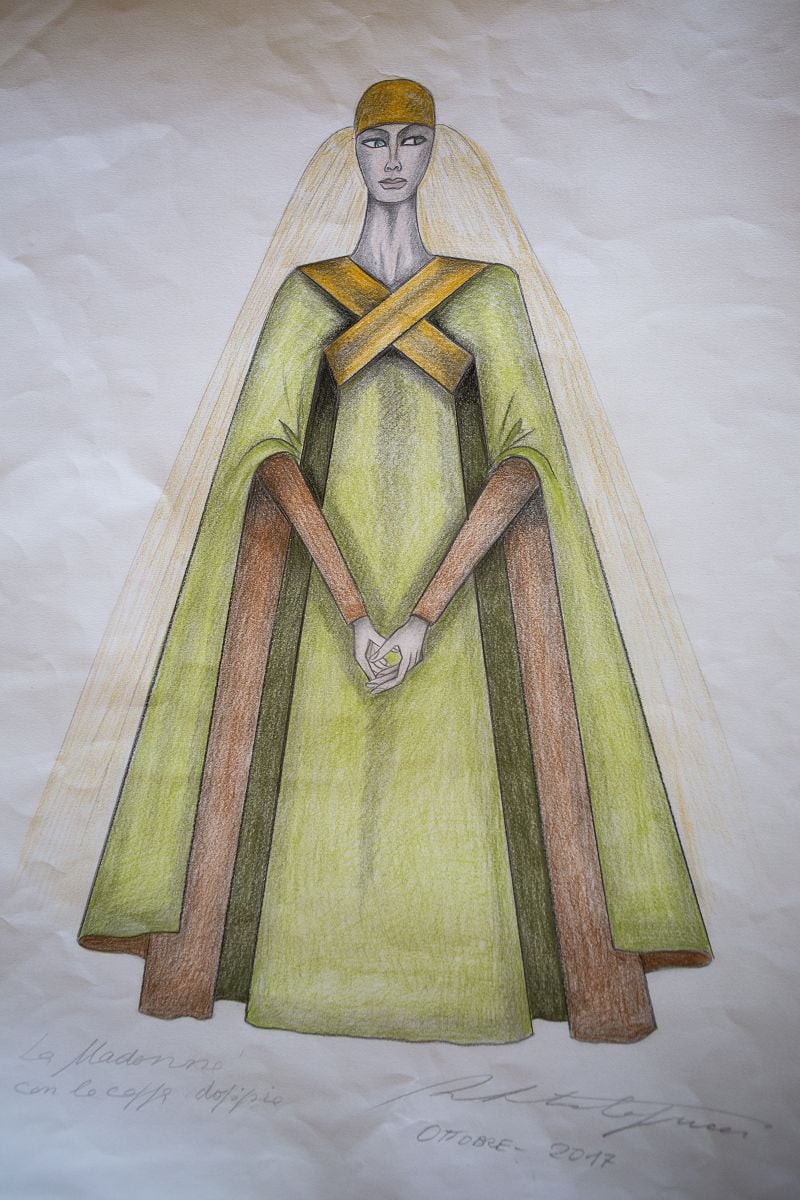


And your costume has been designed by 94-year-old Roberto Cappucci. The New York Times described his designs as “sculptural wonders”.
It’s an utter privilege to be wearing a costume by such an esteemed, world-renowned creator. I choose the word ‘creator’ because ‘designer’ doesn’t feel enough for these works of art. And, my gosh, what a wonderful person. He is so kind, so sweet, and so humble. I’ve seen so many of his designs and your jaw cannot help but drop… each is more genius than the last. Phenomenal. Sergio has used the costume with such genius and elegance that it all comes together beautifully. This artistic team is just mind-blowing.
Georgie Rose is delightful on the telephone – bubbly, generous, well-mannered, and very honest. At one point during our interview, the line goes dead. Calling back, she says, “I sincerely apologise. I managed to cut myself off. I’m afraid this is a little bit me. I save all my elegance for the stage, at least I try to. But in the rest of life, I am a clumsy little thing. So, where was I?” She laughs infectiously.
What has it been like working with Spanish dancer and choreographer, Sergio Bernal?
What an artist. He feels almost beyond human. He has generosity with all that he does. He brings a very distinctive elegance to absolutely everything. He walks into a room, and you feel drawn to his presence. As a choreographer and as a dancer, he is endlessly attentive to details – it’s inspiring to see. He sees everything, he feels everything. You are very aware of this in his dancing, as everything has a purpose, everything has a thought behind it. During the performance, when I have little pauses between transitions, I try to sneak a peek to watch his beautiful solos while trying not to be seen by the public – I can’t help it. What an absolute treasure of a person and artist.
You live with Tourette’s syndrome. How has that influenced your life and career?
For me, it was both a curse and a blessing. From an early age I learnt how much stronger we are than we often realise, and how we decide to react to the challenges we are faced with is what defines us.
My condition was a suspected combination of genetic components and also a trauma triggered at a young age. My tics consisted of very extreme facial contortions, which caused the sides of my mouth to tear and bleed daily. Also, there were many involuntary vocal sounds, and some very violent elbow jabbing, always the right arm; I still don’t understand why. You couldn’t stand too close to me without getting an elbow in the stomach.
But we all need challenges to grow – each has their own – and for me, this was a large one growing up. But through my dedication to ballet, I learned how to gain some control. Ballet gives you an in-depth knowledge of all the tiny muscles in your body, from toes to fingertips, and it teaches you how to engage these muscles, and with that knowledge I found ways to control my more violent tics. So I’m grateful to this art form.
I have to work extremely hard with many elements of my dancing to make it appear effortless. I often joke about my coordination because it’s as if my body parts don’t naturally communicate well. My brain, when I’m dancing, is working overload with not just the choreography, but focussing on the simplest things that should, as an adult, be muscle memory. A normal dancer who has been doing it this long wouldn’t have to think about it, but for me there is a constant working effort. But I think it has helped me find the importance of dancing with heart and soul – the more heart I give a piece, the easier the coordination becomes. I often think this way.
Now I’m older, I can mask the smaller tics, but ballet has helped me to be less embarrassed about this sort of incorrect wiring, which is how I imagine it inside my body. When you’re a child, it doesn’t make you the most popular kid in class, but ballet gave me a sanctuary. Maybe the audience doesn’t always like how I dance, or maybe I’m not doing it well enough, but on stage I feel that I’m supported and accepted. Strangely, it’s where I feel safest.

You trained at The Royal Ballet School and then went to Oslo to join the Norwegian National Ballet?
Not immediately. I was lucky enough to perform and tour with The Royal Ballet and the English National Ballet, two phenomenal companies with stunning repertoire. I learned a lot and was grateful for those opportunities at a young age.
In 2015, I was offered a car commercial for a ridiculous amount of money, which at that age you can only dream of. I had a choice between doing the commercial or auditioning for the Norwegian National Ballet. Everybody said I was absolutely bonkers, but I decided to go for the audition. I was young and I wanted to learn from the greats. I wanted to work hard and embrace the artistic culture that we have, which I thought it would enrich me. I was lucky enough in Oslo to then be offered a lifetime contract, so for me it was a reminder to go with your gut, your heart. Go with your soul. I’m really happy that I made that decision, 100%. You can’t put a price on knowledge and experience.
How was your time with the Norwegian National Ballet?
It was very, very special. For that moment in my life, it was where I was meant to be. I made some wonderful friends that I still go and see when I have the opportunity. I was so extremely grateful to dance the works of choreographers that I’d admired and studied since I was a child – Kylián, Crystal Pite, Balanchine, Nureyev, Makarova… the list goes on. The repertoire was phenomenal.


You now live here in Italy… in Rome. When did you leave Norway?
I left in 2023, so I’ve been here two years, though it feels longer. I’m grateful for my time in Norway, but being in Italy feels like coming home.
How did your ‘Italian Connection’ come about?
My husband is Italian, but also, after many years working at the Oslo Opera House, I felt the need for a different city. Norwegian National Ballet was an incredibly privileged place and city to work in, but there’s something about Italian culture that’s vast and powerful with these very passionate people. It just drew me in. So when this opportunity arose, without logic, my head and my heart said yes. Rome is a unique city and its culture inspires me, and in a way, it relit the fire for me to take risks and follow my heart. I’m in love with Italy… what can I say?
You choreographed in Norway and recently on the famous Italian TV talent show, Amici. How did your interest in choreographing begin?
I made my first piece when I was about 11 or 12 years old. It was for the Macmillan Award, which is a choreographic competition they have at The Royal Ballet School. My first piece was called Mistaken Malady, and it depicted a moment in the Victorian era where people with severe Tourette’s syndrome could be mistaken for someone insane and locked away for life in horrific conditions.
I never wanted to discuss my Tourette’s, my twitches, but choreographing this piece gave me a voice for a subject I didn’t know how to tackle in my normal life. I felt I could be honest about something that made me feel incredibly vulnerable. Winning the competition that year, I thought that maybe my Tourette’s didn’t have to have such a negative connotation. I realised I could draw inspiration from this and sculpt very honest movements together based on something that had always made me feel an outsider, yet was suddenly being embraced and applauded by other people. I felt like part of me that I had only hated, maybe had a purpose.
In your bio it says that you contributed to the film The Danish Girl. It caught my eye because Daniele Cipriani, the producer of Madonna della Farfalla, was also a producer on the Lili Elbe Show, a ballet by Sasha Riva and Simone Repele based on the same story.
I was a ballet teacher for the actress playing Ulla Poulsen, the Danish ballerina, and her body double. In the end, these elements were not so necessary because the big dancing production number was not integral to the plot of the film.
But another element which proved to be more important for this film was the movement choreography. As dancers, we have a very specific way of moving around a room… simple mannerisms like how we pick something up off the floor. It’s not something you’re consciously trying to do, but there’s just a way of moving that comes naturally because of our training. It’s tricky not to make it appear forced, and it was an important detail in the film. Maybe because of my Tourette’s, I feel I have an awareness of how people with different backgrounds, jobs, and personalities go about their lives. We have certain elements imprinted.

It’s not every day that one has the opportunity to dance on one of the world’s most famous landmarks – the Castel Sant’Angelo. What are your emotions for tonight?
I’m eternally grateful. I feel even closer to this country now after this wonderful project. I feel close to its people, its culture, and I really hope to have the opportunity to learn more. I want to thank [producer] Daniele Cipriani, as well as everybody involved, for trusting me with this gift to be the Madonna of the butterfly.
What’s next for this English Rose?
[She giggles.] I have an exhibition film in London as soon as this project is done, working with other people with Tourette’s syndrome – actors, doctors, scientists, a neurological specialist – and it will be my first time working with a camera equipped body suit… they call it a Perception Neuron Studio Motion Capture Suit, which should be very exciting. And after that… stay tuned. Let’s say I plan to stay here in Italy. If they will have a slightly odd, slightly clumsy British redhead, I’m theirs.


Graham Spicer, aka ‘Gramilano’, is a writer, director and photographer based in Milan. He was a regular columnist for Opera Now magazine and wrote for the BBC until transferring to Italy. His articles have appeared in various publications from Woman’s Weekly to Gay Times, and he wrote the Danza in Italia column for Dancing Times magazine. Graham was the historical advisor on Codice Carla, the 2023 documentary on Italian ballerina Carla Fracci.
Graham also works as a dance photographer, and his photos have appeared in many books, theatre programmes, and magazines, including Dancing Times, Dance Spirit and Ballet2000, as well as all the major Italian newspapers.
He is a member of the Dance Section of The Critics’ Circle.


Very interesting article, both with regard to Georgie Rose’s career and to how she manages and uses Tourette’s. It must have been wonderful to dance in the Castel Sant’Angelo!
A fascinating article! Thank you so much!