Review: Ballet de Lorraine’s hi-energy blast with a Folia and a kaleidoscopic Acid Gems
Graham Watts sees Ballet de Lorraine in works by Adam Linder and Silva Ferreira, which left the dancers and the audience on a high.
| Title | Acid Gems | a Folia |
| Company | CCN Ballet de Lorraine |
| Venue | Queen Elizabeth Hall, London |
| Date | 5 March 2026 |
| Reviewer | Graham Watts |
In this fleeting three-day visit to London, Nancy-based Ballet de Lorraine, one of several Centres Chorégraphiques Nationaux (CCN) scattered around France, brought two works unknown to British audiences.
Adam Linder’s Acid Gems is said to have taken inspiration from George Balanchine‘s Jewels, the association of gems and jewels being the clue, but frankly I would not have guessed at this link through Linder’s choreography. As the audience arrived, we were greeted by two performers sitting on top of something akin to wheeled tennis umpire chairs, chatting to one another against a bright pink backdrop. During the half-hour work they were wheeled around and carried by two “guardians” for no obvious reason.
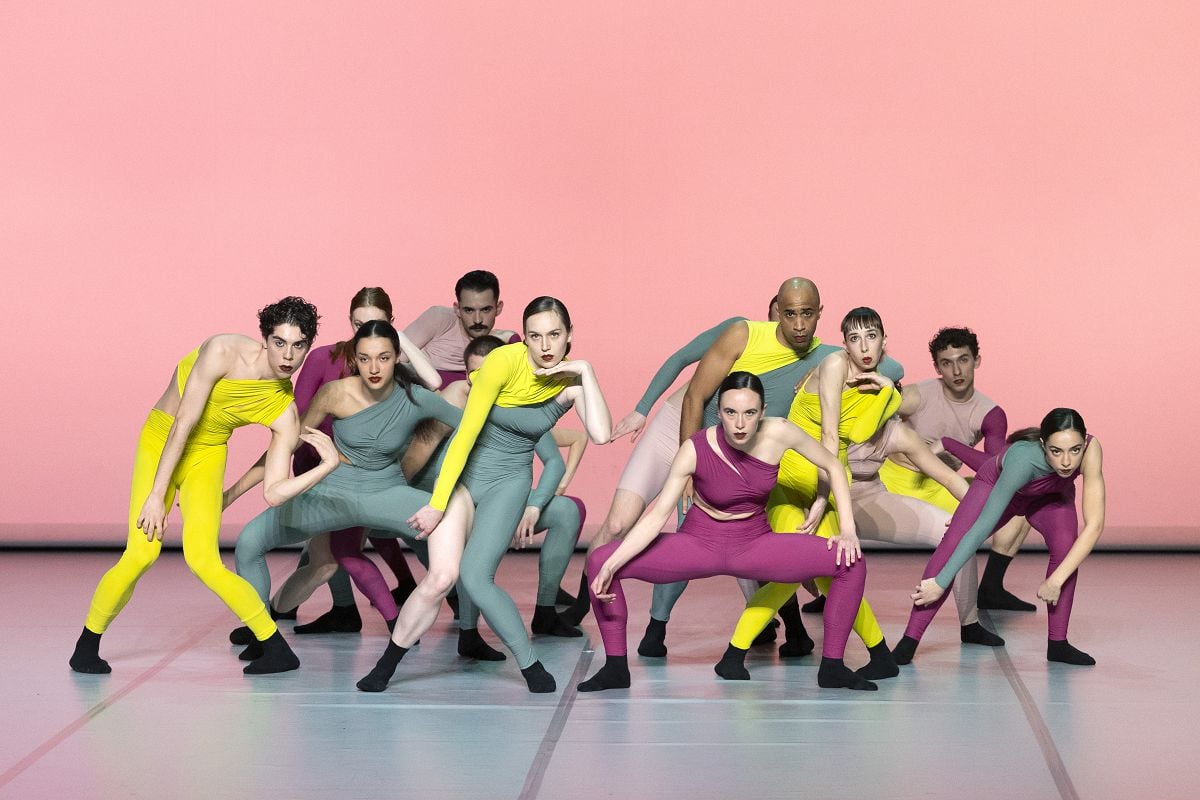
When the dance began, Linder’s fourteen-strong ensemble was dressed in tight Lycra, in vibrant yellow, green and pink costumes (designed by Antonin Tron). No two dancers were dressed alike, either in colour combo or detail – material was absent from a leg here, a shoulder or an arm there. If there was no unity in their uniform, there was the strongest harmony in their collective movement during Linder’s group choreography. At times they seemed to breathe and move like a single organism, writhing to Billy Bultheel’s percussive and pulsating music.
Almost twenty years ago, Linder won the Place Prize (2008) in London for his work Foie Gras, a duet with Lorena Randi, which I must say I thoroughly disliked at the time, but instead of kick-starting a UK-based career for the former Royal Ballet School student, he disappeared from our sight to make a career for himself in Berlin.
I think that Acid Gems was the first of his works that I have seen since Foie Gras. Although I struggled to get the connection with gemstones, apart from perhaps the brilliance of the costumes, and I never understood the relevance of the two performers on the moveable highchairs, Linder’s choreographic language was always well-structured, having a kaleidoscopic feel, often fascinating and sometimes spectacular. The freesheet handed out at the QEH described it as ‘like a classical ballet that’s been plugged into a neon socket’ and that is an apt description that I can’t top!

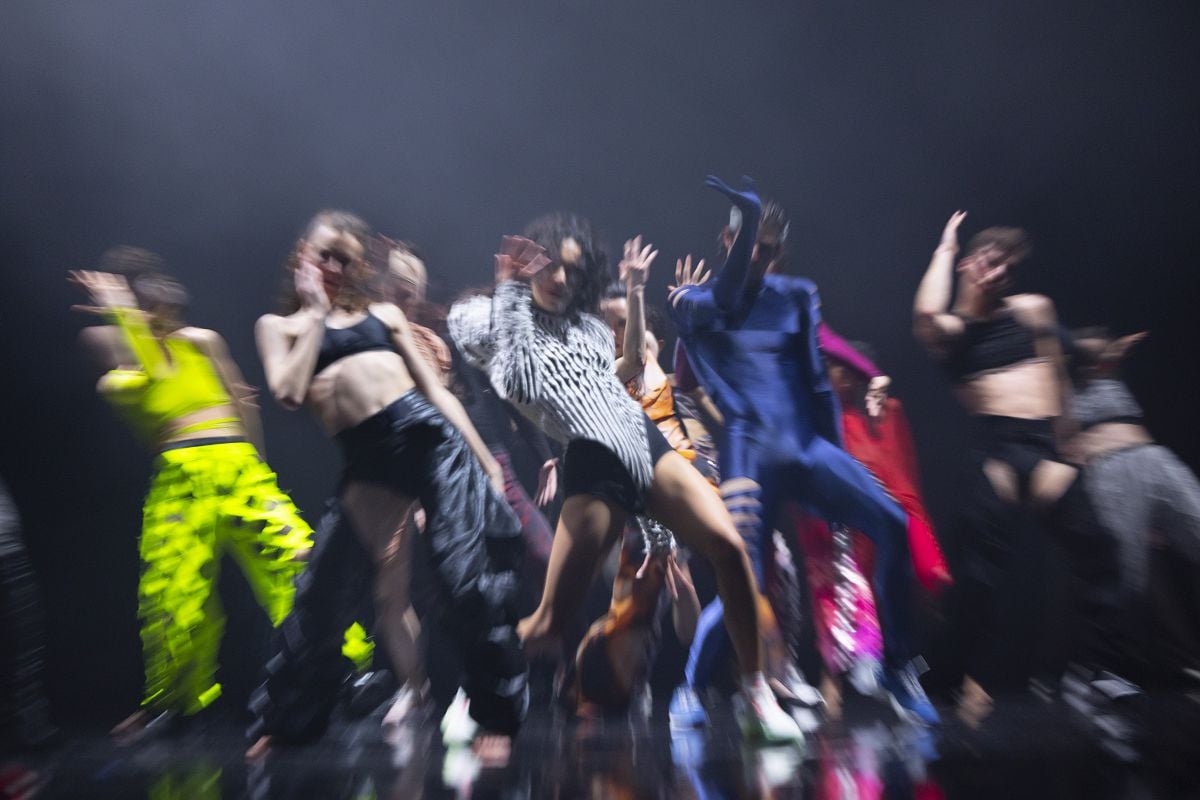
From one former UK prize-winner to another, since this double bill was completed by Marco da Silva Ferreira’s a Folia. His CARCAÇA was on the shortlist for last year’s Rose Prize at Sadler’s Wells, and it shared the fact that I didn’t like it much either! Like CARCAÇA, a Folia is similarly inspired by the cultural and social history of Portugal. In this case, the peculiar 15th-century phenomenon of peasants, sometimes cross-dressing, exploring ‘concepts of ecstasy, euphoria and collective rebellion’. Based on accounts of these rural festivals, Fereira has imagined an encounter between the madness of those fertility rituals and modern club culture and contemporary dance.
The hazy opening revealed dancers appearing from the floor or wandering in from the wings wearing an eclectic variety of costumes, including a pink dress, tight black shorts, latticed yellow trousers (worn by Laure Lescoffy, easily the smallest dancer onstage but also the most evident) and striking black chevrons. Eventually, the ensemble grew to over 20, virtually the whole company (the vast majority of whom were white European). It was pleasing to see such a large-scale contemporary work, rarely on offer here in the UK.
The music was a mix of clubland thump and Luis Pestana’s arranged version of Arcangelo Corelli’s Violin Sonata in D Minor, which formed the backdrop to what appeared to become a wild party with each dancer showcasing their talent within an energetic mass, egged on by the vocal encouragement of their peers. It was certainly a hi-energy blast, and the dancers were universally excellent. I didn’t see the cultural references to rural rituals of seven centuries ago, but that didn’t matter a jot. It left the dancers and the audience on a high, which is all that really matters.

Graham Watts is a freelance writer and dance critic. He writes for The Spectator, Tanz, Shinshokan Dance Magazine (Japan), Ballet Magazine (Romania), BachTrack and the Hong Kong International Arts Festival and has previously written for the Sunday Express, Dancing Times, Dance Europe, DanceTabs, London Dance, the Edinburgh International Festival and Pointe magazine (USA). He has also written the biography of Daria Klimentová (The Agony and the Ecstasy) and contributed chapters about the work of Akram Khan to the Oxford Handbook of Contemporary Ballet and on Shobana Jeyasingh for the third edition of Routledge’s Fifty Contemporary Choreographers.
He is Chairman of the Dance Section of The Critics’ Circle and of the UK National Dance Awards and regularly lectures on dance writing and criticism at The Royal Academy of Dance, The Place and (until the war) for Balletristic in Kyiv. He was a nominee for the Dance Writing Award in the 2018 One Dance UK Awards and was appointed OBE in 2008.