Review: Calvin Richardson makes an expressive and beautifully danced debut in The Royal Ballet’s Mayerling

Jonathan Gray sees Calvin Richardson’s debut in Mayerling with The Royal Ballet – Tall, elegantly proportioned, expressive and, above all, blessed with great physical strength.
| Title | Mayerling |
| Company | The Royal Ballet |
| Venue | Royal Ballet and Opera, London |
| Date | 2 April 2026 (matinée) |
| Reviewer | Jonathan Gray |
Cast changes in The Royal Ballet‘s latest revival of Kenneth MacMillan‘s epic three-act Mayerling saw the unexpected appearance of Calvin Richardson as Crown Prince Rudolf at the matinée on 2 April. It was an auspicious debut.


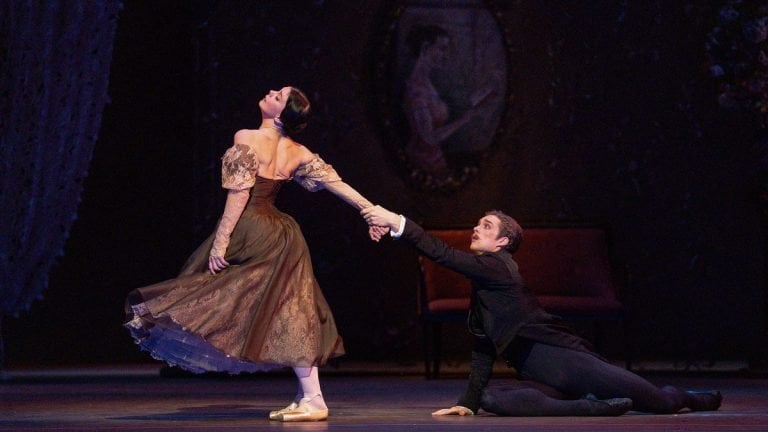
Replacing the injured Steven McRae, Richardson seemed ideally cast for one of the most arduous male roles in the classical repertoire. Tall, elegantly proportioned, expressive and, above all, blessed with great physical strength, Richardson took on the challenge of the role and met every hurdle head-on. In return, he rewarded the audience with a perceptive interpretation of the role that can only deepen and become richer with maturity and experience. This was an account of Rudolf that offered not only beautiful dancing – seldom have I seen the Crown Prince’s first solo during the Wedding Ball so fluidly performed, and with such flowing legato line – but a compelling portrayal of a young heir to the throne frustrated and angered by the lack of opportunities he is offered at the Imperial court.
Dislike of his father, the Emperor Franz Joseph, yearning for the love of his mother, the Empress Elisabeth, and trapped within a cage of royal etiquette in which he has little power or influence, Richardson’s Rudolf lashes out in the only way he is able, by terrorising his young bride, Princess Stephanie, on their wedding night. Clearly frightened by her experience, yet provoked to fight back, Viola Pantuso (also making her debut) was outstanding as Stephanie, with her performance conveying a stronger streak beneath the meek exterior of Rudolf’s unlucky bride.


In the second act, Richardson suggested Rudolf had sunk into a life of complete dissolution, with drinking, whoring and drug-taking his only outlet in a life that is also controlled by the malign ministrations of his former mistress, Countess Marie Larisch. Danced by the excellent Anna Rose O’Sullivan, another debutante, she brilliantly emphasised the manipulative and corrupting nature of Larisch’s character, whilst also demonstrating that she is the only person on whom he can rely. Joined by the superb Sarah Lamb as the prince’s new teenage lover, Baroness Mary Vetsera, the two women unwittingly lead Rudolf down into a heart of darkness, from which there will be no escape for any of them.


Richardson supported all of the women he danced with in the many strenuous pas de deux throughout the ballet with immense command, but it was only during the final act that I felt his performance began to flag just a little, his dancing and acting becoming more contained and controlled, just at the point where it should be at its most intense and raw. Nevertheless, this account of Rudolf was a momentous achievement for Richardson, and it also offered much promise for the future. Bravo.
It is good to report, too, on the vastly improved musical performance that afternoon by the Orchestra of the Royal Opera House, conducted by Martin Georgiev. They played John Lanchbery’s arrangement of the music by Franz Liszt as it ought to be played, and I thank them for that. All in all, a highly impressive afternoon.
This run of Mayerling continues until the end of May 2026