
Review: Tulsa Ballet conquers London with a balletic richness made in America

Graham Watts sees Tulsa Ballet’s ‘Made in America’ triple bill at Royal Ballet and Opera – a young, dynamic ensemble, with an overarching sense of theatre.
| Title | Made in America: Classical Symphony | Divenire | Remember Our Song |
| Company | Tulsa Ballet |
| Venue | Linbury Theatre, Royal Ballet and Opera |
| Date | 13 May 2026 |
| Reviewer | Graham Watts |
Tulsa Ballet came, we saw, and they conquered. Given that Oklahoma City only just makes it into the top 50 US cities by population, it clearly punches way above its weight in terms of balletic richness. If there are 15, let alone 50, ballet companies in the US that are as good as this, then I’ll eat my hat!
The overall impression is of a young, dynamic ensemble that has been superbly coached, not only in the complex art of ballet technique but crucially embellished with an overarching sense of theatre since these dancers, none of whom appeared to be beyond their early 20s, had an easy and comfortable rapport with the audience. All teeth n’ smiles but in an endearing way that was enhanced by the cosy intimacy of the Linbury Theatre.


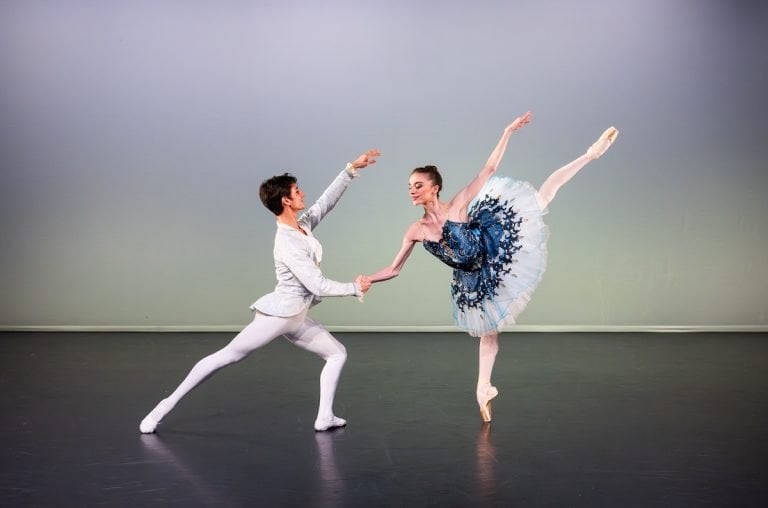
Their Made in America triple bill started with the challenging powerhouse ballet of Classical Symphony by Yuri Possokhov, a perfect showcase for the controlled speed and exuberant attack that characterise American ballet above all else, and these dancers nailed the high-energy neoclassical, non-stop movement with breathtaking success.
It was the only ballet on the programme that I had seen before, and a great part of its strength lies in the musicality of Possokhov’s choreography set against three parts of Prokofiev’s delightful First Symphony (known as ‘the Classical’). For anyone coming to this ballet for the first time, the mid-section gavotte for a male-presenting group seems to have been lifted from the Romeo and Juliet score for the former and his mates to dance playfully prior to the Capulet ball! In fact, the reuse was the other way around since Prokofiev borrowed this piece from his 1917 symphony for the ballet score, written almost two decades later.
Classical Symphony is an ensemble piece requiring consecutive dances of high virtuosity, and the whole group of 14 dancers played their parts in a very satisfying introduction of their company to the UK, with Nao Ota and Jun Masuda accomplishing the lead couple dancing with aplomb.


Nicolo Fonte’s Divenire was another challenging piece and the first of two works that introduced a new ballet choreographer to these shores. Where Classical Symphony was all about motion and momentum, this was more lyrical in its shape-shifting sculptural quality.
Inspired by the luscious music of Ludovico Einaudi, recorded as was all the music in the programme, Fonte follows patterns in the music in his choreography for a dozen dancers, building layers of duets, trios and larger group dances. It was certainly sugary and largely mentally unchallenging dance that just flowed over the audience, but it left me wanting more, which is no bad thing.


Andy Blankenbuehler is, of course, best known for the runaway success of his Hamilton choreography, and it is a mark of some esteem that the only ballet he has made is Remember Our Song for Tulsa Ballet in 2019. It was important to add diverse movement language to the programme, but also to emphasise the ballet-and-Broadway mix, which is a massive part of American ballet culture, from Jerome Robbins to Christopher Wheeldon.
There was a small element of circus, too, since balancing atop a ladder held by other dancers was part of the action. It is set to a diverse score that merges jazz, 1940s and contemporary music and follows a group of sailors stationed on a submarine during World War II (although, to be fair, I doubt I would have known that without reading the programme). Blankenbuehler represents their memories and passions of better times at home in a compelling work of dance theatre that is greatly enhanced by the evocative costumes of Lisa Zinni.
Teague Applegate and Giulia Canavese are the main characters, Charlie and Helen, although Remember Our Song – like the two works before it – is really an ensemble work for the whole company with thirteen dancers filling the Linbury stage with their effervescent performance.
Tulsa Ballet was formed in 1956 and, now in its seventieth year, it is Oklahoma’s preeminent arts organisation. Judging by the audience on this opening night, many of its balletomane followers at home had followed the company on this groundbreaking tour to London. Their passion is a tribute to the dancers and the repertoire, which is a great credit to artistic director Marcello Angelini and his team. Come back soon!

Graham Watts is a freelance writer and dance critic. He writes for The Spectator, Tanz, Shinshokan Dance Magazine (Japan), Ballet Magazine (Romania), BachTrack and the Hong Kong International Arts Festival and has previously written for the Sunday Express, Dancing Times, Dance Europe, DanceTabs, London Dance, the Edinburgh International Festival and Pointe magazine (USA). He has also written the biography of Daria Klimentová (The Agony and the Ecstasy) and contributed chapters about the work of Akram Khan to the Oxford Handbook of Contemporary Ballet and on Shobana Jeyasingh for the third edition of Routledge’s Fifty Contemporary Choreographers.
He is Chairman of the Dance Section of The Critics’ Circle and of the UK National Dance Awards and regularly lectures on dance writing and criticism at The Royal Academy of Dance, The Place and (until the war) for Balletristic in Kyiv. He was a nominee for the Dance Writing Award in the 2018 One Dance UK Awards and was appointed OBE in 2008.



Oklahoma City and Tulsa are two different cities, just FYI.