Review: Birmingham Royal Ballet performs 20th-Century Masterpieces

Graham Watts sees Ashton’s Birthday Offering, Jooss’s The Green Table and Balanchine’s Theme and Variations – an excellent programme to close a very good year at BRB.
| Title | 20th-Century Masterpieces |
| Company | Birmingham Royal Ballet |
| Venue | Birmingham Hippodrome |
| Date | 19 June 2026 |
| Reviewer | Graham Watts |
Birmingham Royal Ballet ended its 2025/26 season with two days of 20th-century masterpieces, works that originated in London (Birthday Offering, 1956), Paris (The Green Table, 1932) and New York (Theme and Variations, 1947). Given the dates of these world premieres, they are firmly mid-Century. The respective creators of these works, Sir Frederick Ashton, Kurt Jooss and George Balanchine are most certainly 20th-century masters of choreography.

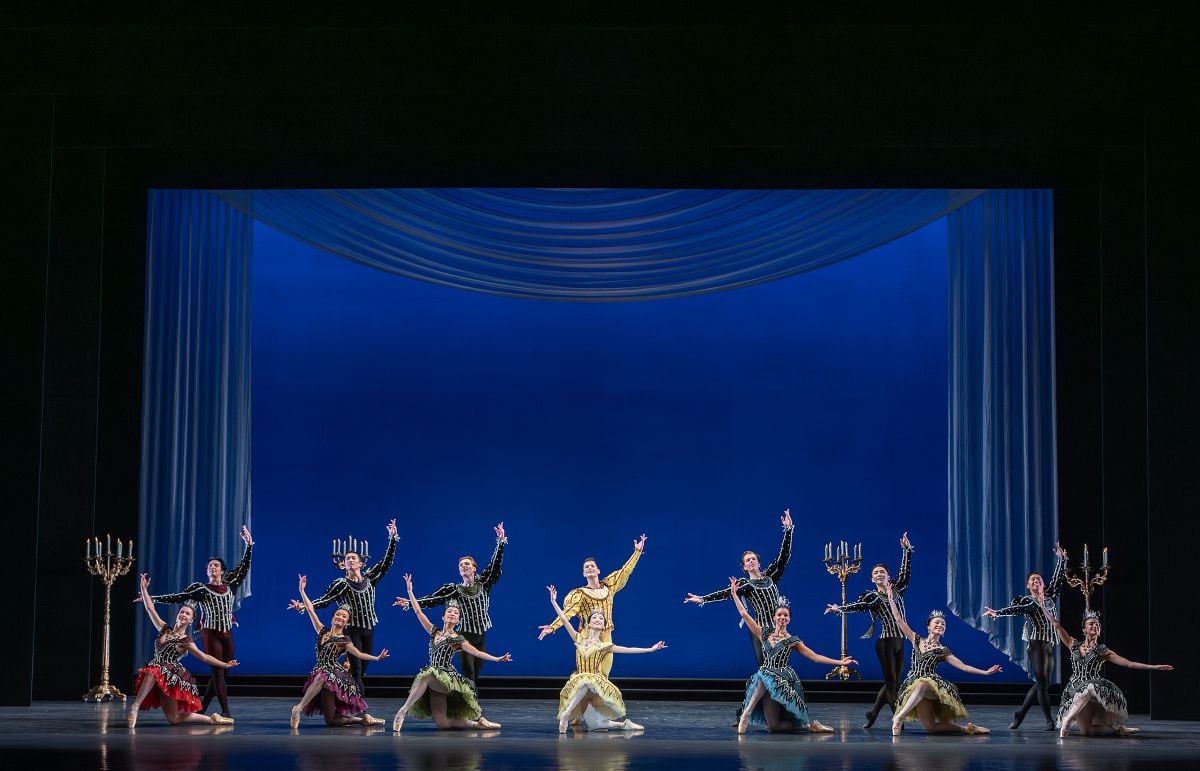
Birthday Offering opened the programme and, disrespectful though it may be to suggest, I don’t see Ashton’s love letter to the seven great ballerinas of Sadler’s Wells Royal Ballet at the time of the company’s 25th anniversary as being amongst his best work. If I were to choose an Ashton Masterpiece, this might not even make the top ten.
It’s certainly sumptuous, especially since BRB has returned to the original and lavish costumes by André Levasseur, but the ballroom format leaves the cavaliers largely as walk-on parts, particularly as the men simply stand at the back while six ballerina soloists go through their party-piece solos, which is the lion’s share of the work. It deliberately echoes the structure and format of Petipa’s fairy variations in The Sleeping Beauty, but without nearly the same style or innovation. They were party pieces in a sense since Ashton choreographed each solo to match the strengths of the ballerina on whom the work was created. Seventy years later, they seem twee and repetitive. The choreography, certainly as performed here, is often stop-start with abrupt changes of position and direction. Nonetheless, these excellent dancers did their best with the challenges. The last of the variations, danced by Yu Kurihara, was performed with an eye-catching verve and charisma.
Headlining the work were Momoko Hirata and Matthias Dingman (in the roles created on Margot Fonteyn and Michael Somes). Hirata sparkled with an effervescent flair and Dingman provided solid and strong support.


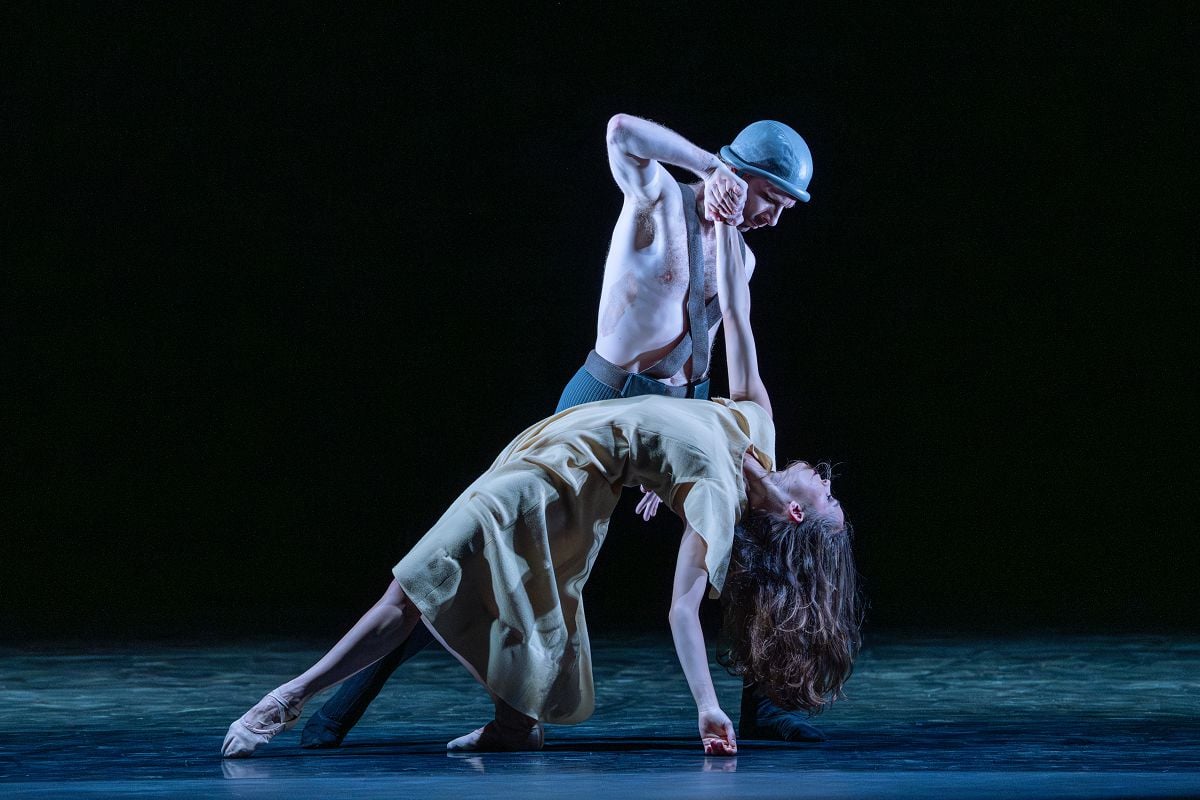
Kurt Jooss’s seminal anti-war ballet, The Green Table, was the middle offering. It was already sixty years’ old when first revived on the company, and this revival, more than thirty years since it was last performed, was the undoubted highlight of the programme.
Jooss’ anti-war polemic begins and ends with the iconic scenes of caricature around the eponymous table with ten masked ‘Gentleman in Black’, wearing white gloves, dress suits and spats. Their comic movement to incongruously jolly music, suggests the nonsense of peace talks by people (politicians, diplomats, businessmen – Jooss was never specific) who are not to be touched by the impact of war but may profit from it. The prologue ended with the ten men (three of whom were male-presenting women) firing blank pistols into the air, causing gasps in the audience. The epilogue began with the same surprise shooting before continuing with a repeat of the opening sequence. Given the importance of peace talks today these scenes were all the more poignant in their continued relevance.
Between the scenes of the ‘gentlemen’ around the green table, there were distressing sequences of men in battle, grief-stricken women, profiteering and refugees, with the extraordinary figure of Death a constant leitmotif. Lachlan Monaghan was superb in delivering the ominous, heavy-footed, slow movement of Death, made memorable by the black-and-silver costume, face paint, and headdress (the original Art Deco designs of German painter Hein Heckroth).
Gabriel Anderson was the enthusiastic Standard Bearer, ebulliently swishing his flag; Max Maslen and Tom Hazleby were the Old and Young Soldiers flanked by Death; Eilis Small, the grief-stricken Mother; Rosanna Ely, the younger woman; and Riko Ito sleazed through the piece as the bowler-hatted profiteer. There were quick changes for all six of these dancers since they were all also amongst the ‘Gentlemen in Black’. A major plus in the work is Fritz Cohen’s memorable score, so redolent of the 1930s, which was performed superbly by the piano duo of Jeanette Wong and Yen Lee.


The programme closed with Balanchine’s blast of grand faux-Russian classicism in Theme and Variations, created to the last movement of Tchaikovsky’s Orchestral Suite No.3 in G Minor, lusciously performed by The Royal Ballet Sinfonia, conducted by Paul Murphy.
Even though just 24 minutes in duration, it is a huge challenge to the male lead. For many years after it was created, only one dancer (the athletic Igor Youskevitch) was allowed by Balanchine to perform it. Enrique Bejarano Vidal handled the consecutive double/single repetitions of tours en l’air confidently with great balon and solid technique. Unusually, for Balanchine this ballet showcases the man as much as his ballerina, and Miki Mitzutani was elegance personified in the main ballerina role.
It’s a challenge for a company not used to dancing Balanchine’s choreography regularly to get it right and the company seemed largely unified in the movement but not always exactly together in the right style. I was, however, impressed by Lucy Waine who seems to have all the natural qualities of a Balanchine ballerina.
All in all, this was an excellent programme with which to wind up a very good year for BRB.

Graham Watts is a freelance writer and dance critic. He writes for The Spectator, Tanz, Shinshokan Dance Magazine (Japan), Ballet Magazine (Romania), BachTrack and the Hong Kong International Arts Festival and has previously written for the Sunday Express, Dancing Times, Dance Europe, DanceTabs, London Dance, the Edinburgh International Festival and Pointe magazine (USA). He has also written the biography of Daria Klimentová (The Agony and the Ecstasy) and contributed chapters about the work of Akram Khan to the Oxford Handbook of Contemporary Ballet and on Shobana Jeyasingh for the third edition of Routledge’s Fifty Contemporary Choreographers.
He is Chairman of the Dance Section of The Critics’ Circle and of the UK National Dance Awards and regularly lectures on dance writing and criticism at The Royal Academy of Dance, The Place and (until the war) for Balletristic in Kyiv. He was a nominee for the Dance Writing Award in the 2018 One Dance UK Awards and was appointed OBE in 2008.