Review: Michael Keegan-Dolan’s How to be a Dancer in Seventy-Two Thousand Easy Lessons
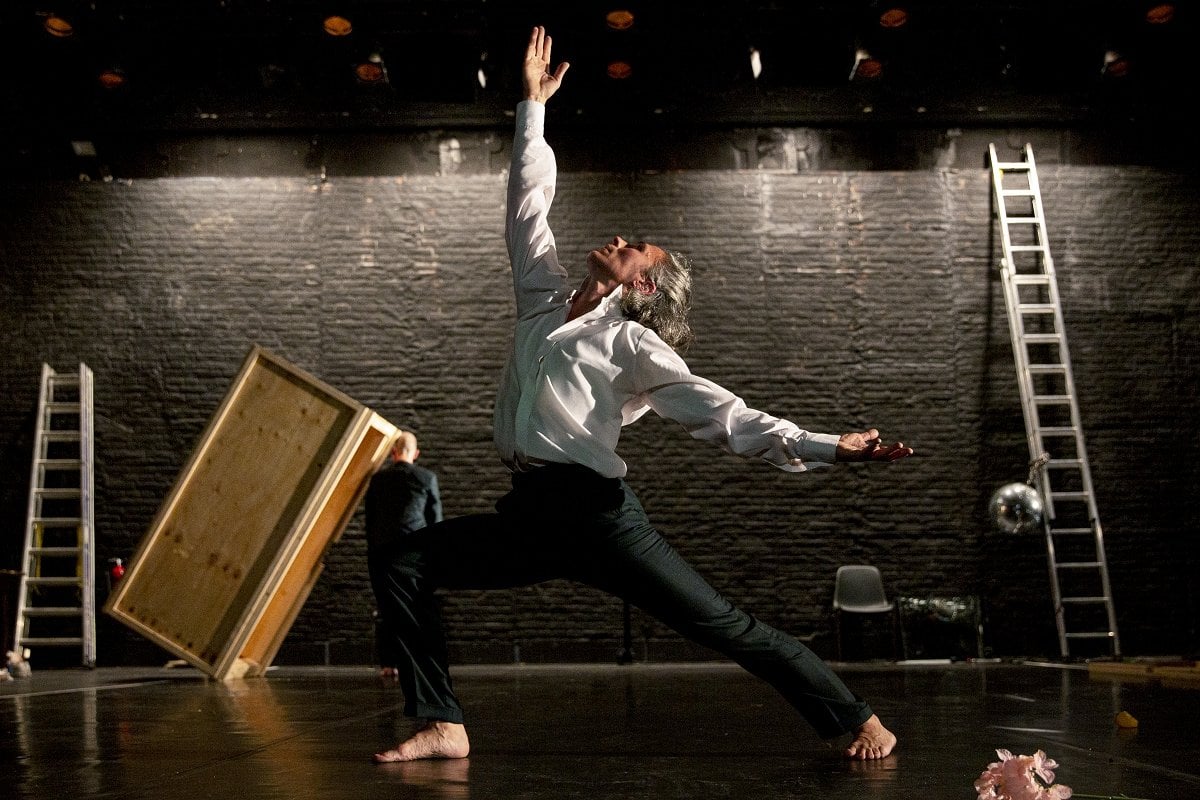
Graham Watts sees Michael Keegan-Dolan and Rachel Poirier in “How to be a Dancer…” – “never less than absorbing”.
| Title | How to be a Dancer in Seventy-Two Thousand Easy Lessons |
| Company | Michael Keegan-Dolan/ Teaċ Damsa |
| Venue | Sadler’s Wells East, London |
| Date | 17 September 2025 |
| Reviewer | Graham Watts |
Imagine having to host a major family celebration on the day after your partner announced a divorce! Well, that’s pretty much what happened here at Sadler’s Wells East the day following Michael Keegan-Dolan’s publicly declared decision to part company with the theatre after 14 years as an associate artist due to the venue’s sponsorship from Barclays Bank. No further comment about that decision here, although in retrospect it may have been less confusing for the announcement to have been made after these performances.
Back to the event itself and the undeniable observation that this quirkily and absurdly titled work contained little dance, and what there was was largely performed by Keegan-Dolan’s creative (and life) partner of the past 20 years, Rachel Poirier. She stole the show with an extraordinary and expressive barefoot solo to the repetitive and insistent theme in Ravel’s Boléro (commissioned, of course, by a dancer, Ida Rubinstein). When the music started – and in keeping with the rest of the show – it seemed that it would be but a snippet of the ubiquitous theme but Poirier lasted the whole 15 minutes or thereabouts, mostly confronting the audience with a face-on performance in a “court” that was squared-off with gaffer tape, while her partner stood motionless to the side holding a huge destabilised packing crate to prevent it from falling, itself a test of endurance to match Poirier’s impressive stamina in the dance.
The deep packing case was the focal point of the work’s opening, with Poirier testing all health and safety protocols by seemingly cutting off the case’s lock and hinges with an angle grinder, dancing sparks shooting across the wood, while she smoked a cigarette. At least she was wearing some safety specs. From within the case, the pair extracted all manner of props, including a dartboard, small bicycle, rugby ball and a trio of concrete breeze blocks. In another temptation of fate, the daredevil Poirier placed the three blocks on top of each other and then balanced precariously barefoot on top.
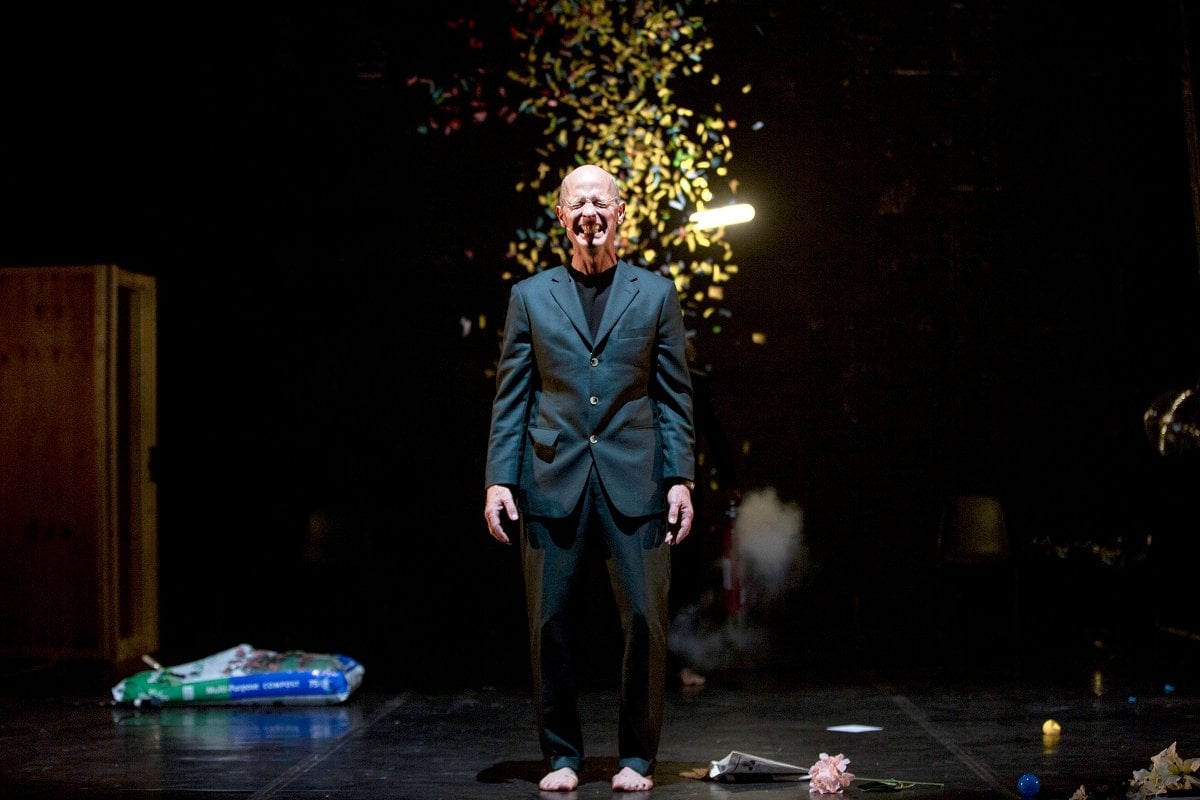
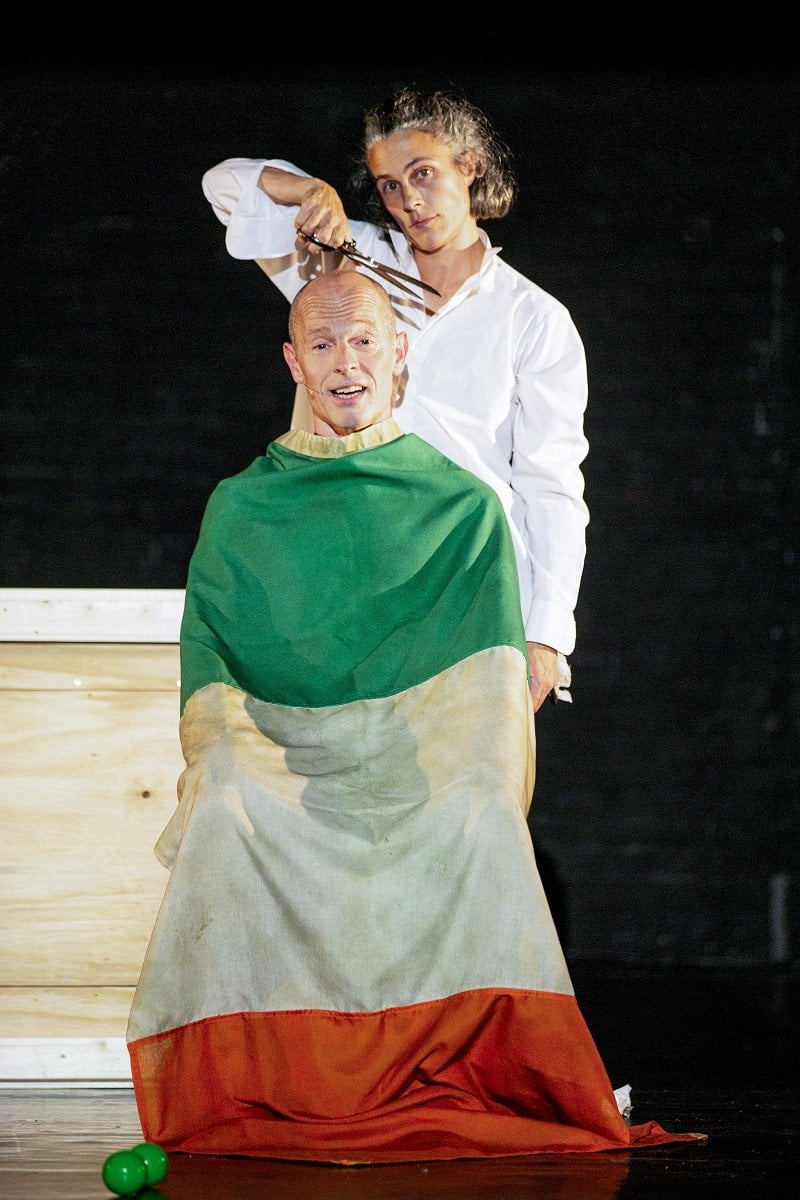
This work is an autobiographical take on Keegan-Dolan’s life and therefore each of the props had some relevance to his history or to the works made by himself and his companies, Fabulous Beast and Teaċ Damsa. Elements of the choreography also seemed familiar from past works.
His story began with tales of a childhood in North Dublin, as part of a large family (nine siblings, I believe) under the strict autocracy of the Roman Catholic Church. One memorable life-changing incident – humorously told – was at a schoolboy rugby match when he stood ready to heroically catch an “up-and-under” with the entire opposing team bearing down on him, and in that instant young Dolan (he added the Keegan later in honour of his great-uncle, Edward Keegan, who fought with the Irish volunteers in the Easter Rising of 1916) decided to sashay aside Gene Kelly style, allowing his opponents to score and thus attracting the opprobrium of schoolmates, teachers and a father opposed to his desire to follow in Gene’s footsteps.
There followed a lengthy exposition of his journey to London in the 1980s, intent on becoming a late-starting ballet dancer, complete with the racism of “F-off Paddy” that anyone with an Irish accent suffered at the height of the IRA’s terrorism. These difficulties were suitably offset by a funny story about losing his virginity: in short, he knew where to put it, but didn’t know that the man had to move!
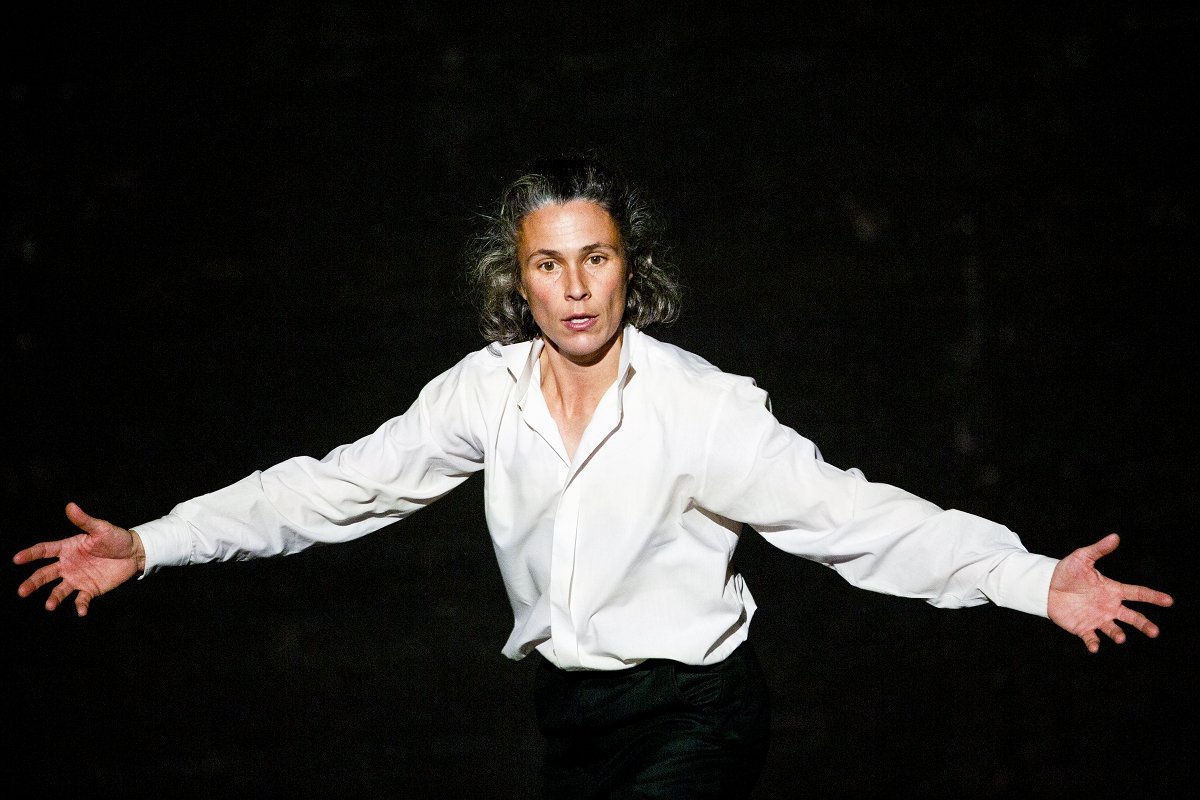
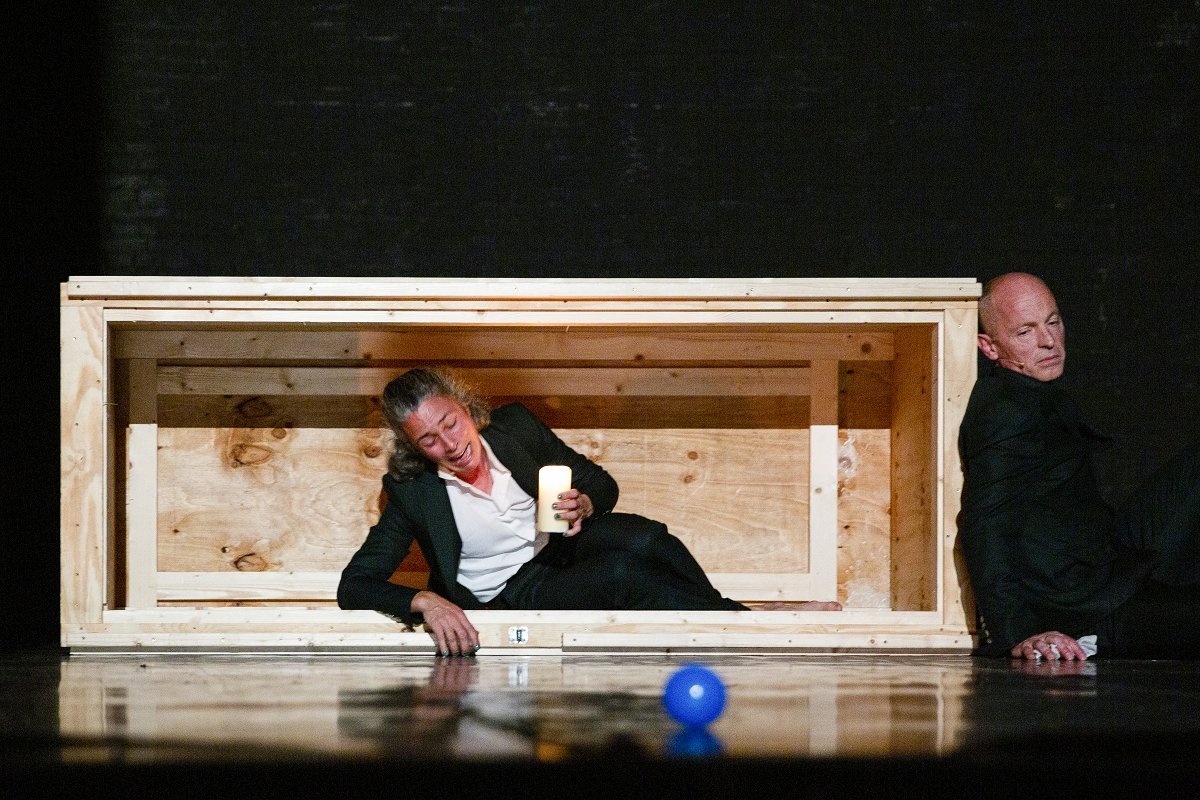

If you have read this far, you will have deduced that this was very much stand-up comedy of the anecdotal kind, with Poirier acting as a cross between a dresser (Keegan-Dolan stripped to his Y-fronts at one point) and something akin to a magician’s glamorous assistant before she came into her own via the folksy Boléro.
In addition to Ravel, the work also paid homage to Keegan-Dolan’s fancy for the music of Stravinsky and, in particular, the Firebird, a recording of which bookended the 80-minute show, concluding with the epic, uplifting finale, in which, counter-intuitively, the two protagonists sat motionless, a few metres apart, staring into the audience.
The work was conceived and developed during Covid with the two performers collaborating closely with their lighting designer, Adam Silverman, who morphed into a co-director with Poirier. It premiered at the Dublin Festival in 2022 and has toured extensively (from Madrid to Mexico) ever since.
Inevitably, with such an autobiographical focus, the work tends towards self-indulgence at times, while remaining audacious at all times. The theatre (all the writing is by Keegan-Dolan) is a heady mix of tragedy and comedy and, to their great credit, the two performers were never less than absorbing.

Graham Watts is a freelance writer and dance critic. He writes for The Spectator, Tanz, Shinshokan Dance Magazine (Japan), Ballet Magazine (Romania), BachTrack and the Hong Kong International Arts Festival and has previously written for the Sunday Express, Dancing Times, Dance Europe, DanceTabs, London Dance, the Edinburgh International Festival and Pointe magazine (USA). He has also written the biography of Daria Klimentová (The Agony and the Ecstasy) and contributed chapters about the work of Akram Khan to the Oxford Handbook of Contemporary Ballet and on Shobana Jeyasingh for the third edition of Routledge’s Fifty Contemporary Choreographers.
He is Chairman of the Dance Section of The Critics’ Circle and of the UK National Dance Awards and regularly lectures on dance writing and criticism at The Royal Academy of Dance, The Place and (until the war) for Balletristic in Kyiv. He was a nominee for the Dance Writing Award in the 2018 One Dance UK Awards and was appointed OBE in 2008.