[Review] The Royal Ballet in Wayne McGregor’s The Dante Project – “a masterpiece”

Kathrina Farrugia-Kriel sees The Royal Ballet’s first restaging of Wayne McGregor’s The Dante Project
| Title | The Dante Project |
| Company | The Royal Ballet |
| Venue | The Royal Opera House, London |
| Date | 25 November 2023 |
| Reviewer | Kathrina Farrugia-Kriel |
The Royal Ballet‘s The Dante Project returned to the mainstage for the first time since its premiere in Autumn 2021. Resident choreographer Wayne McGregor brought together composer Thomas Adès, design artist Tacita Dean, and his two regular creatives, Lucy Carter on lighting and Uzma Hameed on dramaturgy. Tackling Dante Alighieri’s La Divina Commedia is a tall order for any artist, but McGregor’s stellar group capture the spirit of Dante (as a poet who fled his native Florence, and also as a character in the Commedia), led by the antiquities poet Virgil and later the heavenly Beatrice, as he makes his way through the afterlife.
‘Inferno’ (hell) was first created in 2019; the 2020 pandemic delayed ‘Purgatorio’ (purgatory) and ‘Paradiso’ (paradise) which followed in late 2021. This three-act ballet is a classic for contemporary times, making a full-evening work that resonates across texts and narratives, choreography and composition, and visual design. It was a bold, daring collaborative enterprise, which has paid off for all involved as well as ushered in two further stagings this year: for the Paris Opéra Ballet in May, and the Royal Danish Ballet earlier last month.
McGregor’s astuteness was to engage Hameed, his firmly established dramaturg, and contain the scale of The Dante Project. Hameed’s dramaturgy is a pared-down, frugal affair across the three-act ballet, rendering accessibility to the density of the Commedia. Indeed, it is the efficient dramaturgical approach, evolved through ballets such as Woolf Works (2018) that has transformed McGregor’s creative interests into successful works. Like the composite threads in Woolf Works, the components of the production strike the right chord. Dean’s designs give depth to each of the three acts: from the darkness of the depths of hell, to the surreal, peachy purgatory and the shifting vastness of celestial paradise. However, the jewel in the creatives is the music, and McGregor’s collaborative choice is a winner here – Adès’ composition is truly a masterpiece of its time. As a young person, Adès was moved by Stravinsky’s ballet music and that surely marked the signs of a ballet composer ‘in the making’. Taking his initial cues but also departing from Liszt, Adès, now a well-seasoned ballet composer, creates a tour-de-force of a score for The Dante Project. On listening to the score a second time around, I once again found that the complex rhythms, together with the thrilling instrumentation, render a sublime exercise in composition. It is ‘musique dansant‘, but not as we know it – there are twists and turns at every corner, and the dancers clip, slide, fall and recover as though they ride the musical notes. McGregor shapes his signature movement of undulations and jaggedness on the impressive score under the baton of Jonathan Lo. The orchestra pit was truly alive as their performance carried the dancers through darkness, suspension and, finally, ascension.
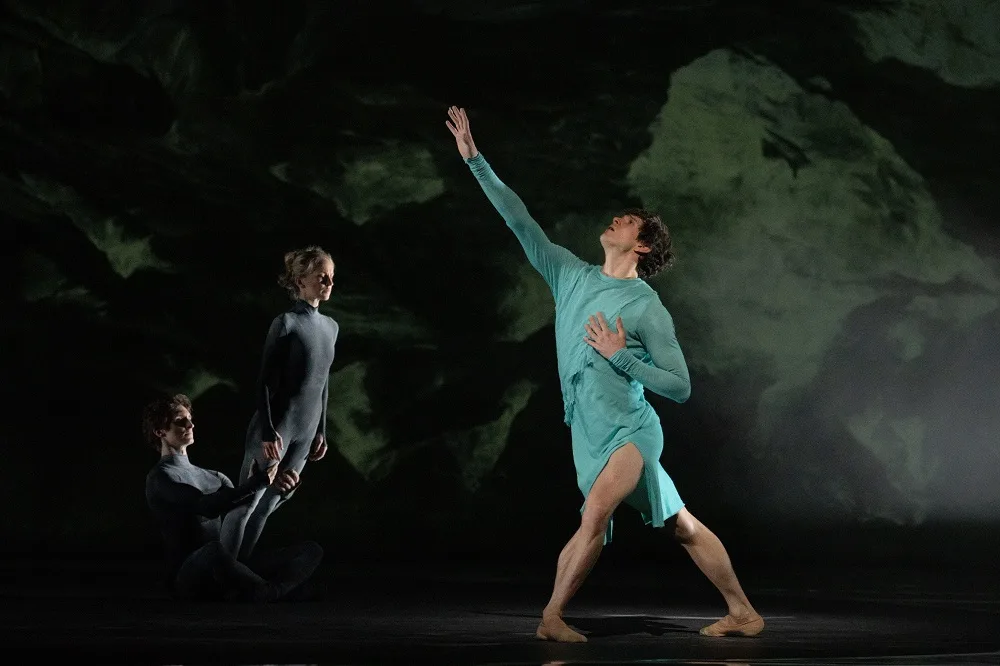
Principal dancer William Bracewell continues Dante’s journey following the inimitable, now retired, Edward Watson who created the role in 2021. Bracewell captures the spirit of McGregor’s muse, rendering both an intense pathos and sublime presence – he is the young, tortured poet and Watson’s coaching is golden. Bracewell delivered a stellar performance. Equally powerful is Gary Avis‘ presence as Virgil, the calm that leads his mentee across the three afterlives. Avis is the character artist that all companies desire to have: versatile, solid, and charismatic, not too showy but with a mature sparkle that rightly fits the role. One could say that of Avis as Leonard Woolf in McGregor’s Woolf Works too. The ‘Thieves’ section is a reminder of the sublime quality of the male dancers in the company, the best in the last twenty-five years or so.
McGregor could have easily just focussed The Dante Project on the male dancers alone. Leo Dixon is a revelation in ‘The Pope’s Adagio’ – he moves stealthily, commanding through the darkness and harnessing the intriguing musical cadences. The arrival of Melissa Hamilton, as Satan, heralds the closing of ‘Inferno’. Her solo is short, but enough to remind the audience that there is no room for judgement (this is hell, after all, and Carter’s lighting astutely closes the first act with Dante’s vision of the dark hole he finds himself in).
The five ‘Penitents’ (Matthew Ball, Lukas B. Brændsrød, Nicol Edmonds, Marcelino Sambé, Joseph Sissens) are the backbone of ‘Purgatorio. The two young dancers, Anna Kondo as young Beatrice, and Alfie Napoletano as young Dante, move with such clarity and connections with the older versions of themselves (bright futures lie ahead for these two dancers). Fumi Kaneko is a celestial Beatrice, heralding the transition between ‘Purgatorio’ and ‘Paradiso’ in the most resplendent manner. As the ‘celestial bodies’ move through phases and existences of interplanetary paradise, Kaneko and Bracewell lead a truly magnificent company. May it not be too long before this masterpiece is restaged at Covent Garden.