
Review: The Royal Ballet in MacMillan’s Romeo and Juliet – wonderfully fresh with lively dancing and vivid interpretations

Jonathan Gray sees Romeo and Juliet with Yasmine Naghdi and Matthew Ball who continue to deepen and intensify their interpretations.
| Title | Romeo and Juliet |
| Company | The Royal Ballet |
| Venue | The Royal Opera House, London |
| Date | 4 March 2025 |
| Reviewer | Jonathan Gray |
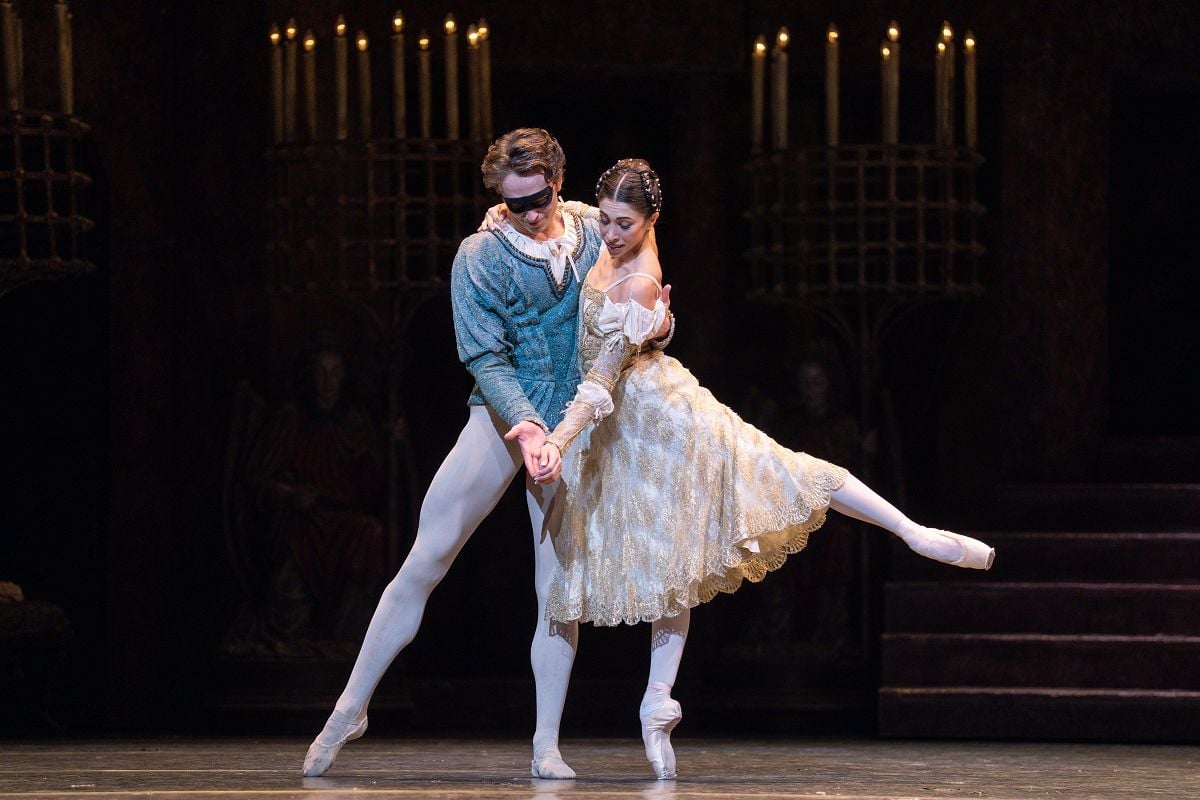
Celebrating its 60th birthday, and seldom absent from the repertoire of The Royal Ballet for very long, Kenneth MacMillan‘s Romeo and Juliet was back on stage at Covent Garden on 4 March for a run of anniversary performances. It is entirely right that the company should be marking this milestone in the history of this important ballet, but you could be forgiven for thinking, after such a long time since its creation, that Romeo and Juliet might now seem a little jaded. This latest revival, however, overseen by former principal dancer Laura Morera, who now acts as Artistic Supervisor for the MacMillan Estate at The Royal Ballet, came up wonderfully fresh, with lively dancing and vivid interpretations from the company. As with the excellent revival she oversaw last season of MacMillan’s Manon, Morera has once again drawn out the best in the dancers, stimulating them and encouraging them to take a new look at choreography they know very well.
Despite its familiarity, MacMillan’s ballet continues to make a strong dramatic impact on audiences (there were gasps of surprise, as well as delighted laughter from some of the people sitting close to me), but at this performance it was a pleasure also to observe how the corps de ballet danced with such spirit and involvement. Their torsos swayed and bent, their feet pointed and sprang with vitality, and, as their bodies drew deep into the rhythms and power of Prokofiev’s music, you truly believed they were the townspeople and aristocrats of renaissance Verona. This was, as MacMillan had always wanted, a ‘real’ world depicted on stage.


Taking the roles of Juliet and Romeo on opening night were principals Yasmine Naghdi and Matthew Ball. I well remember their debuts in the ballet a decade ago, at a Schools’ Matinée with an audience of rapt children, and since then the pair have continued to deepen and intensify their interpretations of the roles. Both artists perform the choreography wonderfully, with intelligence, clarity and attention to detail. Ball has a fluency and fluidity of movement, especially in his solo during the Ballroom scene, that made everything he danced look gorgeous, and he partnered his Juliet with strength and ardour. Naghdi’s fluttering pointe work and shimmering pas de bourrées helped suggest Juliet’s youth, and the ballerina revelled in the glorious shapes and forms of her dances. I just wished, however, for a little more recklessness and emotional involvement from the pair; to me they seemed a little too self-contained and muted truly to convey the dramatic turmoil of their young lives.
Whilst there were some rather stolid performances from several of the ‘mature’ character artists (excepting, as always, the patrician Lady Capulet of Elizabeth McGorian), the same could not be said of Joseph Sissens, who gave an impish, naughty, musically dynamic and dramatically exciting account of Mercutio, or of Leo Dixon, who was a mercurial Benvolio. I also enjoyed the playing of Claire Calvert, Annette Buvoli and Isabella Gasparini as the three Harlots, who added much earthy atmosphere to the ‘Market’ scenes. Conductor Koen Kessels’ account of Prokofiev’s score was at times too stately but, overall, this was a fine account of the ballet from both dancers and musicians.
With performances of Romeo and Juliet continuing until 26 May, and with numerous cast changes still to come, London audiences have every opportunity to reacquaint themselves with this classic of the repertoire.



Jonathan Gray was editor of Dancing Times from 2008 to 2022.
He studied at The Royal Ballet School, Leicester Polytechnic, and Wimbledon School of Art where he graduated with a BA Hons in Theatre Design. He was on the Curatorial Staff of the Theatre Museum, London, from 1989 to 2005, assisting on a number of dance-related exhibitions, and helping with the recreation of original designs for a number of The Royal Ballet’s productions including Danses concertantes, Daphnis and Chloë, and The Sleeping Beauty.
Jonathan Gray has also contributed to the Financial Times and The Guardian, written programme articles for The Royal Ballet and Birmingham Royal Ballet, and is co-author of the book Unleashing Britain: Theatre gets real 1955-64, published in 2005. He is a member of the Dance Section of The Critics’ Circle.



Leo Dixon was Benvolio, not Mercutio.