Review: Astana Ballet Theatre and Mosaic del Arte’s Blind Forgiveness in Athens

Graham Watts sees Astana Ballet Theatre and Mosaic del Arte’s Blind Forgiveness at the Pallas Theater in Athens – Julian Mackay and Natalia Fernandes Menes: “a combination that was mesmerising in its absorbing and romantic impact”.
| Title | Blind Forgiveness |
| Company | Astana Ballet Theatre / Mosaic del Arte |
| Venue | Pallas Theater, Athens |
| Date | 13/14 September 2024 |
| Reviewer | Graham Watts |
There have been times when new full-length ballets were as rare as hens’ teeth but, happily, those days appear to have gone. This coming season is awash with new work, and I suspect that, in so many ways, this particular addition to the global repertoire may prove to be the most unusual newcomer; and if any of those that are to follow are even half as satisfying, then ballet is in for a very good year.
Blind Forgiveness is the latest outcome from an independent production company, Mosaic del Arte, founded in Dubai with a mission to make art appeal to new audiences without losing its timeless essence. In creating this ballet for its world premiere in Athens, the company has partnered with the Astana Ballet Theatre of Kazakhstan, where the ballet was crafted. It’s a fascinating and innovative model of private investment into an established ballet company to make new work for international consumption and I hope that it both prospers into more projects and provides a lead for others to follow.
Billed as a “rock ballet” with international film star, Christopher Lambert (he of Tarzan and Highlander fame) as the narrator, it was more in the nature of a modern fairy tale with an excellent score by Arseni Smirnov that had lyrical, orchestral, jazz (including an outstanding trumpet theme in the second act) as well as rock elements, most notably in the punctuation of two scintillating electric guitar solos. This eclectic score both gelled seamlessly across all its diverse parts and matched the movement narrative onstage. The orchestra of Astana Ballet Theatre, under the direction of chief conductor, Arman Urazgaliyev, handled the integration of all these disparate elements with impressive equilibrium.
Another success was the production’s design, in terms of set, costumes and lighting. The former, by Anastasia Kapustina, made effective use of the relatively small stage by placing the performers on different levels: the orchestra in the pit and at one side; and the stage on two levels with the rock band and some of the dancing at height. Costumes by international fashion designer, Igor Chapurin, captured the range of the ballet’s many facets with clarity and style; and the scale of the production was suitably enhanced by very effective digital projections, often extending out into the audience. The lighting cues were sometimes slightly off on the opening night, but this irritation was greatly improved at the second (and final) show.


The simple narrative concerned an unnamed dissolute guy (I had the impression of an ageing rodeo cowboy) prone to heavy alcohol consumption and with the sexual morals of an alley cat, portrayed in a prologue of reminiscences by Lambert – seated at a front-of-curtain table as if reading his memoirs – and, as a dancer, by Bayerisches Staatsballett principal, Julian Mackay. His character’s waywardness is temporarily calmed when he meets a blind girl, danced by Astana Ballet Theatre’s Brazilian principal, Natalia Fernandes Menes. The essence of her impact is reflected in the early words of Lambert’s opening narrative (“she sees better than I do… because she sees with her heart”).
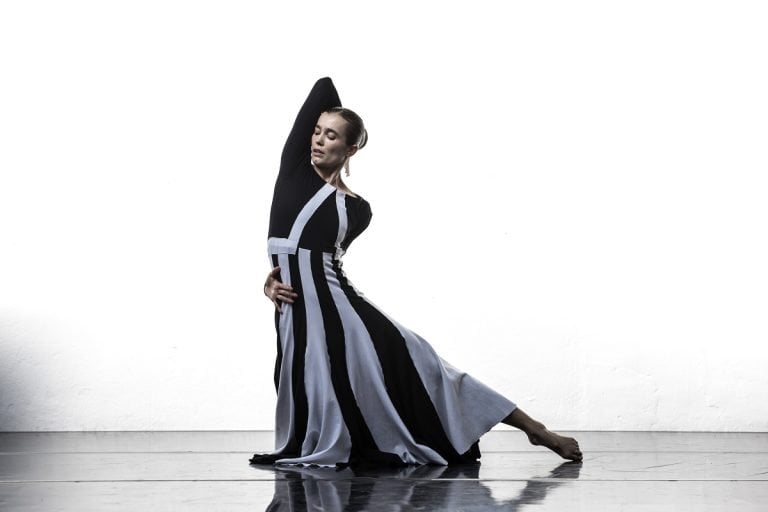
Kirill Radlev is an émigré Russian choreographer, now based in Spain, and his is certainly a name to follow for the future. I have fond memories of his At Sunset duet (performed at the Ballet Icons gala in 2021) by Léonore Baulac and Mackay (clearly a muse) and witnessing the expansion of his choreographic palette to a full-length ballet while utilising such diverse musical influences was yet further evidence of a major talent in development. His solo choreography made full use of the classical skills of the lead dancers, notably the virtuoso powerhouse of Mackay’s relentless artillery of jumps and ferocious spins and the exceptional port de bras and beautiful line of Fernandes Menes. Their several pas de deux were both passionate and precisely partnered, a combination that was mesmerising in its absorbing and romantic impact.
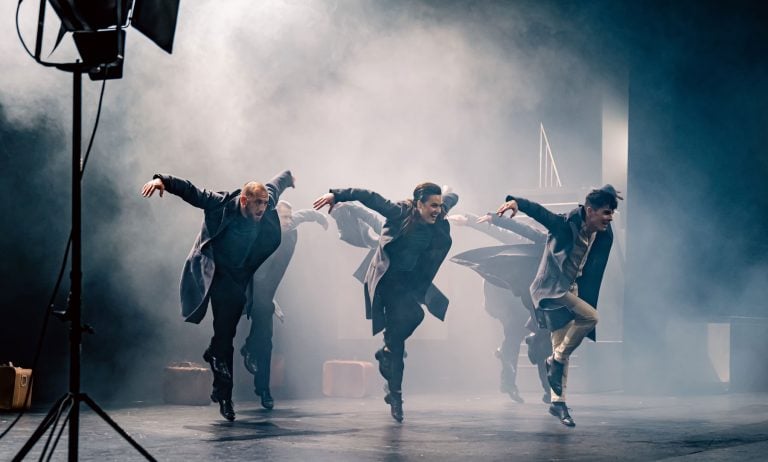
I was also impressed by the Astana Ballet Theatre corps and soloists. Their unity of movement in the ensemble sequences was exceptional and, unusually, Radlev choreographed some group sequences as if they were a dozen simultaneous pas de deux, framed around the principal couple, involving long sequences of MacMillanesque power with more lifts than Schindler! Radlev’s group choreography in the (tastefully observed) orgy scene early in the second act was remarkable for the symbiotic flow of the large ensemble.
Unfortunately, the biggest disappointment on the opening night came with the poor sound quality that made much of Lambert’s opening monologue inaudible and produced odd clicks and bangs during the early scenes – a problem I suspect that comes with a late get-in to an unfamiliar theatre. For reasons unknown to me, Lambert did not reappear for the second show and the role of the narrator was taken offstage with Mackay himself providing the live voiceover in the style of an ageing cowboy (hailing from the hinterland of Yellowstone in Montana, Mackay spoke with real-life experience – Kevin Costner could not have done it better) and it was a great improvement on the previous evening. It’s a substitution that should be kept for future performances.