Ratmansky and Peck world premieres in New York City Ballet 2025 Winter Season

New York City Ballet 2025 Winter Season highlights:
World Premiere Ballets by NYCB Resident Choreographer JUSTIN PECK and NYCB Artist in Residence ALEXEI RATMANSKY
A Centennial Tribute to NYCB ballerina MARIA TALLCHIEF to honour the 100th Anniversary of her birth
The return of CHRISTOPHER WHEELDON’S Carnival of the Animals with JOHN LITHGOW in the Role of the Narrator
The 2025 Winter Season concludes with 13 performances of PETER MARTINS’ production of Swan Lake
New York City Ballet‘s 2025 Winter Season opens on Tuesday 21 January 2025 and continues for six weeks at the Lincoln Center.
The Winter Season will feature 20 ballets including world premieres from Justin Peck and NYCB Artist in Residence Alexei Ratmansky. All performances will be accompanied by the 62-piece New York City Ballet Orchestra under Music Director Andrew Litton.
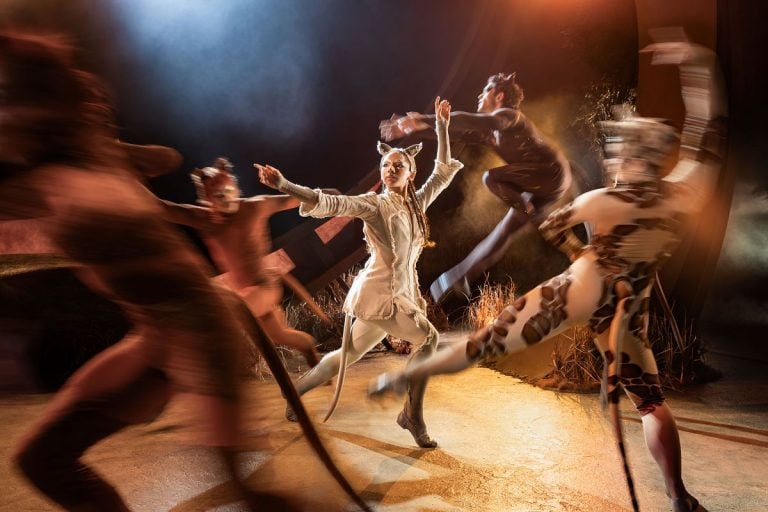
The season will also feature two works by Christopher Wheeldon – two-time Tony Award-winning choreographer and director and former dancer with NYCB – who was the Company’s Resident Choreographer from 2001 to 2008. These works will include Carnival of the Animals featuring actor John Lithgow who will reprise the role of the Narrator, which he created for the world premiere of the ballet in 2003. Lithgow is also the author of several books for children and wrote the text for Wheeldon’s Carnival of the Animals, which was later adapted into a children’s book.
Set to Camille Saint-Saëns’ musical suite, Wheeldon’s ballet features a cast of nearly 50 dancers, with Lithgow’s narration telling the story of a young boy who falls asleep in New York’s Museum of Natural History and dreams that the people in his life have been transformed into animals. The production has set and costume design by Jon Morrell and lighting design by Natasha Katz.


The 2025 Winter Season will open on 21 January with a programme of works by NYCB co-founder George Balanchine. Concerto Barocco, Allegro Brillante, and Brahms-Schoenberg Quartet are three of twelve works by Balanchine that NYCB will perform during the six-week season.
The second night of the season will feature an all-Stravinsky programme featuring two works by Balanchine – Danses Concertantes and Stravinsky Violin Concerto – and two works by NYCB co-founding choreographer Jerome Robbins – The Cage and Concertino.
Additional repertory for the 2025 Winter Season includes Balanchine’s Divertimento No. 15 and Tchaikovsky Pas de Deux. The season will close with 13 performances, from 19 February until 2 March, of Tchaikovsky’s Swan Lake, staged by the Company’s former Ballet Master in Chief Peter Martins.
Originally choreographed for the Royal Danish Ballet in 1996, the production features sets designed by the late Danish artist Per Kirkeby, costumes by Kirkeby and Kirsten Lund Nielsen, and lighting by NYCB Resident Lighting Designer Mark Stanley.


2025 Winter Season World Premieres
Justin Peck
The first World Premiere of the 2025 Winter Season is a new work by Justin Peck on 29 January. His new ballet is called Mystic Familiar, set to an original score from Dan Deacon, whose “USA I- IV” from his 2012 album America provided the score for Peck’s 2017 ballet The Times Are Racing.
Deacon’s new orchestral score for NYCB is an expansion of his song Become A Mountain; Peck previously used the song for a ballet of the same name created for the Juilliard Senior Class of 2022, and a short film he created for the athletic shoe brand On. For all winter season performances of Mystic Familiar, Deacon is scheduled to perform as a guest artist with the NYCB Orchestra. Peck said:
I’ve been wanting to create a new work for NYCB with a commissioned score by Dan since The Times Are Racing, and I’m thrilled that he’ll be joining the company for the premiere performances.
The set design for Mystic Familiar will feature a backdrop by the Los Angeles-based visual artist Eamon Ore-Giron, the costumes are by fashion designer Humberto Leon, who previously worked with Peck on costumes for The Times Are Racing and several other projects, and with lighting design by frequent Peck collaborator Brandon Stirling Baker.
Alexei Ratmansky
The second World Premiere of the Winter Season is by Alexei Ratmansky and will premiere on 6 February on a programme with Robbins’ In the Night and Balanchine’s Symphony in Three Movements. For this new work, Ratmansky will stage a suite of dances from Marius Petipa‘s full-length Paquita that incorporates the ballet’s Grand Pas from Petipa’s 1881 staging of Paquita, as well as Balanchine’s Minkus Pas de Trois, Balanchine’s restaging of Petipa’s pas de trois from Paquita, which was created in 1948 for the Grand Ballet du Marquis de Cuevas and restaged for NYCB in 1951. NYCB has not performed the Minkus Pas de Trois since 1993.
Originally choreographed by Joseph Mazilier for the Paris Opera Ballet in April 1846 to a score by Édouard Deldevez, Paquita was restaged by Petipa one year later for St Petersburg’s Imperial Ballet, which also marked the first work that the French-born ballet master staged in Russia. In 1881, Petipa revived the ballet and added new pieces of music composed by Ludwig Minkus, including some additional music for the pas de trois in the first act and the grand pas in the last act.
In 2014, Ratmansky, in collaboration with historian Doug Fullington, choreographed a reconstruction of Paquita for the Bayerisches Staatsballett in Munich, working from the Stepanov notations created by Mariinsky Theatre regisseur Nicholas Sergeyev held at the Harvard Theatre Collection at Houghton Library, which provided a detailed record of how the ballet was performed in the early 20th century, during Petipa’s lifetime. For the winter season premiere, Ratmansky will create a new work that is unique to NYCB using the extensive research he did for the 2014 reconstruction as a starting point, incorporating details from the staging by Alexandra Danilova of the Paquita Grand Pas for Cincinnati Ballet in the early 1980s; 1890s drawings of the Grand Pas principal couple by Mariinsky Ballet premier danseur Pavel Gerdt from the Bakhrushin Museum in Moscow; as well as Ratmansky’s own contributions. Ratmansky said:
Paquita is a jewel of a ballet, full of intricate steps, refined musicality, and gentle humour. Petipa’s choreographic universe has a Ballerina at its centre; he makes her shine but also challenges her.
Technically and artistically that makes him akin to Balanchine, and that’s where the idea of combining Mr. B’s Minkus Pas de Trois, a reworking of Petipa’s Act I pas de trois, with Petipa’s Act III Grand Pas came from. I am very excited to see how these two worlds divided by the artistic revolution of the early twentieth century will coexist today.
The costumes for the new work will be designed by Jérôme Kaplan, who will be working with NYCB for the first time. Kaplan has designed several ballets for Ratmansky, including the 2014 reconstruction of Paquita, as well as his full-length productions of Swan Lake, Don Quixote, and Coppélia. Mark Stanley will create the lighting.


Tallchief Centennial Programme
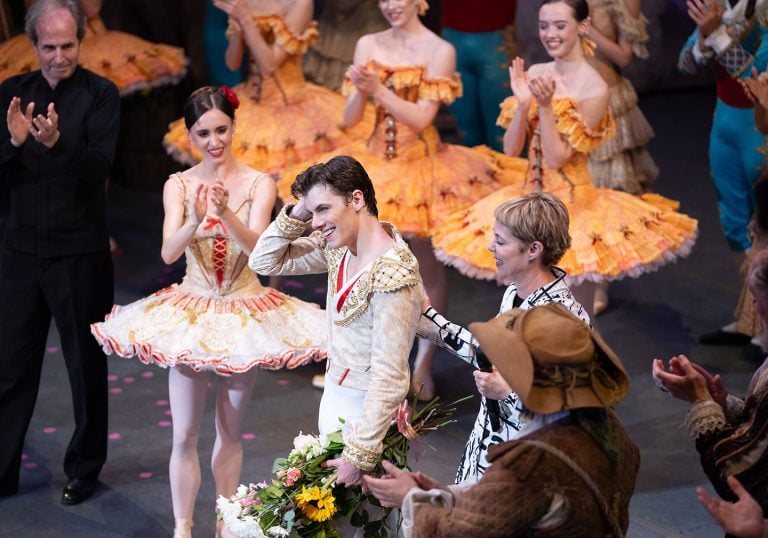
The 2025 Winter Season will also include a special programme in tribute to the 100th anniversary of the birth of the legendary American ballerina Maria Tallchief, a founding member of NYCB and George Balanchine’s first wife. Tallchief, of Osage descent, was born in Fairfax, Oklahoma on January 24, 1925, and moved to New York at the age of 17, first dancing with the Ballet Russe de Monte Carlo, where she met Balanchine, and later with Ballet Society, a precursor to New York City Ballet.
With the founding of NYCB in 1948, Tallchief became the Company’s best-known dancer during its early years and went on to create some of Balanchine’s most important roles, including the Sugarplum Fairy in the choreographer’s production of The Nutcracker in 1954.
For the Tallchief centennial programme, which will debut on Wednesday 5 February, NYCB will dance three Balanchine ballets created for and closely associated with the ballerina: Scotch Symphony, choreographed in 1952 to music by Felix Mendelssohn; Sylvia: Pas de Deux, from 1950 with music by Léo Delibes and last performed by NYCB in 1994; and Firebird, choreographed in 1949 to Stravinsky’s score, and the role that made Tallchief a star.
For complete programme information visit nycballet.com

Graham Spicer, aka ‘Gramilano’, is a writer, director and photographer based in Milan. He was a regular columnist for Opera Now magazine and wrote for the BBC until transferring to Italy. His articles have appeared in various publications from Woman’s Weekly to Gay Times, and he wrote the Danza in Italia column for Dancing Times magazine. Graham was the historical advisor on Codice Carla, the 2023 documentary on Italian ballerina Carla Fracci.
Graham also works as a dance photographer, and his photos have appeared in many books, theatre programmes, and magazines, including Dancing Times, Dance Spirit and Ballet2000, as well as all the major Italian newspapers.
He is a member of the Dance Section of The Critics’ Circle.