Review: Ismaël Mouaraki’s Le sacre de Lila with Destins Croisés – “an exquisite care to detail”

Graham Spicer sees Ismaël Mouaraki’s ‘Le sacre de Lila’ with a company of eight from Québec and Morocco exploring trance and spirituality.
| Title | Le sacre de Lila |
| Company | Destins Croisés |
| Venue | MilanOltre | Teatro Elfo Puccini |
| Date | 12 October 2024 |
| Reviewer | Graham Spicer |
French-Moroccan-Canadian choreographer Ismaël Mouaraki, inspired by the Lila (Arabic for “night”) ceremonies – traditional Moroccan mystical and musical celebrations – created La sacre de Lila (‘The Rite of Nite’, if you will) to explore “trance and spirituality”. The piece is from 2022 and celebrates the 20th anniversary of his company, Destins Croisés, and 25 years since Mouaraki’s first choreographic work.
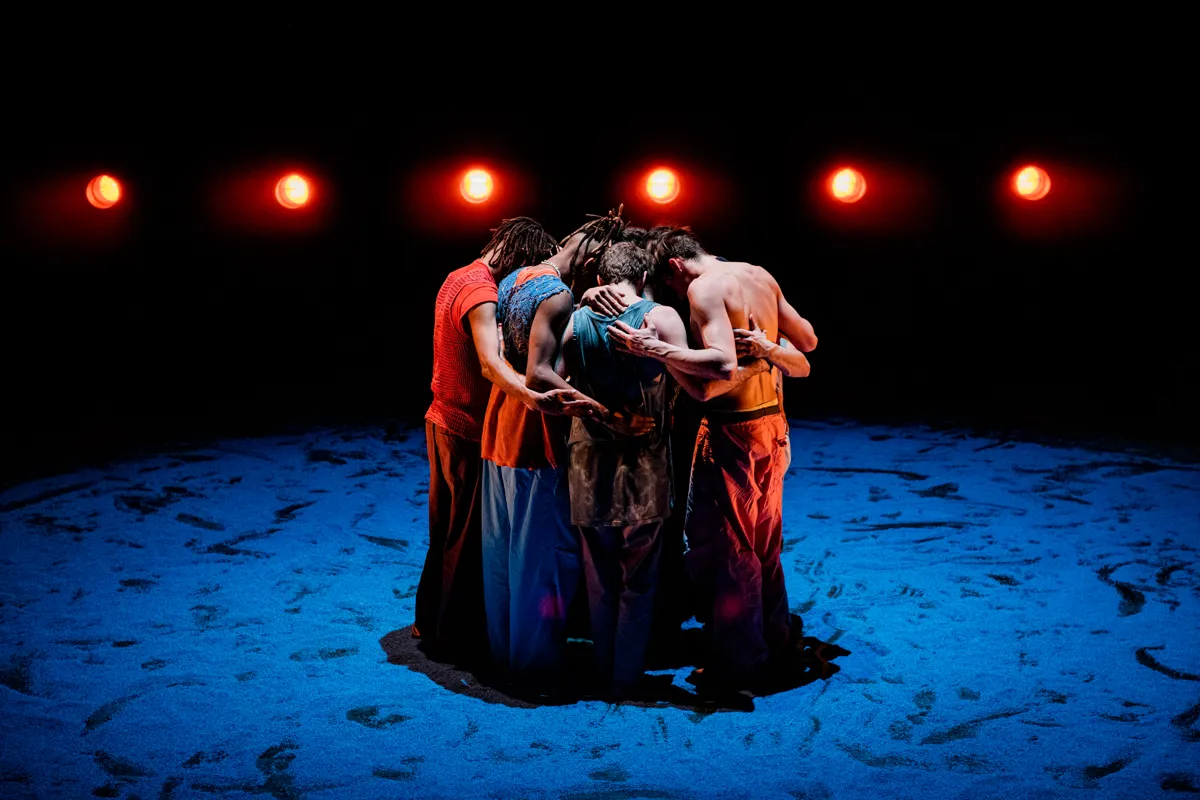
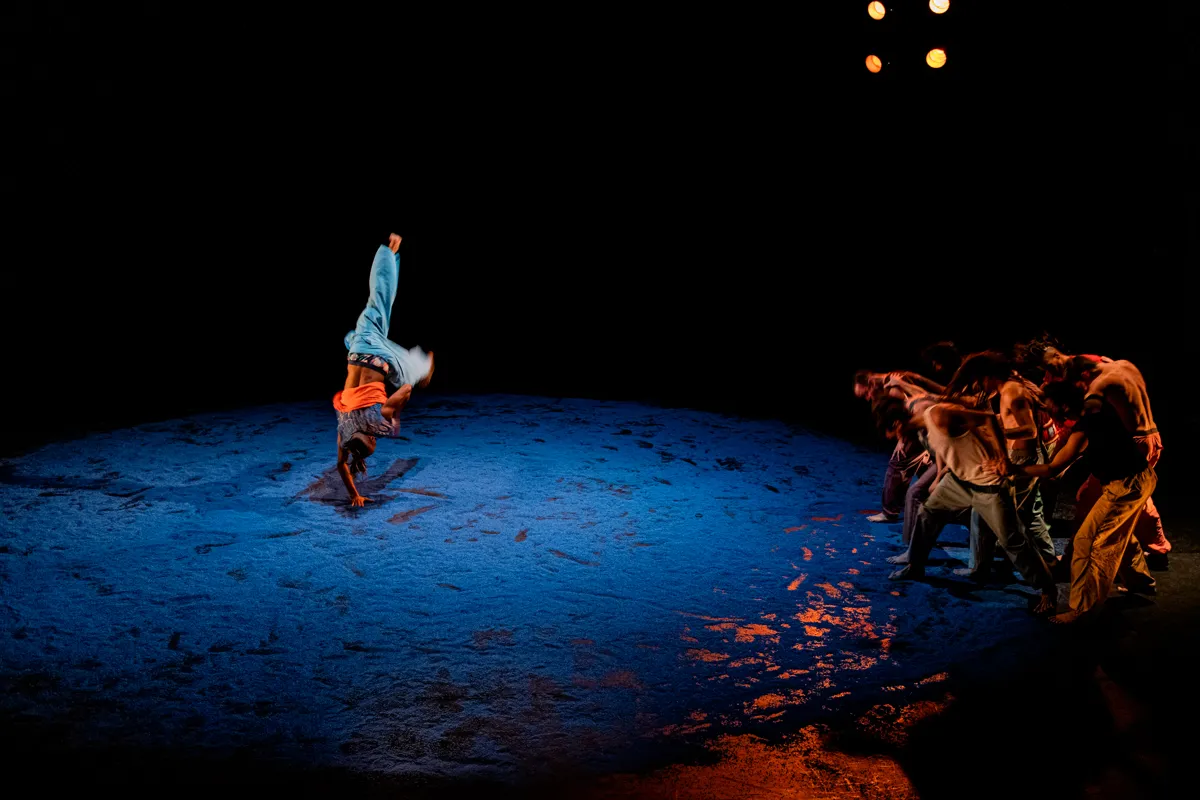
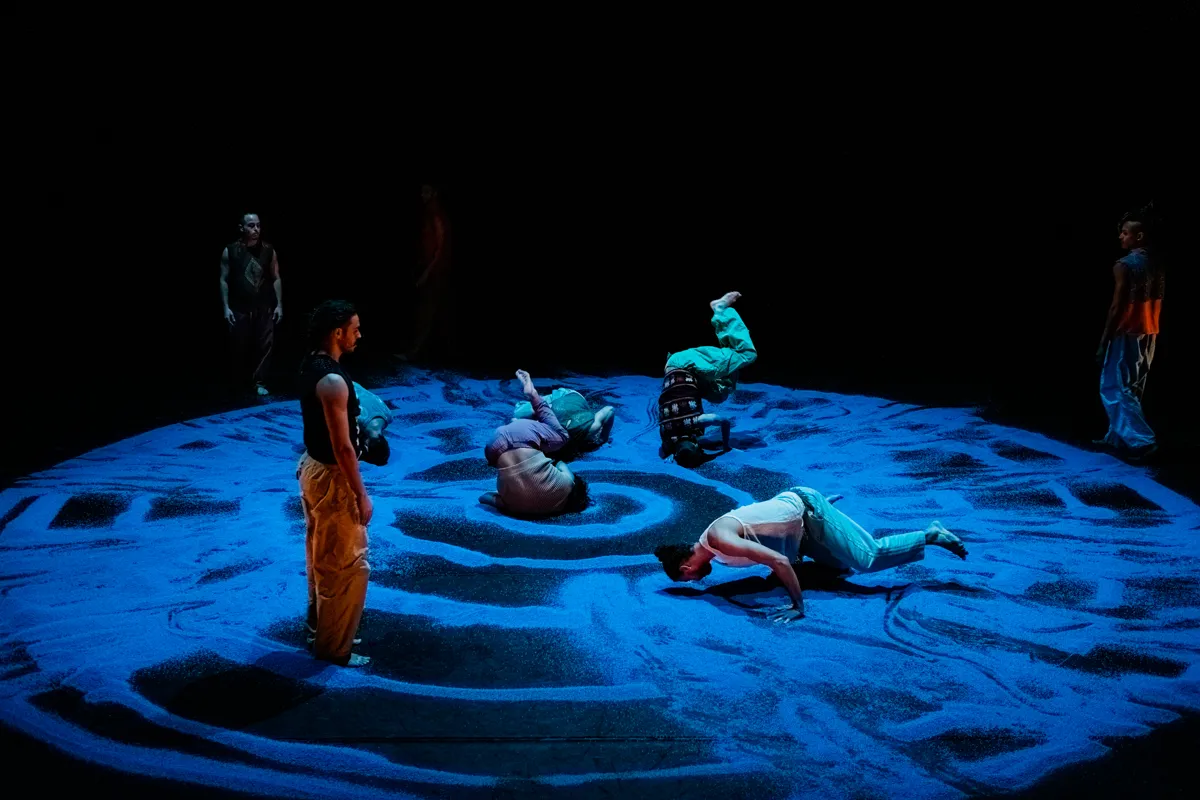
Eight male dancers in a circle carry bags of blue sand that they empty to trace a spiral that covers the entire dance floor. The sand pattern doesn’t last long as soon they are throwing themselves into it, spinning on their backs in it, and whipping it with their hair.
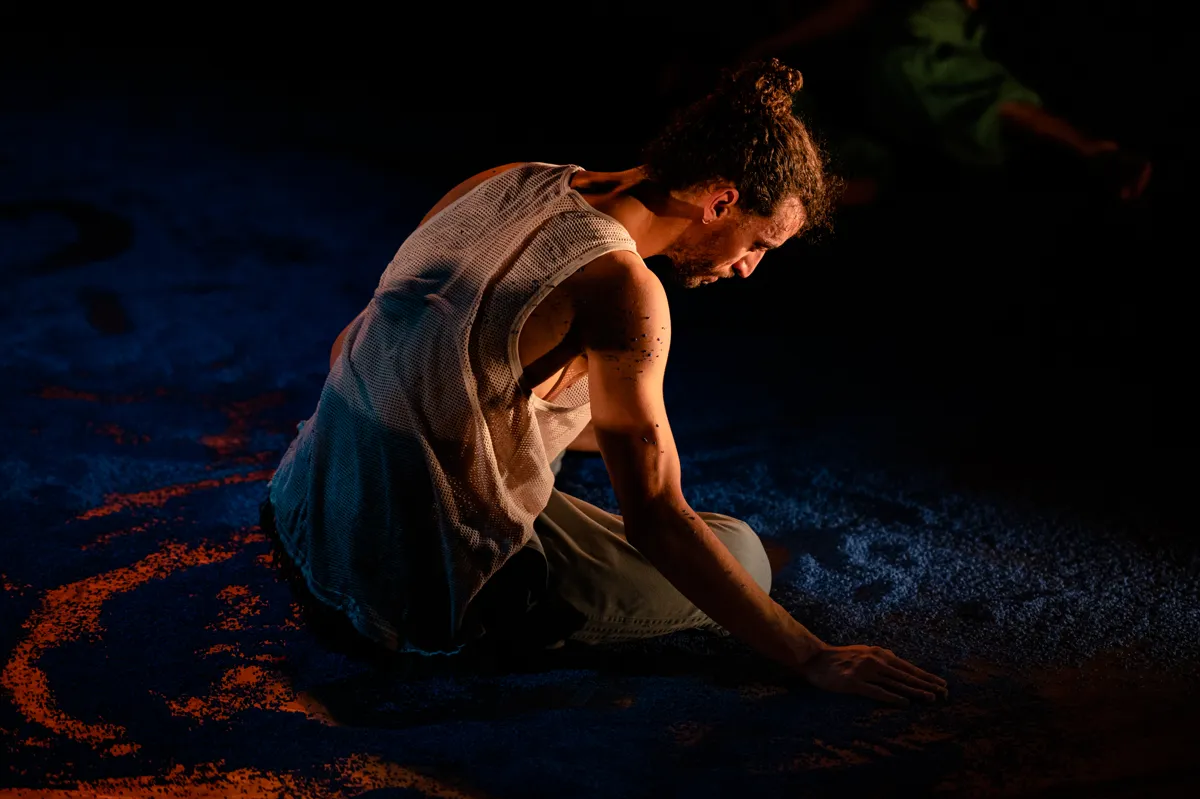
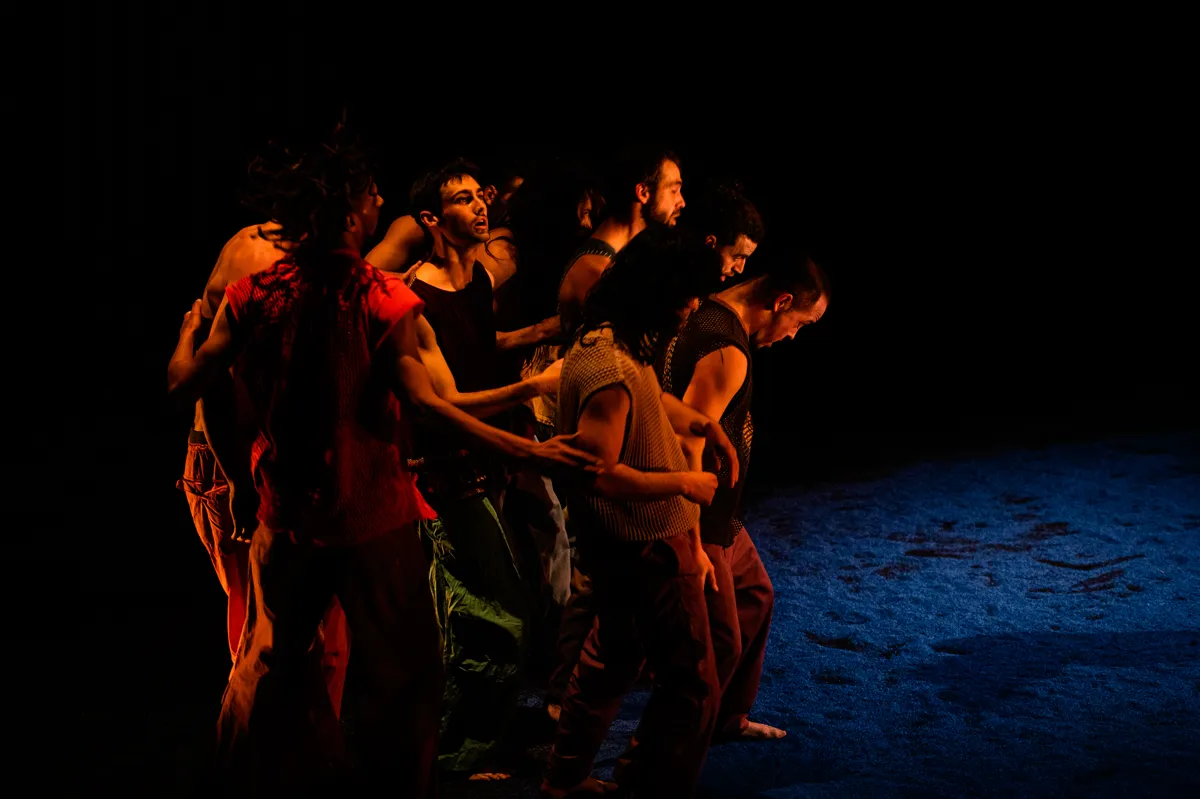
The blue sand – in fact, small rubbery plastic pieces that allow the dancers to perform on it without slipping – instantly conjures up the atmosphere of a desert at night. The men, from Québec and Morocco, use many street dance moves but also dance in groups and pairs. A homoerotic undercurrent is evident from the first duos, with head-to-head, and almost mouth-to-mouth, intimacy. Three smaller men are usually the ones lifted and manipulated around the bodies of the taller dancers. One bare-chested man in particular (I’m guessing, but I think he’s Danny Morissette) had a very touching and finely controlled duo with Léo Coupal-Lafleur (again a guess). Morissette was one of the busiest of a very busy company – there were few pauses after the initial sand sprinkling. He has certainly been trained in classical dance, though he was pliable and uninhibited in his contemporary dance moves, and often dominated the scene.

The programme notes informed us that the piece was about ‘spirituality,’ and it was easy to draw connections between movement, lighting, and grouping that reflected this. But one oft-repeated theme saw a single dancer, seemingly improvising his hip-hop moves, joined by others in a perfectly coordinated sequence — suggesting that individual happiness and well-being can lead to harmony in a group.
There is an exquisite care to detail, which is satisfying when even in large opera houses wrinkles on a backcloth are tolerated, dancers come out of character when still in view of the audience, and lighting can be sloppily remounted.
Canadian guitarist and composer Antoine Berthiaume included Arab motifs (maybe traditional tunes) in his score with recorded male vocals supplemented by the dancers themselves, most notably by the impressive Moroccan B-Boy Yassine Khyam.
However, even being close to the stage, it was odd not to feel fully immersed emotively in the work – and I’m always very willing to be sucked into a dramatic situation. I watched appreciatively, and I was thoroughly engaged and absorbed by the performance, but – although satisfied by all other aspects – I was left emotionally indifferent.


Graham Spicer, aka ‘Gramilano’, is a writer, director and photographer based in Milan. He was a regular columnist for Opera Now magazine and wrote for the BBC until transferring to Italy. His articles have appeared in various publications from Woman’s Weekly to Gay Times, and he wrote the Danza in Italia column for Dancing Times magazine. Graham was the historical advisor on Codice Carla, the 2023 documentary on Italian ballerina Carla Fracci.
Graham also works as a dance photographer, and his photos have appeared in many books, theatre programmes, and magazines, including Dancing Times, Dance Spirit and Ballet2000, as well as all the major Italian newspapers.
He is a member of the Dance Section of The Critics’ Circle.