Review: Pina Bausch’s Vollmond – you’ve got to see it to believe it

Matthew Paluch sees Pina Bausch’s Vollmond – “Two hours of unpredictable, avant-garde work ranging from nonchalant comedy turns to pure dance.”
| Title | Vollmond |
| Company | Tanztheater Wuppertal Pina Bausch + Terrain Boris Charmatz |
| Venue | Sadler’s Wells, London |
| Date | 14 February 2025 |
| Reviewer | Matthew Paluch |
Two men enter the stage, arrive centrally, and then proceed to execute a large swooping action with their entire bodies: soft knees and a generous swooshing arc of the arm. The movement is simple and beautiful, and enhanced by the object they’re both holding – an empty, plastic water bottle.
Each time they swoop, physics comes into play. Air enters the bottle and makes an eery whooshing sound. The action is repeated numerous times and then taken over by the whacking of a large stick. The sound quality is similar but becomes more pointed, aggressive.
Who else would have the bravery to start a work with such simplicity? Develop material solely with an end point agenda? Use by-product sound to establish an environment that evokes mystery and violence at the same levels? Create material that immediately pulls the observer into a deeply focused, sensory state? Only Pina Bausch I’d argue.
Tanztheater Wuppertal Pina Bausch + Terrain Boris Charmatz are currently at Sadler’s Wells performing her 2006 work Vollmond, and basically, you’ve got to see it to believe it.
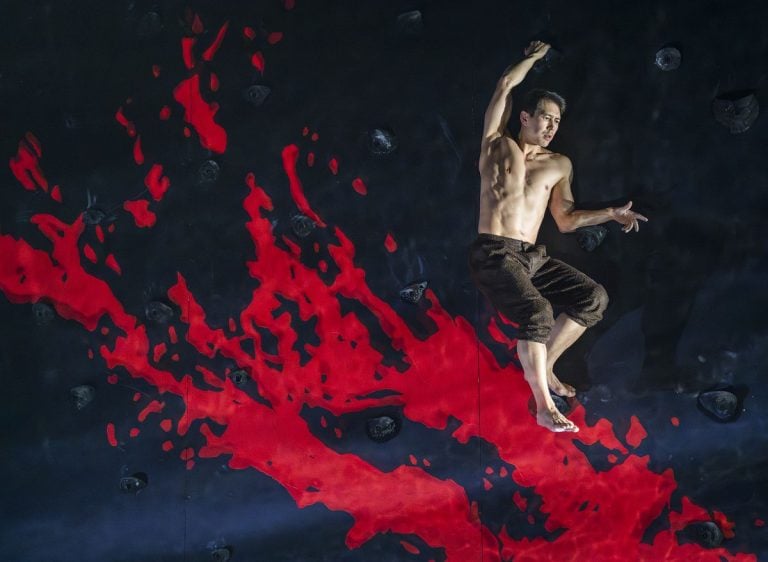
Bausch always pulls a crowd. The Wells feels different when the company are in town – buzzy and full of anticipation, and Vollmond is anything but a disappointment. It’s basically two hours of unpredictable, avant-garde work ranging from nonchalant comedy turns to pure dance verging on physical theatre, that at times segues into the realm of extreme sport.

As one enters the theatre a giant rock sits on the stage. The prop of all props. It’s sheer size alone, awesome in its own right. One doesn’t realise immediately, but the floor it sits on is in fact a pool of water say some six inches deep. H20 features elsewhere with different types of rain arriving throughout the performance. Some heavy, some the finest of mists, at times a solitary drop (accident or premeditated?). Towards the end of the work, the dancers use plastic bowls to collect water to thrash at the rock. As the water is thrown it ricochets off the hard surface creating murmurations that become choreography in their own right. Waterography?
If we understood the genius that is Bausch, then there would be one around every corner. This, obviously, isn’t the case. And if one was brave enough to try and explain why her work still has such originality, the conversation would discuss her structural freedom, from absurd to deadly serious; her dynamic range, from intimate to bombastic; and of course the performers.
Bausch’s intention is undoubtedly to access her understanding and ongoing analysis of humanity, but it’s the performers that bring it to life – be they the original collaborators, or later casts like the one currently in charge of communicating the masterpiece. Not once throughout does one feel a sense of people doing ‘someone else’s work’ – what’s offered feels authentic, embodied and of the most importance to the performers. And to be part of Bausch’s company you have to be so much more than a dancer. You need to be able to hold space, act and throw yourself about with zero second-guessing.
The work ranges from light comedy to heavy emotion, and all that’s in between. The cast often talks directly to the audience offering proverbs without lecturing, to each other to share instructions, and to themselves. The latter takes on an element of catharsis, be it hysterical laughter, weeping or simple information: “I wait… I weep”. I’m still trying to work out the lady walking across the stage, hitting her back with a coat hanger and then rewarding herself with a bite of carrot. Anyone?
As entertaining as the absurdity of the work is, it’s still the dance passages that have the biggest impact on my own experience. The movement language isn’t groundbreaking per se, but it’s just done so well and seems to never repeat. Each phrase offering a new combination of dynamics, details and forms. Gesture features throughout, as does suspension, floorwork and the vast covering of space. In Vollmond I was also struck by the material for the male dancers. Bausch’s work can often conjure notions of the female (see below), but in this piece the men have solos that emphasise aspects of sensitivity and intimacy – and they are executed extremely well.


Bausch’s canon features a certain kind of woman, basically her – tall, willowy, long hair, and generally in a dress (ballgown or silk slip) wearing stilettos. It’s a beautiful silhouette – but can start to feel one-dimensional in a two-hour work. To be clear, there is some range of height and body type in the cast. But in general, the (notion of the) Bausch woman continues as she is. In one section the cast sport swimwear, the men with bare feet, yet the women still in high heels. In that moment I felt like an audience member in a 20th century beauty pageant.
Elsewhere the women can feel like objects – being slapped around, vigorously shaken, then kissed, having a bra undone, breasts being exposed due to thin straps or damp material. Even in the partnering, predictability abounds – woman in silk dress and stilettos being lifted and rotated in slow motion like a powerless object.
I realise I’m a man, thinking and saying the above. So perhaps the issue is mine alone, and my male gaze is to blame. And some would say I’m being woke or a snowflake. I’d argue I’m explaining what I felt – and not suggesting it’s right, or the only way to read the work. And for the naysayers, fear not, there’s a momentary glance of penis if you’re quick, so perhaps the men (well man) are suffering from a similar fate. They definitely all fit into a recognisable fold also – somewhere between Gene Kelly and Adrien Brody.
For any reservations, the work has to be seen to be experienced. You don’t often find full nights of contemporary dance. Generally, it’s 60 mins-ish, then home. Yet with Vollmond there’s a 20-minute interval before embarking on the second half. Even in the longer passages one can just sit back and wonder at the technical wizardry of the work – where else do you see a dancer floating on a Lilo across a mini stage lake before disappearing under a giant rock only to re-emerge on the other side and vanish into the wings?!
That said, my companion did look at their watch some 10 minutes before the night came to a close. No comment.