
Review: Valentino Zucchetti’s The Nutcracker for New English Ballet Theatre

Lily Hyde sees Valentino Zucchetti’s production of The Nutcracker for New English Ballet Theatre – it’s a show with heart.
| Title | The Nutcracker |
| Company | New English Ballet Theatre |
| Venue | Sainsbury Theatre, LAMDA |
| Date | 18 December 2025 |
| Reviewer | Lily Hyde |
A couple of weeks ago, I interviewed Valentino Zucchetti – First Soloist of The Royal Ballet – about his production of The Nutcracker for New English Ballet Theatre. The first full-length production for both the company and choreographer, Zucchetti spoke with a calm authority about the changes made and the rather harsh confines the show had to operate within (not least a small company and small budget) but part of me was unconvinced – how can you take the most famous ballet in the world, condense the runtime to ninety minutes, perform it with a cast of fourteen dancers and have it work?
It is, therefore, an absolute delight to report that not only does Zucchetti’s production succeed – it does so with just twelve dancers.
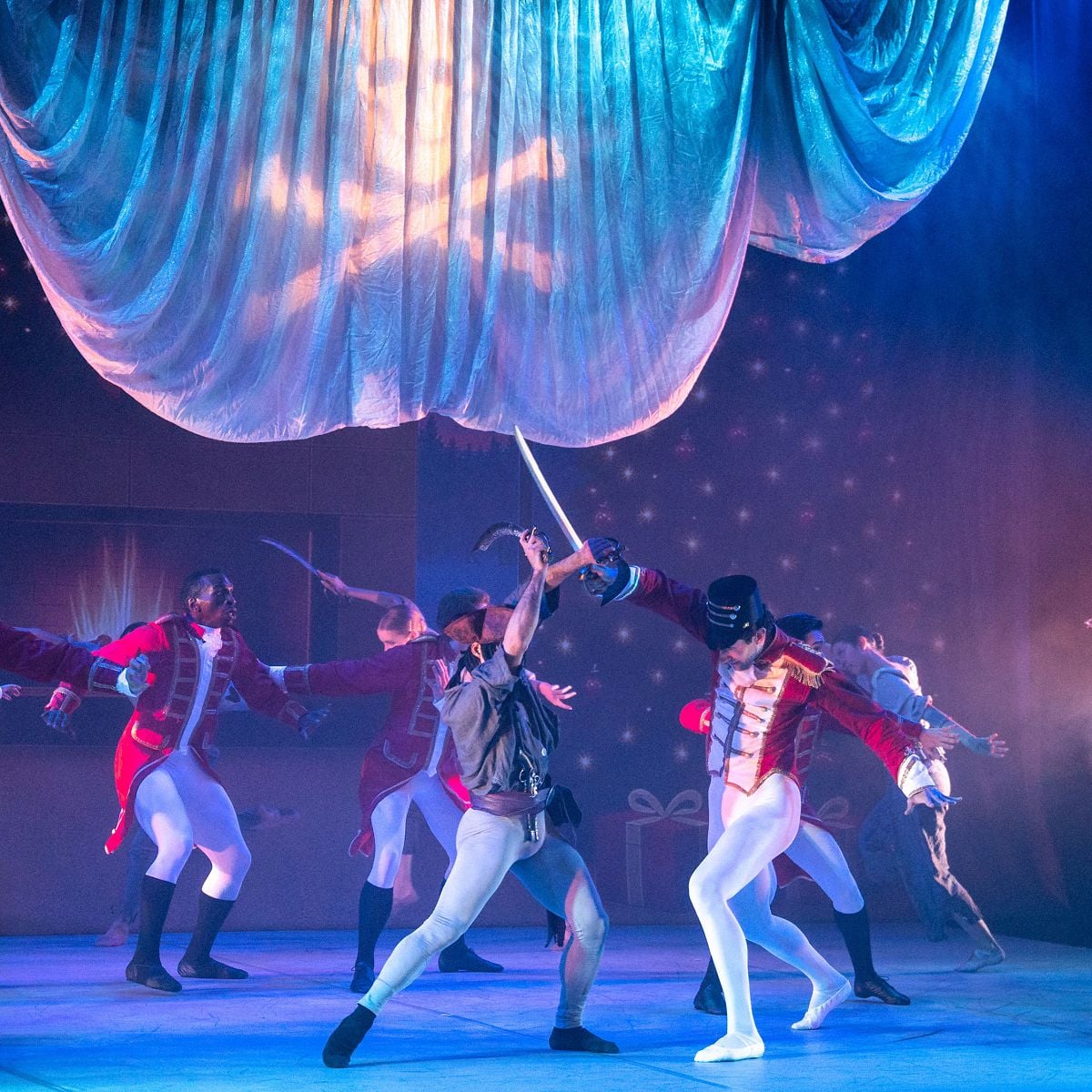
The story starts in the present day(ish), with Derren, the Drosselmeyer character (named after Derren Brown, the British “psychological illusionist”, no less), packing presents – a nutcracker for Clara, and a ship for her pirate-obsessed brother, George. Played by Paul Meneu, he leaves the stage in a fantastic coat and gives the audience a cheeky, assured wink.

As previous reviewers and Zucchetti himself have said, the party is a little sedate, but if the party is the highlight of The Nutcracker, then it’s a failure. Once the solos (and not the younger guests’ attempts at The Running Man and Macarena) start in earnest, it’s exciting to watch. Usually played by Drosselmeyer’s dolls, the production substitutes the soloists who have been hypnotised by Derren into performing. Fluid and dynamic, Rebecca Arias’s solo in particular was a clear standout, and despite the hypnosis bringing an unintentionally sinister undertone, there is enough within the party for it to be consistently entertaining.
Apart from a couple of audio glitches, the cuts were smoothly done, and the grandparents, usually played by ballet school graduates who’ve taken a kohl liner to their forehead, were not missed. Such was the quality of the dancing that neither was the growing Christmas Tree. Performed in the small 220-seat Sainsbury Theatre at LAMDA (London Academy of Music & Dramatic Art), such a transformation wouldn’t be possible, but in its place was a pirate ship, cleverly brought to life with a sheet, projections and a lot of dry ice. Despite the limitations of the production, it is considered and has so much heart that it’s impossible not to be charmed by it.
Zucchetti has a wonderful choreographic quality where his work is able to fill the music. There is not a note or movement wasted, but at the same time, his work has great potential for scalability; its ambition is ferocious.
The pas de deux between Clara and the Prince genuinely wouldn’t look out of place in a major production, and I would go as far as to say that it is better than some currently being performed in some of the biggest opera houses in the world.


Indeed, the Waltz of the Snowflakes filled the stage more effectively with ten dancers than other productions do with twenty-four, and though it may have been a necessity that forced the production to have male dancers as Snowflakes, they immediately fitted in and brought a dynamic airborne quality to the piece. Some of the formations were a little weak and may have benefited from more rehearsal time, but I recognise that’s a privilege the company might not have.
The individual performances were incredibly strong. Audrey Nelson brought a radiant youthfulness to Clara, and Hiroki Takano brought a steely confidence and sweeping lines to his Nutcracker. Leila Wright, pulling double duty as the Snow Queen and Flower Queen in Act Two, brings a commendable strength and authority to both (a nice follow-through from her work in Act 1 as Clara’s mother).
The divertissements, here neatly based on the presents the party guests received in the first act, were nicely done. Rebecca Arias held her own in the Fan solo and could well be a Kitri of tomorrow. The Russian Hat dance, brought to life with ferocity by Paul Meneu and Louis DeFelice, was such a celebration of the male form that I would be curious to see what Zucchetti would produce if he choreographed a piece just for male dancers. The Champagne and Coffee dances felt a little sticky in places, but perhaps this wouldn’t be as noticeable were the audience not mere feet from the dancers.
Again, Zuchetti’s choreography for the Waltz of the Flowers fills the music beautifully, and is a spectacle that wouldn’t look out of place on a stage five times its size, nor would the dazzling costumes by Lisa James. The Sugar Plum Fairy pas de deux is energetic, dynamic and entirely new. The Sugar Plum Fairy’s solo, danced by Audrey Nelson with a blithe ease, felt the closest the choreography came to Peter Wright‘s, but Zucchetti’s choreographic voice is strong enough for it to have felt like a gentle nod rather than overt imitation.
The Final Waltz and Apotheosis highlight what a feat this production is as dancers revive multiple roles, sometimes changing within mere seconds. For all the production’s efficacy and legerdemain, it’s a show with heart whose classical ballet form remains no less pure or enchanting.
In an age of surge pricing and cuts to arts funding, productions like NEBT’s have never been more important to preserving and sharing the art form. Having heard about rumours about venues for a tour next year, I am certain that this production will entertain audiences across England and abroad for many years to come.

Lily Hyde is a cultural and dance writer based in London. Her writing has appeared in The Fence and The Creative Independent, and she runs the cultural newsletter, Falling Upwards. She is currently writing her first novel.


Bravo Valentino!!
I’ve usually discovered that “limitations” often lead to inspiring imagination and creativity.