Review: The Bloom Prize with Stav Struz Boutros, Leïla Ka, and Wang Yeu-Kwn

Graham Watts sums up The Bloom Prize 2025 with works from Israel (Stav Struz Boutros’ Sepia), France (Leïla Ka’s Maldonne) and Taiwan (Beings by Wang Yeu-Kwn).
| Title | Stav Struz Boutros: Sepia Leïla Ka: Maldonne Wang Yeu-Kwn/Shimmering Productions: Beings |
| Company | Various |
| Venue | Lilian Baylis Studio, Sadler’s Wells, London |
| Date | 29 January – 8 February 2025 |
| Reviewer | Graham Watts |
The Rose International Dance Prize has a younger sibling: The Bloom Prize, for choreographers with less than ten years’ experience. Three finalists in this global contest for emerging choreographers were in competition for a cash prize of £15,000 and a trophy designed by Es Devlin. They came from Israel (Stav Struz Boutros’ Sepia), France (Leïla Ka’s Maldonne) and Taiwan (Beings by Wang Yeu-Kwn and Shimmering Production). I was not surprised that there was no dance production from the UK on the shortlist for a prize that was sourced and developed in the UK.
In his speech announcing the awards, the chair of the judging panel, Professor Christopher Bannerman, spoke of the difficulty in choosing between apples and pears, adding in mangos and other fruit to expand the analogy. And that contrast was very evident where – at an hour’s duration – one finalist (Maldonne) was twice the length of the other two. The works could hardly have been more different.

.jpg "Shimmering Production Yeu Kwn Wang photo by CHEN Wei Sheng 微光製造王宇光個人照 攝影陳韋勝(彩色)")

I have no argument with Stav Struz Boutros winning for her honest and highly personal, self-performed solo. Her Georgian heritage has informed the development of a new dance language based on the movement conversation between conventional female Georgian dance (the Jeirani solo tells the story of a female hunter that is danced only by women) and by adapting Khorumi, a traditionally male folk dance, to a feminine form. Boutros wore an exquisite lime green costume, also inspired by her Georgian heritage, elaborately decorated with hundreds of pearls. Long-plaited hair extensions reached past her waist.
Boutros’ choreography contrasted with the conventional upright Georgian tradition by being frequently performed closer to the floor, her steps sweeping out from the hip in a squatting position, requiring lots of contact on the knees. The music for Sepia is a mix of Russian and Armenian folk songs.
Sepia was created during the pandemic as part of Boutros’ ongoing research about Caucasian and Soviet cultures, including the exploration of these ancient Georgian war dances. The work’s title means warrior and derives from her Georgian grandfather’s name, and the performance featured a sheathed knife that he gave to her, providing an element of both nostalgia and violence. Sepia, however, stands as a symbol of peace, with ritual and domesticity at the core of her long and arduous solo.
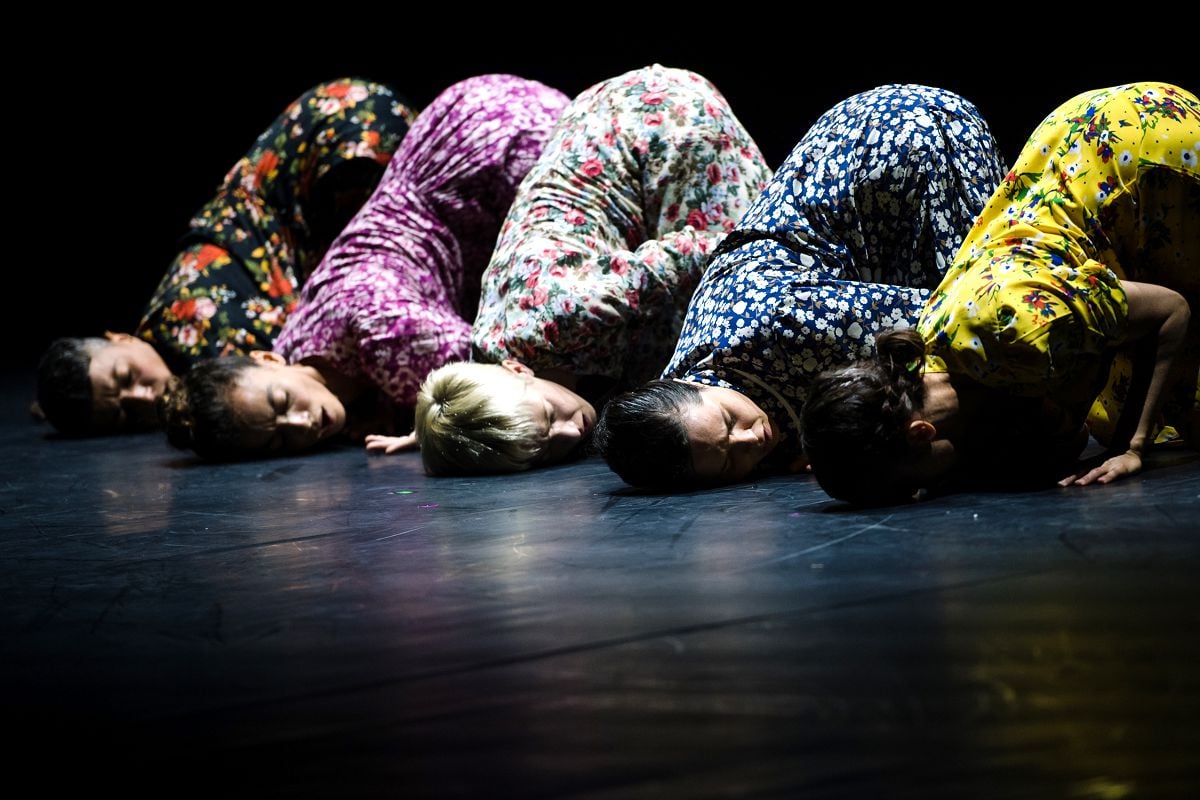
Maldonne involved five female dancers (including the choreographer) and 40 patterned, largely floral, dresses (all of which were bought from second-hand stores), which were not the only material of interest. It is a work that explores the difficulties of women freeing themselves, as Ka states in the programme note, ‘from all the things that confine us and make us feel stuck’. The choreographer could learn from the ‘less is more’ maxim since this seemed to be several works forced into one. The transitions between each section were not seamless and made the work seem deliberately episodic.
It started with the women standing in a row, not moving their feet, with anguished expressions and heavy breathing, their hands making gestures and feeling their faces, as if wiping away tears. This led into a sequence where the dancers fell and got up repetitively. Hooks were lowered from the ceiling on which dresses were hung and whisked up towards the flies. The stillness of the opening and closing sections contrasted with aggressive violence in the mid-section. There was also an incongruous episode where the dancers lip-synched as expressive torch singers, to Patti Page’s The Tennessee Waltz, in which the singer’s best friend steals her sweetheart!
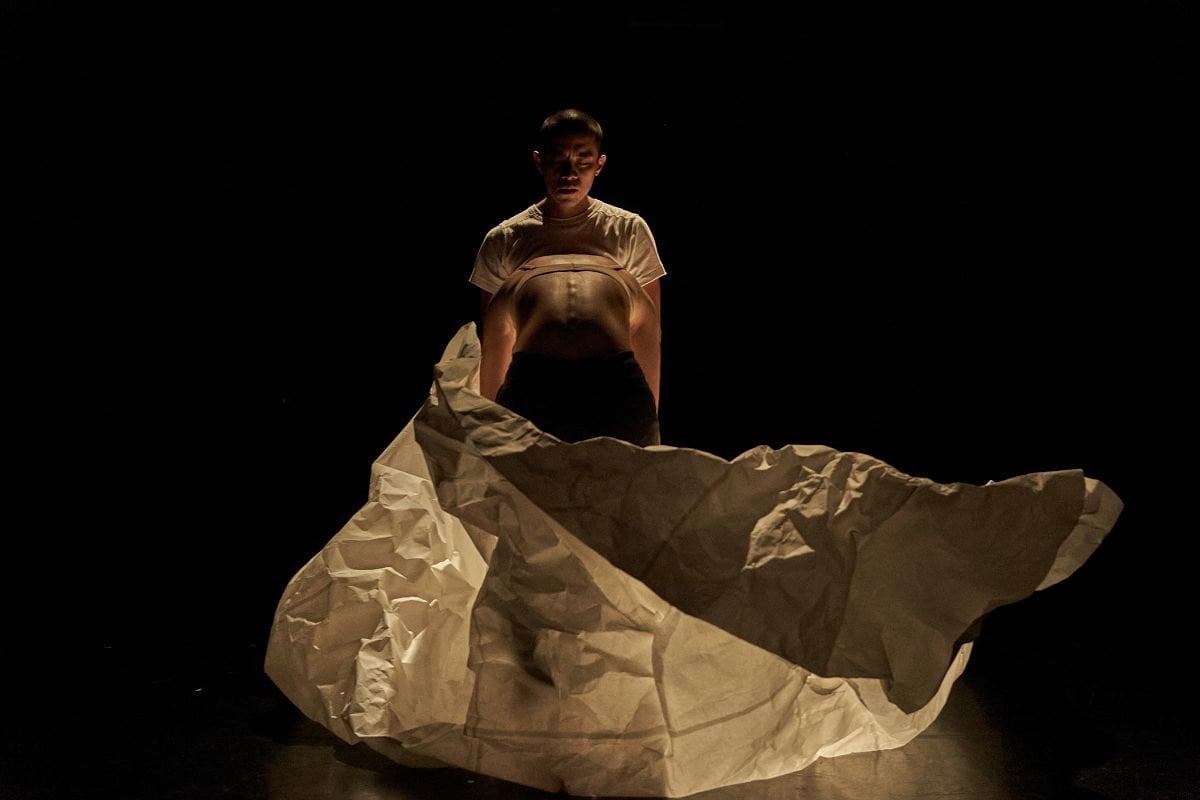
Beings was also dominated by striking visual imagery. The choreographer, Wang Yeu-kwn, entered onto the dark dance stage, carrying his partner, Lee Yin-Ying, on his shoulders. But they were both unseen, covered in a shroud of treated calligraphic rice paper. The resultant misshapen sculpture looked like a giant meringue!
Eventually they extricated themselves from the paper, which became a canvas for rough graffiti, including the drawing of a cute dog (raising a chuckle from the audience). The ink from the drawings transferred itself as tattoos on the dancers’ bodies and (so I read) the dancers cut down the rice paper after each performance to create cards, which are given as presents, with the name and date of the performance written on the back. This really was dance masquerading as visual art with actual art as a post-show offering!
When the dancers started to perform together, their partnering was intricate, with an emphasis on slow movement, weight transference and balance. It was fascinating dance, but all too brief a proportion within the work as a whole.
Each of the three finalists in The Bloom Prize are winners, having been elevated above thousands of contemporaries simply by being selected for this event. I suspect that we will hear much more about them all in years to come.


Graham Watts is a freelance writer and dance critic. He writes for The Spectator, Tanz, Shinshokan Dance Magazine (Japan), Ballet Magazine (Romania), BachTrack and the Hong Kong International Arts Festival and has previously written for the Sunday Express, Dancing Times, Dance Europe, DanceTabs, London Dance, the Edinburgh International Festival and Pointe magazine (USA). He has also written the biography of Daria Klimentová (The Agony and the Ecstasy) and contributed chapters about the work of Akram Khan to the Oxford Handbook of Contemporary Ballet and on Shobana Jeyasingh for the third edition of Routledge’s Fifty Contemporary Choreographers.
He is Chairman of the Dance Section of The Critics’ Circle and of the UK National Dance Awards and regularly lectures on dance writing and criticism at The Royal Academy of Dance, The Place and (until the war) for Balletristic in Kyiv. He was a nominee for the Dance Writing Award in the 2018 One Dance UK Awards and was appointed OBE in 2008.