
Review: Matthew Bourne’s Swan Lake – a roller-coaster of memorable moments in comedy, parody, pathos and tragedy

Graham Watts sees the return of Matthew Bourne’s ‘all male’ Swan Lake in London – There is so much to admire… excellent performances across the board.
| Title | Swan Lake |
| Company | New Adventures |
| Venue | Sadler’s Wells, London |
| Date | 11 & 12 December 2024 |
| Reviewer | Graham Watts |
If there were an award for the best new dance production of the last 30 years, then Matthew Bourne’s ground-breaking interpretation of Swan Lake would certainly be the odds-on favourite to win. This revival at Sadler’s Wells (where his swans’ flight started in November 1995) showcases a new generation of principal players, all of whom have cut their teeth in the company rather than being parachuted in as starry guests. Bourne’s confidence in this emerging cohort is justified by excellent performances across the board, more than satisfactorily filling the feathers of those that have gone before.
The production is a roller-coaster of memorable moments in comedy, parody, pathos and tragedy, all superbly intertwined in what is effectively a tale of a young man’s sexual awakening when dreams and reality coalesce into a narrative that successfully conceals the joins between them.
A unique stylistic identity is clear and consistent throughout the work in Lez Brotherston’s extraordinary designs – the vintage 50s styling of the Queen and her court (gorgeous dresses with full circle skirts and wide-brimmed hats) with each of the seven princesses at The Royal Ball owning their own distinctive identity. The monumental set design is integral to the show’s inimitable style, including that magnificent, raked bed with its Royal crest that turns into a platform from which the Queen and Prince wave to their subjects; and the seedy Swank nightclub, the Prince’s ejection from which is humiliatingly captured by the paparazzi.
The 2018 revival brought an uptick in lighting designs (by Paule Constable) and sensitive digital effects – the swan on a giant ad for Swan Vesta matches (how clever!) miraculously takes flight, encouraging the prince to follow it to a park bench by an urban lake.
Unusually, Bourne is presenting this revival on two principal casts, and I had the privilege of seeing both on consecutive days. It is difficult to squeeze the breadth of a hair between them in terms of quality and entertainment although the two sets of interpreters brought interesting contrasts to their roles. To be brutally fair, there were a few (minor) glitches in the first of these performances that were absent from the follow-up.


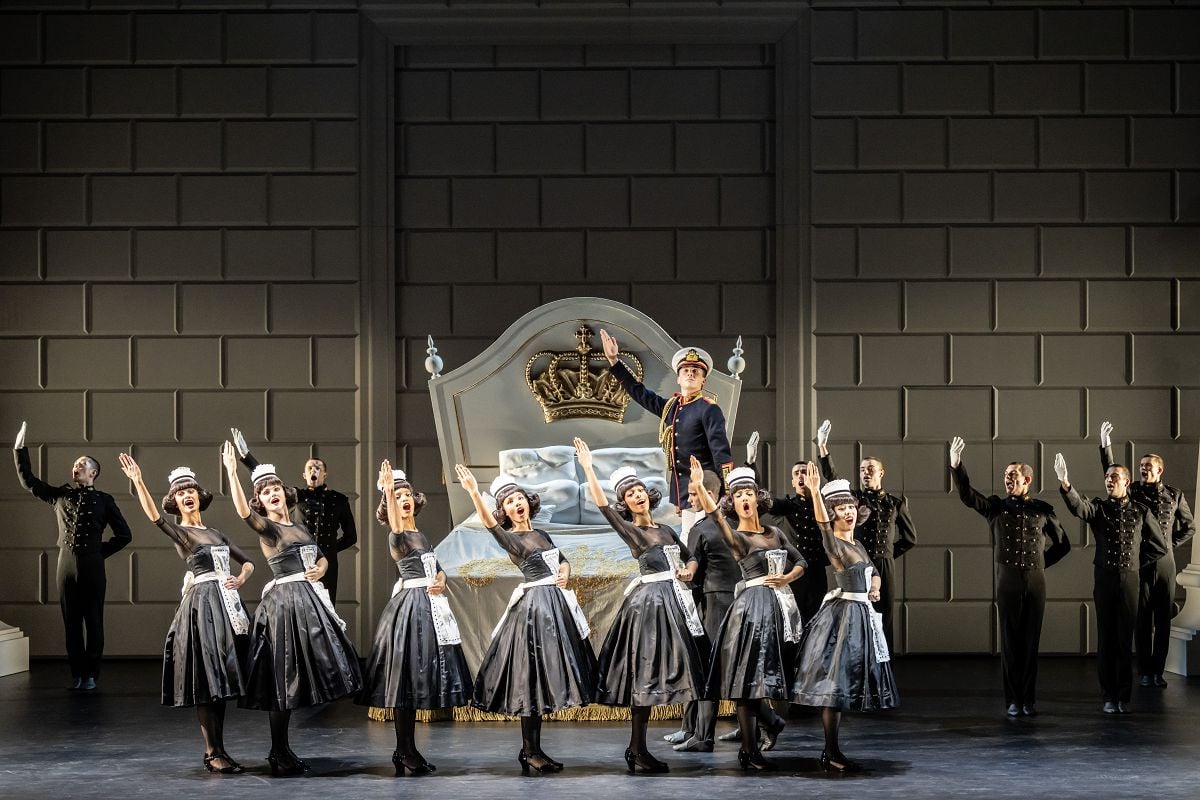
It was a performer common to both casts that deserves the headline comment since Katrina Lyndon stole every scene she was in as the good-hearted Girlfriend in a perfectly nuanced performance that brought ladette essences of TOWIE (The Only Way is Essex) alongside superb comic timing, excellent dancing and the pathos of misunderstood intentions. Her various interactions with the exasperated Queen provided an ongoing thread of comedic highlights.
Nicole Kabera and Ashley Shaw gave similar, impressive interpretations of the austere, yet lascivious, Queen, dutifully going about their public duties with the Prince adorning their arm, but without showing a scintilla of affection for him. Shaw is one of the finest dance actresses at work today, selling every iota of a complex character with great expressiveness; and – to her great credit – Kabera’s performance came from the same top drawer. There was a similar synergy in the portrayals of the sinister background figure of the Private Secretary by Cameron Flynn and James Lovell.
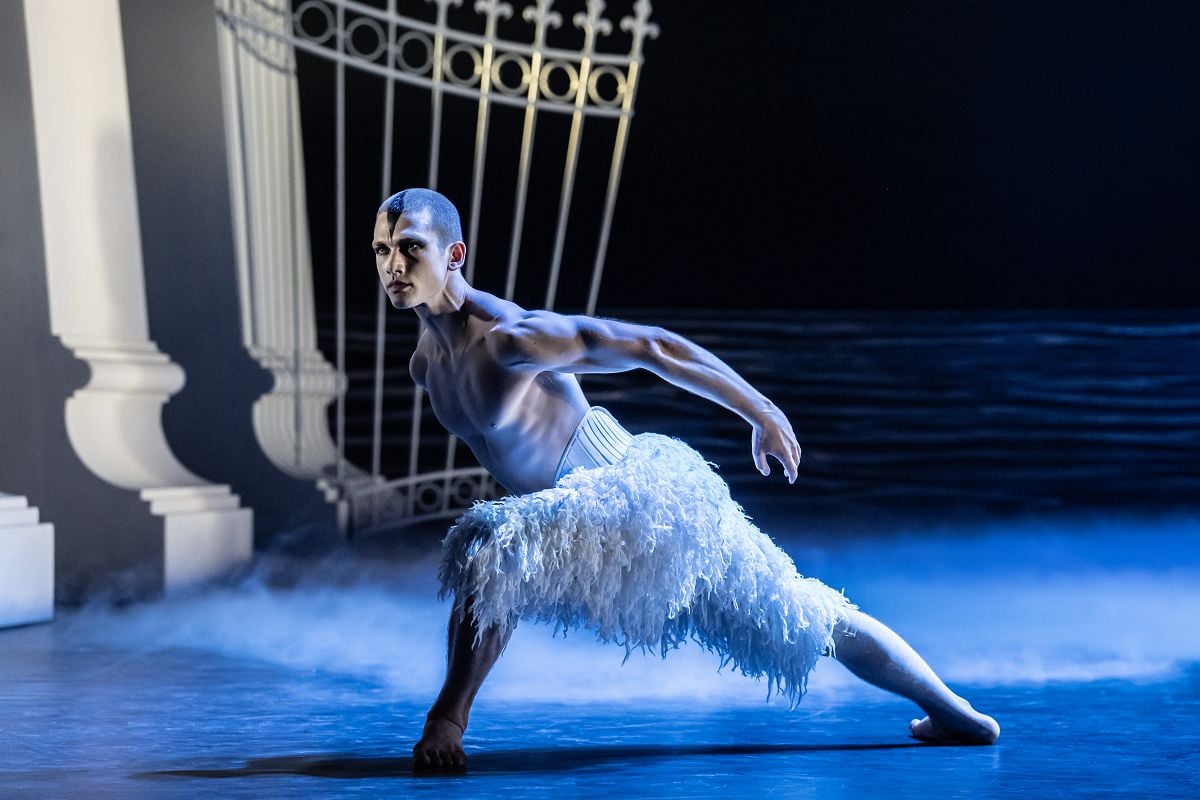
And so, I come to the two principal roles, those of The Swan/Stranger and The Prince (no one has a name in Bourne’s set-up). At the first performance this love-hate match was performed respectively by Harrison Dowzell and James Lovell (proving his versatility before performing as the Private Secretary on the following afternoon); and these roles were then interpreted by Jackson Fisch and Stephen Murray. Each, in their own way, was excellent and I give particular credit to Fisch’s portrayal of The Stranger where he imposed his mysterious gatecrashing character on the Ball guests with striking vigour and vitality.
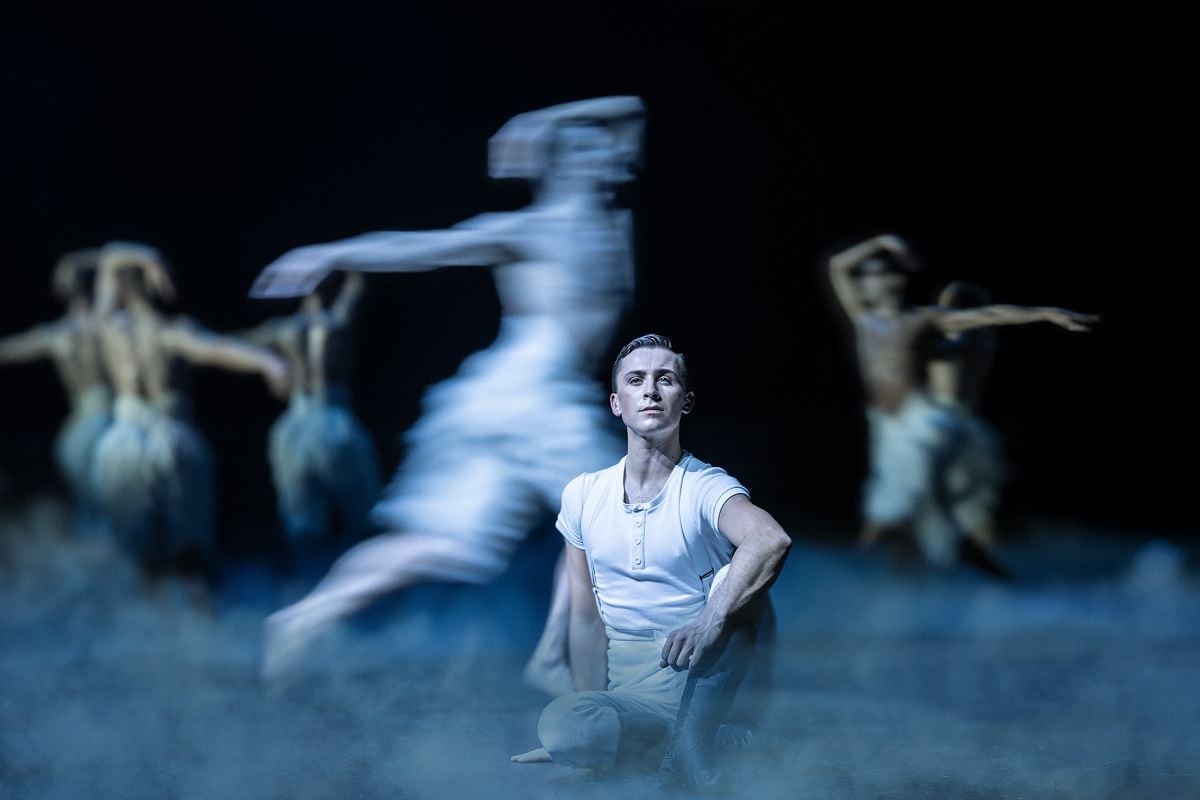
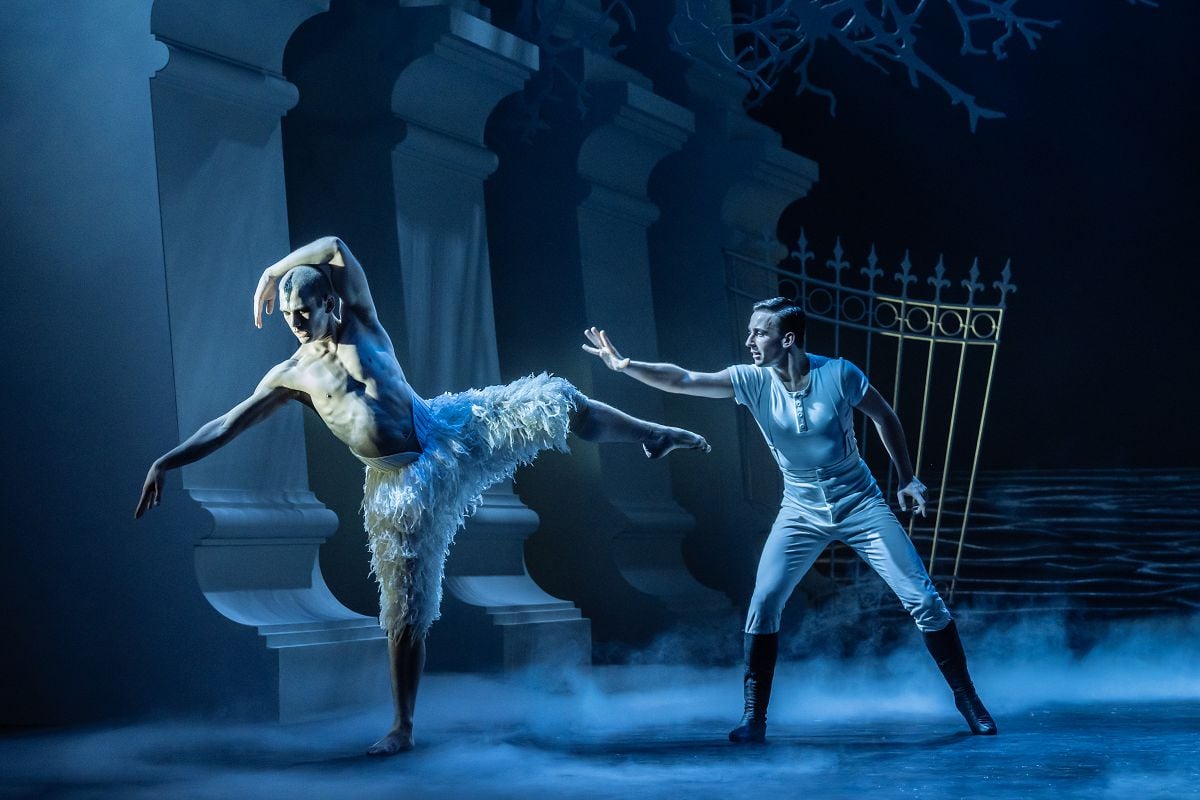



Both Lovell and Murray captured the Prince’s tortured journey with the right mix of reluctant duty, social anxiety and repressed sexuality. I more appreciated Murray’s long hard stare at the unveiled naked male statue and his anger at The Girlfriend’s acceptance of a bribe from the Private Secretary (she tries to refuse it) but this might just have been a case of familiarity having seen the show just the night before. Both men exuded that newfound, ebullient sense of confidence as The Royal Ball began, following their life-saving encounter with The Swan by the lakeside, which makes their subsequent descent into madness all the more palpable.
Of course, the reason why many mistakenly refer to this as the all-male Swan Lake is to do with the fourteen male swans in their feathered plus fours and black diamond forehead motif, one arm often crooked over their heads in mimicry of a swan’s long neck. Their synchronicity and visceral malevolence in the final act were as remarkable as always. There is so much to admire in this production, but it will always be those swans that are forever identified with its brand (one of the few in modern dance that has risen into public consciousness).


Graham Watts is a freelance writer and dance critic. He writes for The Spectator, Tanz, Shinshokan Dance Magazine (Japan), Ballet Magazine (Romania), BachTrack and the Hong Kong International Arts Festival and has previously written for the Sunday Express, Dancing Times, Dance Europe, DanceTabs, London Dance, the Edinburgh International Festival and Pointe magazine (USA). He has also written the biography of Daria Klimentová (The Agony and the Ecstasy) and contributed chapters about the work of Akram Khan to the Oxford Handbook of Contemporary Ballet and on Shobana Jeyasingh for the third edition of Routledge’s Fifty Contemporary Choreographers.
He is Chairman of the Dance Section of The Critics’ Circle and of the UK National Dance Awards and regularly lectures on dance writing and criticism at The Royal Academy of Dance, The Place and (until the war) for Balletristic in Kyiv. He was a nominee for the Dance Writing Award in the 2018 One Dance UK Awards and was appointed OBE in 2008.


True ballet is live interaction between dancers and musicians, yet this article doesn’t even mention the brilliant live orchestra. Dance, lighting, set design, costumes all get discussed in detail, as if ballet is entirely visual. It’s no wonder that ballet companies are ditching live musicians if reviewers don’t celebrate the magic of that interaction, somehow taking for granted the harmonies and rhythms in Tchaikovsky’s score that inspire and propel the wonderful dancers’ artistry, and the skill of the conductor in allowing the phrasing of dancers and musicians to breathe as one.
Live orchestra!It has almost impossible to discover this,many thanks for confirming it.
I agree! I saw Swan Lake at Sadlers Wells and the live music was so exciting. I have seen other dance shows with recorded music and thought it was good but hearing the music right in front of you was amazing. I sat in the seats at the side of the stage and I could see the orchestra and the way the conductor was directing them but also seemed to be directing the dancers or at least making it all mix together. There were so many moments where the music seemed to fit to the action like in a film and the emotion was so much more powerful when the music all worked at the same time as the dancing. At the end it was the live music that made me cry and not just the story on the stage. It needed both! Why does the reviewer not talk about the real music because so often we get recorded music and it’s not at all the same! I don’t go to that many live shows I go to the cinema to see opera and ballet but I will go to live shows if there is real music like this!! I’ve been to musicals but it sounds like a band on a CD not like this which sounded real!!