Review: Gala De Danza in London – a showcase full of new ideas

Graham Watts sees Gala De Danza – a peculiar venue for an unusual gala, which despite the title was much more than dance.
| Title | Gala De Danza |
| Company | produced by Christina Lyon |
| Venue | Central Hall, Westminster, London |
| Date | 27 June 2025 |
| Reviewer | Graham Watts |
This was a peculiar venue for an unusual gala, which despite the title was much more than dance, embracing a wide range of music acts, including a famous break-dancing countertenor and a performance of the earth harp, the world’s longest stringed musical instrument, played by its inventor, William Close.
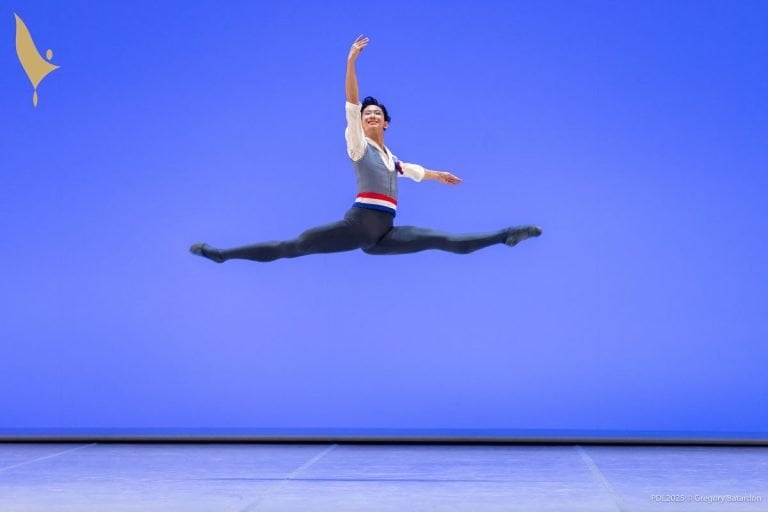
As for the dance, well I’ve not experienced a gala that showcased someone not yet in their teens but here was 12-year-old Spencer Collins of Los Angeles – winner of the Hope Award at the 2025 Youth America Grand Prix (YAGP) – whizzing his way through Franz’s variation from Coppélia with precocious ability and coltish charm.
With its huge domed ceiling and elaborate Viennese baroque architecture, including a huge sweeping central staircase, Westminster’s Central (or Methodist) Hall probably rivals any London dance venue for opulence, but it wasn’t made for a theatrical purpose. Seating at stage level was unraked and from the central balcony, the stage was partly obliterated by the heads of the people in front and by a handrail across the length of the gallery. Another downside is that the venue is dry, so no drinks and no interval, which made for an uninterrupted performance marathon, although the programme moved along swiftly with minimal changeover times between turns.
A bonus was the huge Hill organ, played by the resident organist, Gerard Brooks, to accompany Vsevelod Maievskyi in an angst-ridden solo by Jade Hale-Christofi, one of two world premieres: the other being a sweet Romeo and Juliet duet by Juliano Nunes. Braylon Browner and Kayla Mak finished in a clinch on the floor making a heart shape with their fingers, an embellishment unseen in the cavernous hall but thankfully picked up on two large screens either side of the organ pipes.


The best of the ballet came in four excellent pas de deux, spread throughout the programme beginning with an explosive Flames of Paris duet from Shale Wagman and Viola Pantuso. Wagman blitzed his way through variation and coda with mighty leaps, a huge Cuban flip and multiple pirouettes, spun with ebullient precision. His reputation as an emerging ballet virtuoso with huge potential grows apace. Pantuso, on the eve of her promotion to soloist at The Royal Ballet, handled the complex pointework of her own variation with aplomb. As a couple they were excellent.
New York City Ballet‘s Emma Von Enck and Andres Zuniga brought the pas de deux from George Balanchine‘s Stars & Stripes, an unusual piece for a London gala, essaying the mix of elegance and attack that characterises Balanchine’s choreography in the way that only NYCB dancers can achieve.
Melissa Hamilton reprised her sinuous tenderness in Mauro Bigonzetti‘s Caravaggio duet, which she has danced on the gala circuit with Roberto Bolle, but here partnering Maievskyi. It is a beautiful slow, partnered dance with limbs often entwined and Hamilton’s feet planted firmly in the centre of her partner’s chest. She was superb and I could have watched it again and again. The same is true for the final act pas de deux between Onegin and Tatiana, performed here by Cesar Corales and Francesca Hayward. I had the advantage of having seen them in the full Onegin less than a fortnight previously and this was a very welcome and emotional reprise.
Sadeck Berrabah’s Murmuration Compagnie performed two pieces in their unique style of closely synchronised arm movements (their arms in white against black clothing), which seems unrivalled in its genre. Browner danced a shape-shifting solo to accompany Jakub Józef Orlinski’s mesmerising countertenor performance of Ave Maria; Orlinski returned to sing Vivaldi’s Vedro Con Mio Diletto, accompanied by the London Metropolitan Orchestra, which had opened the show with Vivaldi’s Winter led by saxophonist, Megan Glover.


The link to YAGP was confirmed by 49 young dancers performing two pieces to the music of Swan Lake in ensemble choreography by Nunes, developed after a workshop with invitees from amongst the YAGP finalists. The outcome was closely synchronised movement, including 12 groups dancing new choreography to the cygnets’ pas de quatre (one was a pas de cinque) in two sets of parallel lines. It was mesmerising!
Another musical guest was the Polish percussive guitarist Marcin, who strum-drummed his own solo Alors on Danse before accompanying Latin/ballroom dancers Anton Sboev and Patrizia Ranis in Carmen’s Habanera. The dancers returned for a Rumba to recorded music by Jose Feliciano, in a style that is dominated by exaggerated poses, strutting and overt sexuality. Another “miss” for me was Hale-Christofi’s solo Take Me to Church, a massive YouTube hit for Sergei Polunin but shorn of the evocative venue and David LaChapelle’s direction it seemed to lack impact here, although danced energetically by Nikolas Gaifullin. A somewhat incongruous group piece for six Rambert dancers, entitled Un Petit Départ, choreographed by Emma Evelien with various wheely suitcases, seemed to be a brief trailer for a longer work.
The finale was a regrouping of all the performers, including a breaking vignette from Orlinski, accompanied by an onstage cover of Billie Eilish’s Birds of a Feather, sung by Enesa Berisha, supported by guitarist Mafro River. It was yet another innovation in a showcase that was full of new ideas and performers new to London. Former ABT ballerina, Christina Lyon, has been developing Gala de Danza for over a decade, and this is its first London stopover. Hopefully this eclectic mix has been sufficiently successful to earn a return visit.


Graham Watts is a freelance writer and dance critic. He writes for The Spectator, Tanz, Shinshokan Dance Magazine (Japan), Ballet Magazine (Romania), BachTrack and the Hong Kong International Arts Festival and has previously written for the Sunday Express, Dancing Times, Dance Europe, DanceTabs, London Dance, the Edinburgh International Festival and Pointe magazine (USA). He has also written the biography of Daria Klimentová (The Agony and the Ecstasy) and contributed chapters about the work of Akram Khan to the Oxford Handbook of Contemporary Ballet and on Shobana Jeyasingh for the third edition of Routledge’s Fifty Contemporary Choreographers.
He is Chairman of the Dance Section of The Critics’ Circle and of the UK National Dance Awards and regularly lectures on dance writing and criticism at The Royal Academy of Dance, The Place and (until the war) for Balletristic in Kyiv. He was a nominee for the Dance Writing Award in the 2018 One Dance UK Awards and was appointed OBE in 2008.