Review – Romancero del Baile Flamenco with Compañía Mercedes Ruiz

Graham Watts sees Compañía Mercedes Ruiz in Romancero del Baile Flamenco – a near-perfect demonstration of the elegant and authentic traditions of flamenco.
| Title | Romancero del Baile Flamenco |
| Company | Compañía Mercedes Ruiz |
| Venue | Sadler’s Wells, London |
| Date | 3 June 2025 |
| Reviewer | Graham Watts |
Following on from the contrasting but nonetheless equally theatrical shows of Sara Baras (Vuela) and Manuel Liñán (Muerte de Amor), which opened the main stage performances of this year’s London Flamenco Festival, Mercedes Ruiz brought flamenco back to its roots in a show, which elevated the concept of a tablao (the traditional intimate setting for a flamenco performance) into a large proscenium theatre. It would have been easy for the essential intimacy to become lost in the void between performers and their public, but this was emphatically not the case.
We are currently enjoying a rich generation of experienced bailaoras: Baras and Eva Yerbabuena are both 54, and María Pagés is, astonishingly, 62; at 45, Ruiz is a comparative youngster! I mention these ages not to be ungentlemanly but merely to make the essential and inalienable point that their performance capabilities remain remarkably strong. La Chana continued to perform into her seventies, albeit in later years mostly seated on a chair; these exceptional flamenco bailaoras seem to become enriched by age in the way of the finest Spanish wine, with the wooden floors of the tablao replacing the oak casks!
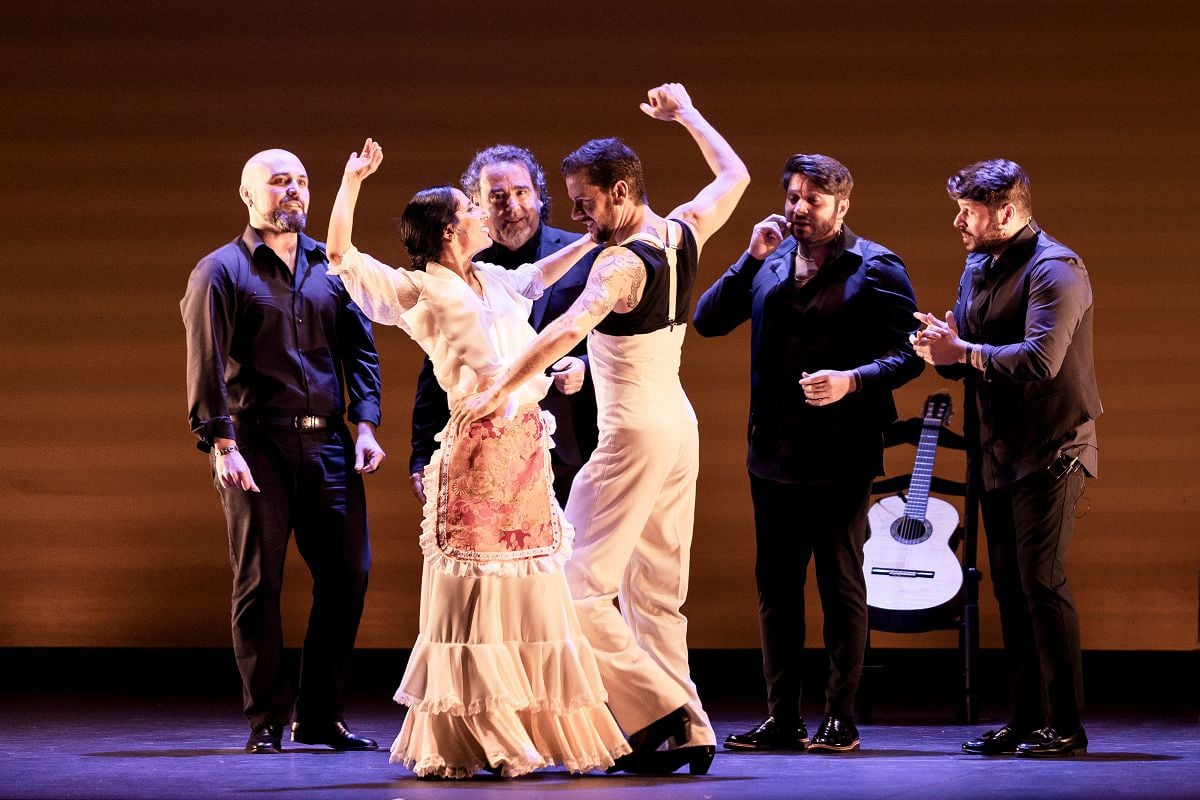
Let’s hope that Ruiz has many more years to entertain us. In Romancero del Baile Flamenco (Ballads of Flamenco Dance), she was ever-present on stage but for the interludes necessary for several costume changes. She demonstrated the complete range of a bailaora’s skills: wearing and manipulating the bata de cola (the traditional frilled dress with a long train); showing exceptional dexterity with both the mantón (an embroidered shawl with fringed tassels) and the fan; and giving impressive demonstrations of her rhythmic, percussive skills with the castanets augmented by finger clicking so robust that the sound travelled across the auditorium.
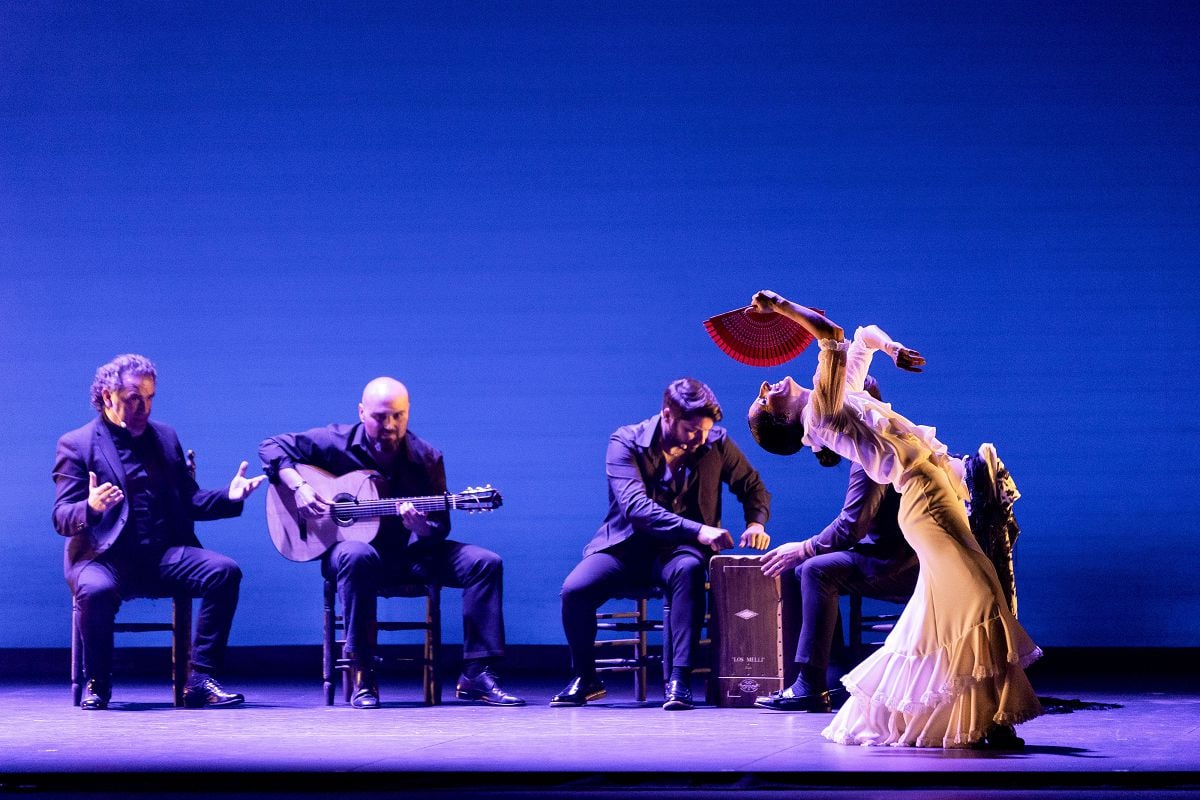
Frankly, it is rare to see this degree of exceptional multi-disciplinary artistry from one dancer (by contrast, Baras gave a superb show of footwork and dancing in Vuela, but she limited this additionality to just the shawl). I stand to be corrected, but I doubt that there is a performer with such versatility as impressively shown here by Ruiz.
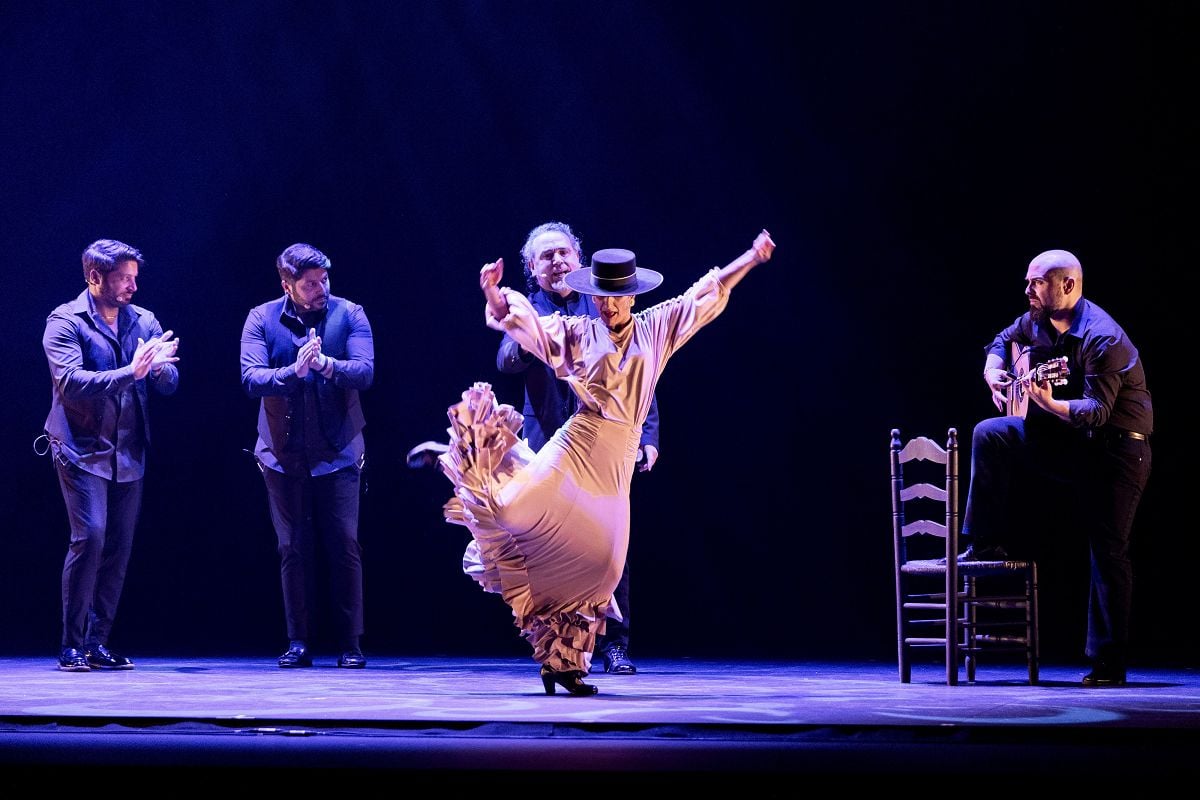
Her choreography is equally diverse, making use of these aforementioned skills and giving her footwork, the exceptional quality of her undulating arms, wrists and fingers and the flexibility of her upper body the opportunity of glowing in the spotlight. With her glossy dark hair scraped back severely into a long ponytail and wearing a collection of beautifully designed traditional clothes, pulled back to reveal black tights and solid, thick-heeled court shoes, she is the very image of the bailaora, and has every finely-honed skill that one would expect from someone who has lived virtually her whole life in flamenco. Ruiz was performing – even on Broadway – at the age of seven!
Whilst this was appropriately very much her show, Ruiz was strongly supported by José Maldonado, a virile, multi-tattooed bailaor, who both partnered Ruiz and performed his solos while she was off getting changed. His high-waisted white suit conjured a brief image of a similarly macho John Travolta in Saturday Night Fever mode! Maldonado not only choreographed his own solos, but he was also responsible for some of the choreography in Muerte de Amor, on the previous evening. One thing that stands out in the multi-faceted arts of flamenco, especially in a Festival such as this, is the significant extent of collaboration between artists.
Compared with the Festival’s opening shows, and in keeping with the intimacy of the tablao, the supporting cast was minimal. Strong, soulful cante (song) was provided by David Lagos – well remembered here in London for his collaborations with Israel Galván; there was excellent, lyrical guitar playing by Ruiz’ musical director, Santiago Lara, who, alongside Lagos, composed the music; with background vocals and rhythmic hand-clapping support from Los Mellis.
In keeping with flamenco tradition, there was a simple set design, dramatically enhanced by the strong lighting effects of Marcos Serna A.A.I and Tatiana Ruiz, which provided emphatic, statuesque conclusions to each danced section, having Mercedes Ruiz and/or Maldonado wrapped in a vivid tableau of exceptionally bright light.
The strapline to Romancero del Baile Flamenco is ‘The evolution of tradition..a flamenco journey, elegant and authentic‘: both the show and its star embodied these ideals so totally that I cannot think of a better way to end this review. The only pity is that we could only experience this near-perfect demonstration of the elegant and authentic traditions of flamenco for one night only.

Graham Watts is a freelance writer and dance critic. He writes for The Spectator, Tanz, Shinshokan Dance Magazine (Japan), Ballet Magazine (Romania), BachTrack and the Hong Kong International Arts Festival and has previously written for the Sunday Express, Dancing Times, Dance Europe, DanceTabs, London Dance, the Edinburgh International Festival and Pointe magazine (USA). He has also written the biography of Daria Klimentová (The Agony and the Ecstasy) and contributed chapters about the work of Akram Khan to the Oxford Handbook of Contemporary Ballet and on Shobana Jeyasingh for the third edition of Routledge’s Fifty Contemporary Choreographers.
He is Chairman of the Dance Section of The Critics’ Circle and of the UK National Dance Awards and regularly lectures on dance writing and criticism at The Royal Academy of Dance, The Place and (until the war) for Balletristic in Kyiv. He was a nominee for the Dance Writing Award in the 2018 One Dance UK Awards and was appointed OBE in 2008.