Review: Debuts 3 – Leticia Dias and Joseph Sissens in The Royal Ballet’s La Fille mal gardée

Kathrina Farrugia-Kriel sees Leticia Dias and Joseph Sissens as Lise and Colas, “finding love, the Ashton way”, in Ballet’s La Fille mal gardée.
| Title | La Fille mal gardée |
| Company | The Royal Ballet |
| Venue | The Royal Opera House, London |
| Date | 6 June 2026 |
| Reviewer | Kathrina Farrugia-Kriel |
A determined young woman discovers love (and some that is unrequited, too) amidst life in the country. As the dawn of a new day emerges from the overture, the farmyard animals, cockerels and rooster, start the day with a gentle warmup into a lively routine. The whimsical choreography sets the tone for Sir Frederick Ashton‘s ballet, La Fille mal gardée; a scintillating two-act ballet that fizzles with magical rhythms and quirky characters.
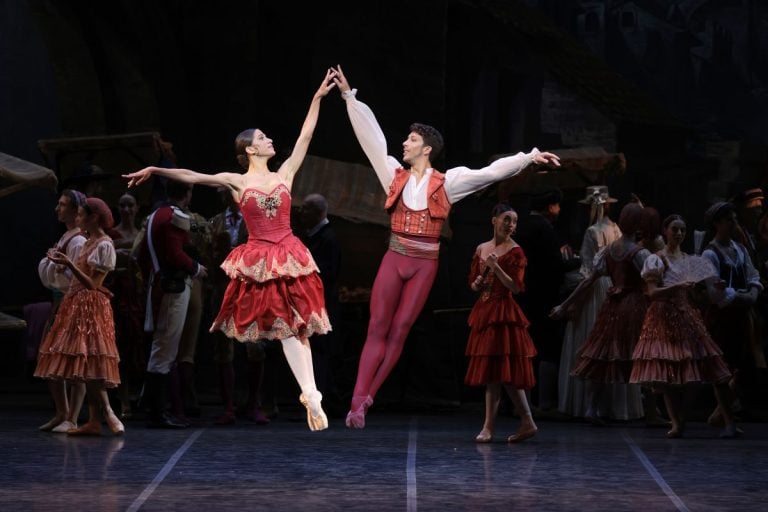
In her role debut, first soloist Leticia Dias charmed her way through Lise’s story. From her first entrance, Dias effervesces as she descends the stairs into the farmyard. With glimmers of a young Natalie Wood, she is an expressive ballerina with a broad palette of emotions. A headstrong, blossoming young woman, she offers a convincing rendition of being under the thumb of her cranky mother, Widow Simone (Thomas Whitehead, who replaced Philip Mosely due to injury). She is also charming in her youthful love for life, and flirtatious in her witty timing. Ashton’s choreography is superbly comical. We see the relationship between mother and daughter through the physicality of wigs, props and rhythm. Whitehead and Dias are convincingly paired. Like the various ribbons we encounter in the ballet, every beat has a story to tell. The first ribbon, a sign of Lise’s love for Colas, is left on the barnyard hook; a ‘hook’ for the burgeoning lovers.


Enter Colas, the object of Lise’s affection. Principal dancer Joseph Sissens is a fine Colas indeed, with his engaging entrance and erudite introduction. Sissens powers through the choreography, maybe with less buoyancy than the traditional Ashton style demands. Nevertheless, his elevation is superb, and his storytelling is genuine and pure as he searches for Lise. When the two finally meet, their extended pas de deux is truly captivating. Sissens and Dias are two young lovers with much desire in their movements – both Colas and Lise whip through their duets and solo material with much youthfulness and glee as they enjoy their moments away from Widow Simone.
A second ribbon, much longer than the first one, shapes the choreographic imagery. In their folding and unfolding through ribbon configurations, Sissens and Dias are precise and playful. However, in its 60th anniversary year, parts of the choreography haven’t aged well.
The whipping action (Colas pretending that Lise is a horse) didn’t sit well with me, particularly in the post-MeToo era. Like poorly-aged cultural appropriation in ballets (I’m thinking of yellowface) or dragging women across a floor (seen in choreography by a male choreographer a couple of years ago), there is a need for some of the ‘older’ 20th-century ballets to revisit such moments. Beyond this ‘ribbongate’ moment, the ballet returns to its glorious use of the corps de ballet. Lise’s friends are a sublime cast (the return of Amelia Townsend after a period of injury was much to celebrate); the community of farmhands is the epitome of Ashtonian style: fast footwork, an upper body that is driven by épaulement, and the joy of more props, including sickles and bundles of hay.


A second love interest, doomed by unrequited love, is the character Alain, performed by the hugely talented Joshua Junker. Timing is everything for Alain, but also giving just enough to make an audience laugh at and pity him, too. Junker’s performance is a mastery of comedic timing, marking every beat with hilarity and pathos all mixed in together. Here, Ashton’s work remains very relevant to the character – it has aged well, and watching the ballet twenty years on, there are moments which are still very beautiful in their rendition. The first act concludes with a truly wonderful use of a much longer ribbon, handled by Lise’s friends, and finally wrapped around the true loves. The quintessentially English Maypole dance is done to precision, and the cast moves to an inch of perfection as it weaves and unweaves the ribbons. A brilliant close to the first act highlights the theatricality of a thunderstorm, leaving Alain tossed around in the wind and rain.
In Act Two, while Colas hides from Widow Simone, Lise is also sent to the same room, unknowingly by Simone. Of course, there is no doubt that the two will end up together, but it is the interim choreography and storytelling that allow the ballet to shine as a true contender among Ashton’s story-ballets. Dias and Sissens shine in their duet, with more confidence as they are now discovered by their community – no more secretive meet-ups. The technical prowess is full-on, showcasing both Dias and Sissens in their leading roles.


The last image of the ballet, however, is left to Junker. Wed to his red umbrella, the same one that got him into a spot of trouble at the end of Act One, Alain returns to fetch his beloved. Junker times each gesture to perfection. His only true love, an inanimate object, is really all that makes him happy.
Ashton’s choreography gives us plenty of narratives: from gestures and images of love, through to the creativity of props. A stellar performance of an Ashton staple. The future is bright for the Ashton repertoire in the hands of this generation of dancers.