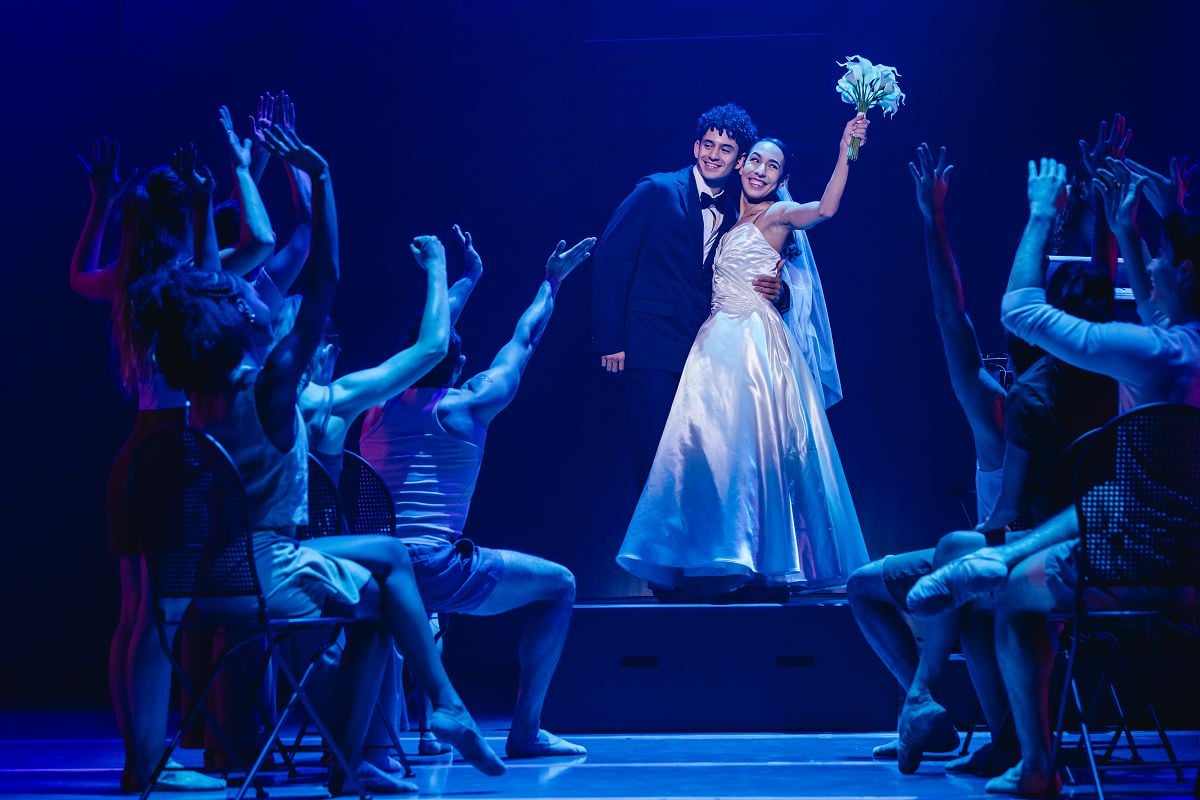
Review: Matters of the Heart – the Joffrey Ballet’s 70th anniversary season continues with a Frida Kahlo-inspired work and a Chicago-set world premiere

Scott C Morgan sees the Joffrey Ballet in a double bill, Matters of the Heart: Chanel DaSilva’s Wabash & You and Lopez Ochoa’s Broken Wings.
| Title | Joffrey at the Harris: Matters of the Heart |
| Company | The Joffrey Ballet |
| Venue | Harris Theater for Music and Dance, Chicago |
| Date | 6 November 2025 |
| Reviewer | Scott C Morgan |
With Joffrey at the Harris: Matters of the Heart, the Joffrey Ballet stepped away from its own subscription season for a special short-run collaboration with Millennium Park’s Harris Theater for Music and Dance in Chicago. This utilitarian and subterranean 2003 theatre (mainly decorated with light tubes reminiscent of Dan Flavin’s minimalist fluorescent artworks) is just a mile away from the Joffrey’s regular performing home at the opulent 1929 art deco Lyric Opera House.
Matters of the Heart is a double-bill pairing of dance pieces showing rocky romantic relationships. First up is a revival of Annabelle Lopez Ochoa’s Broken Wings, a biographical fantasia inspired by the life, work and loves of the iconic 20th-century Mexican artist Frida Kahlo that was originally created in 2016 for English National Ballet. Concluding the show is Wabash & You by Brooklyn-born choreographer Chanel DaSilva. Wabash & You depicts a contemporary love connection that goes sour and was billed as a “world premiere,” even though Matters of the Heart had an earlier out-of-town tryout performance on 1 November at the University of Notre Dame in South Bend, Indiana.


Being familiar with Kahlo’s life and paintings wasn’t entirely necessary to enjoy the surreal imagery and storytelling of Ochoa’s Broken Wings. But if you have seen Julie Taymor‘s 2002 film Frida, or visited recent Kahlo exhibits earlier this year at the Art Institute of Chicago or in 2022 at College of DuPage in the western Chicago suburb of Glen Ellyn, Broken Wings becomes a much more startling and enriching experience because it is filled with so many visual and storytelling references to the beloved artist.
Death pervades everything in Broken Wings with omnipresent Skeleton dancers wearing Day-of-the-Dead skull masks and fanciful mariachi-inspired black outfits. These alternately playful and menacing Skeletons appear at major turning points of Kahlo’s life, including the horrific public transit crash in 1925 when Kahlo was 18, and a traumatising miscarriage in 1932 (events that haunt many of Kahlo’s paintings).
Fiery in depicting all of Kahlo’s chronic physical and emotional pain on opening night was Anais Bueno. It’s a marathon performance of a woman determined to leave her artistic mark on the world and to emerge from the shadows of her at-the-time more famous (and unfaithful) muralist husband, Diego Rivera. To play Rivera, a spry Dylan Gutierrez wore extra padding around his midsection to better reflect the artist’s physical appearance.
The Skeletons of Broken Wings also do the basic work of stagehands to move and manipulate a wardrobe-sized grey box by production designer Dieuweke van Riej. This box opens up several panels to reveal locations like Kahlo’s hospital bed or symbolic imagery tied to different stages of her life.
The gorgeous costumes, also by van Reij, are all very much inspired by Kahlo’s paintings. Lucia Connolly was elegant with antlers as the painting “The Wounded Deer” that Kahlo dreamed up as a surreal self-portrait. Also in the mix are exotic birds and “Leaf Ladies” reminiscent of Kahlo’s many paintings that include exposed arteries and veins.

But the most dazzling visual depiction in Broken Wings is of Kahlo’s many self-portraits. Ochoa and van Riej made an unconventional decision to dress a male ensemble of nine in drag. Each of these “Male Fridas” appears in colourful folkloric skirts and oversized headdresses inspired by Kahlo paintings.
Could this device be Ochoa’s commentary on Kahlo’s strength and power to depict her personal emotional and physical pain in her self-portraits? Or is it a reminder of how Kahlo had the self-belief and resilience to carve out a lasting place for herself in a male-dominated art world?
Either way, these towering Male Fridas move in entrancing patterns and with synchronicity as they all physically and metaphorically lift and buttress the diminutive Anais Bueno as Kahlo. Bueno and the Male Fridas stand out as one of the most beautiful and distinctive features of Broken Wings.
Peter Salem’s score for Broken Wings was also a wonder, drawn in part from Mexican folk tunes with an orchestration filled with Latin percussion instruments. Joffrey Music Director Scott Speck led a fine performance of the Chicago Philharmonic in the pit, alongside a sung interlude onstage with two guitarists and the Mexican soprano Denis Vélez (an accomplished alumna of the Lyric Opera of Chicago’s Ryan Opera Center).


More onstage musical accompaniment was worked into Wabash & You, since it featured a song score and live performance by The Main Squeeze. The band features Corey Frye with high-flying cooing vocals, with Maximillian Newman on guitar, Robert Walker on bass, Benjamin “Smiley” Silverstein on the keyboard and Reuben Gingrich on drums.
One gets the impression that choreographer Chanel DaSilva pieced Wabash & You together based upon existing songs by The Main Squeeze to fit her contemporary narrative of a woman (Amanda Assucena) working in Chicago as a visiting guest artist during a hot and humid summer.
The woman dates and eventually beds a handsome guy (Xavier Núñez), hoping that something more serious is going to happen. But the guy turns out to be a player, so the fling ends unhappily as the woman packs up and leaves town by the end.
Thanks in huge part to The Main Squeeze jamming live on stage, there’s a fun and contemporary vitality to Wabash & You as a 12-member dancing ensemble fills out the cast of dating and mating youths (frequently glued to their smartphones) as everyone navigates a hot Chicago summer. Yet I’m sure some of that magic might be lost if Wabash & You were to be revived and performed to a recorded soundtrack.
DaSilva is a past winner of the Joffrey’s annual Winning Works competition to showcase new works by minority choreographers. DaSilva’s previous Joffrey works include Borders from 2020, Swing Low from 2021 (choreographed for video during the COVID-19 pandemic and then elevated to a live repertory programme) and colorem from 2022.
Visually, Wabash & You evokes Chicago with scenic designer Alexander V Nichols’ silhouetted suggestion of the title street under an elevated train platform. Lighting designer Jim French also saturated the stage with bright colours to match the shifting moods of DaSilva’s amorous dancers.
Wabash & You was fun, and DaSilva proves herself to be a fine modern storyteller through movement. But Wabash & You ultimately paled in scope and felt like a trifle after following so much pain, anguish and visual splendour infused throughout Broken Wings.
As part of Joffrey at the Harris: Matters of the Heart, both Broken Wings and Wabash & You provide a fine showcase for contemporary choreography. It’s also a nice prelude to both the Joffrey’s marathon December return of Christopher Wheeldon‘s Chicago-centric take on The Nutcracker at the Lyric Opera House, plus even more art-inspired Frida Kahlo and Diego Rivera with the Chicago premiere of Gabriela Lena Frank and Nilo Cruz’s 2022 opera El último sueño de Frida y Diego in March of 2026.