
Interview: Valentino Zucchetti, choreographer and Royal Ballet First Soloist, talks about his new Nutcracker

| Lily Hyde talks to choreographer and Royal Ballet First Soloist Valentino Zucchetti as his new production of The Nutcracker for New English Ballet Theatre tours to the Bahamas before a pre-Christmas run in London. |
Ten minutes before I am due to speak with Valentino Zucchetti, First Soloist of the Royal Ballet, he is on the Royal Opera House stage taking his bow as the Cavalier in The Nutcracker. When we meet at the stage door shortly afterwards, he is bright and chatty, not to mention surprisingly free of glitter. We settled in an empty studio, but it is not Peter Wright‘s production of The Nutcracker we are here to discuss, but rather, Zucchetti’s own adaptation for New English Ballet Theatre, which is currently touring The Bahamas and London.
I start with a rather bold question for any ballet dancer: What is Zucchetti’s relationship to The Nutcracker?
My relationship is probably the one that most dancers have to the show – we’ve all been exposed to it from a very young age. I first watched The Nutcracker when I was four, and was part of it when training at La Scala. When you become a professional company member, you establish a very regular relationship with it, but musically speaking, its lightness and melodies have always been in my mind. It never felt too heavy or repetitive to me, because it’s such an amazing score. I started choreographing this version of The Nutcracker in August, and started rehearsing The Royal Ballet’s version soon after, and haven’t gotten tired of it.
Zucchetti has been working with New English Ballet Theatre as an Associate Choreographer since 2013, but this is the first time he has adapted a work for them. I ask how this conversation came about.
New English Ballet Theatre decided to do The Nutcracker relatively late, around February of this year. I wasn’t called in as a choreographer until May. Because I had started a part-time Executive Producer role for the company, I asked who was choreographing, and Karen [Pilkington-Miksa, NEBT’s Founder and Artistic Director], turned around and asked if I wanted to do it.
We’ve put the show together quite quickly, with the story and general idea coming from Karen and Emily [Bridge, the Company Manager]. I’ve changed and adapted a lot, but I didn’t come up with it from scratch. It’s been a very collaborative process.

The project has brought about many firsts for Zucchetti – his first time adapting a ballet and working on a two-act ballet – how did he find the experience?
I really enjoyed it. It’s slightly daunting – there are so many versions of The Nutcracker -but I was very adamant that my version be very cohesive. With a lot of productions, the story is an afterthought; all that matters is that the ballet is sparkly and beautiful. Peter Wright’s version is cohesive, and ours is too, albeit in a very different way.
Speaking of Peter Wright’s Nutcracker, which Zucchetti has been dancing in since 2011, I ask him if the production had any influence on his interpretation, or if he tried to separate himself from it as much as possible.
I tried my absolute hardest to step away from it. In some ways, it was very easy because the parameters of the two productions are completely different. That being said, it was quite hard not to listen to the music and remember all of Peter’s steps,” he laughs, “I know most versions of The Nutcracker, and I made sure mine was like no one else’s.
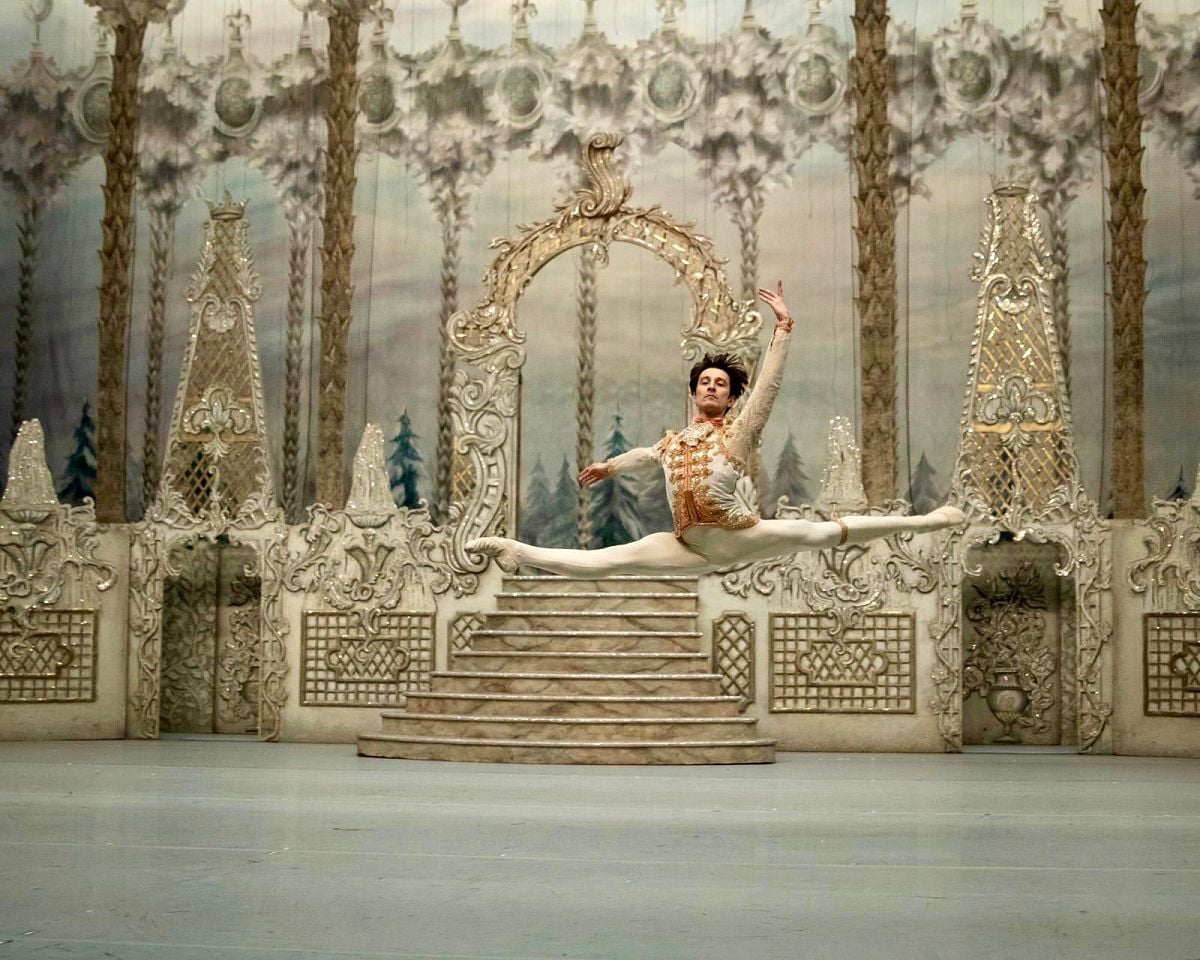
I ask what had been the most challenging aspect of the show, and Zucchetti’s expression becomes slightly pained.
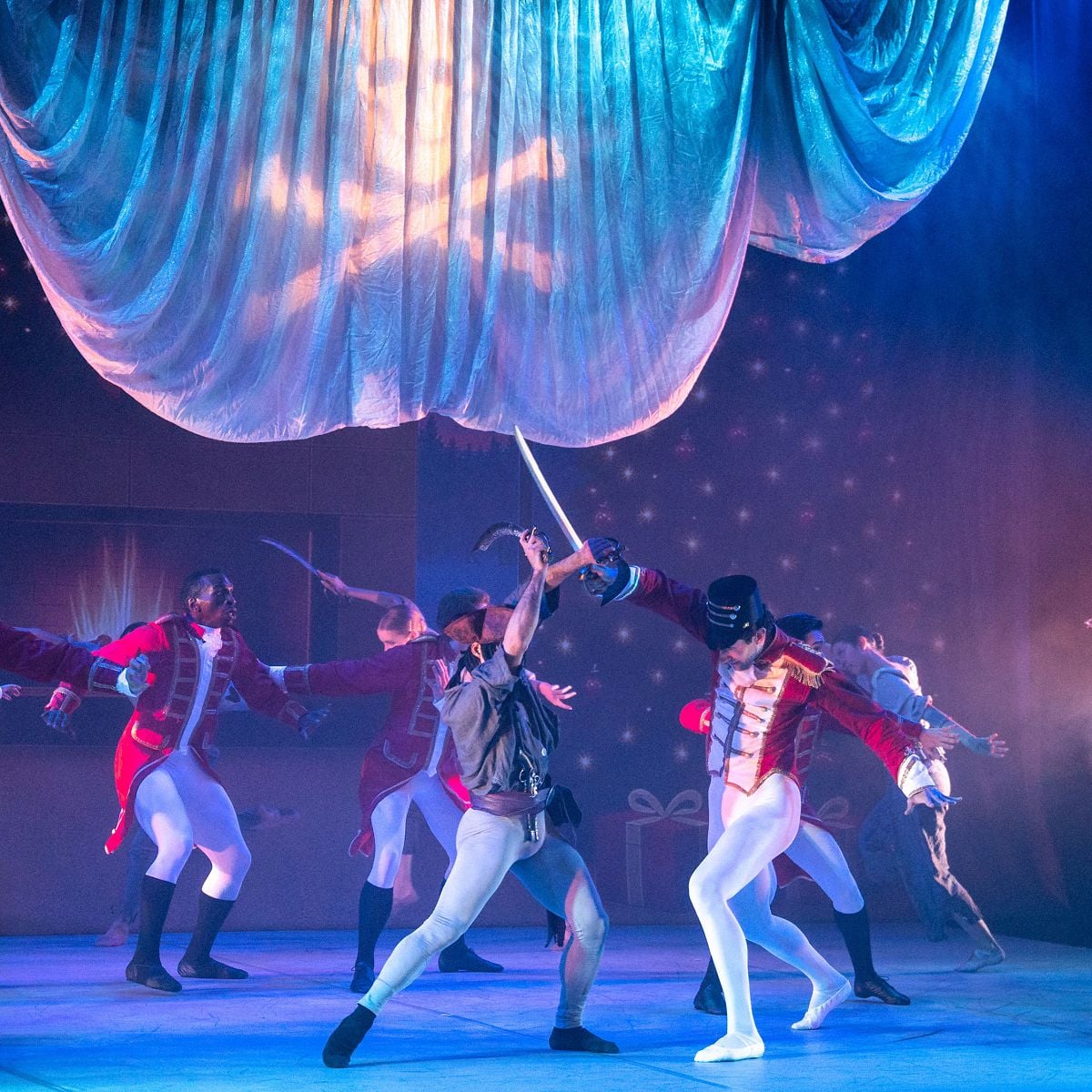
We have a cast of fourteen dancers, so it’s very heavy on them. As the choreographer, there was a fine balance between making it choreographically interesting, full, and elaborate without killing the dancers! We’ve had some very good reviews so far, but one piece of feedback was that some people found the party scene quite timid, but if it were more elaborate, the dancers wouldn’t be able to cope, so there needed to be some sacrifices in the choreographic waves of the show.
The ballet has also been shortened by twenty minutes, though Zucchetti promises you wouldn’t notice it. Derren Brown has also been an inspiration for the character of Herr Drosselmeyer, but I am loath to spoil too much.
I ask how Zucchetti has been managing his multiple roles, as both a First Soloist at The Royal Ballet, and a Choreographer, Dancer and Artistic Producer at New English Ballet Theatre.


I just have a lot of energy and not a lot of free time. We finish touring The Nutcracker, and then I go back to doing shows at The Royal Ballet. NEBT goes into its Spring season in February, and they’re not only performing a piece of mine, but I’m helping to organise their international touring. The wheel never stops!
We move on to talking about Tchaikovsky. Having previously used the music of Rachmaninoff for 2021’s Anemoi and Saint-Saëns for 2022’s Prima, his original pieces, I asked Zucchetti how he felt about using Tchaikovsky’s most famous music to choreograph.
It was pretty easy. Tchaikovsky oozes classical ballet, and this version isn’t necessarily neoclassical. I couldn’t be too experimental – we wanted to keep it fresh, but keep the magic of classical ballet alive; it has to be beautiful.
Moving onto Petipa, Zucchetti says, “When it comes to The Nutcracker, Petipa’s structure has to be in place. Even though there are no specific Petipa steps in our production, there are things that Petipa and Tchaikovsky worked out about the show and its musical journey that I didn’t and know I shouldn’t change.”
I ask if Zucchetti has learned anything about the craft of choreography from adapting a ballet?
For sure. In some ways, it’s easier because the framework is there. Structure is an exercise in itself, and a blank slate can be much harder, because you can go anywhere. Decisiveness is a quality that a choreographer needs to have.
Would he be open to adapting more works in the future, or would he rather focus on original stories?
Both! There are a few existing ballets that I would like to tackle. There are some ballets like Cinderella and Raymonda which, in my mind, are yet to have a definitive version that I’m happy with. I’m not sure I would tackle something like Romeo and Juliet because MacMillan’s version is really hard to top. I just don’t think it’s needed. In that case, I would be much more excited about bringing brand new stories to the stage.


Zucchetti won the Royal Ballet School‘s Ursula Moreton Choreographic Award back in 2005. Can he see a throughline from where he started as a choreographer to where he is now?
I’ve always been drawn to classical ballet, and ballet on pointe, because I feel like that’s where my passion and ability lie. However, for most of the time I’ve been choreographing, I felt ignored. I think that creating a new classical ballet piece doesn’t land with the audience because it seems rather conventional. There’s this kind of limbo, where companies and audience members expect a new piece to feel modern, and that classical pieces should be the great classical pieces of the past. There’s a very thin margin where choreographers can deliver new classical pieces.
When I started choreographing more contemporary works, people started to respond to my work. Kevin [O’Hare, the Director of The Royal Ballet] noted that very few people choreograph on pointe, and encouraged me to carry on. I still feel like my passion isn’t really shared. Most new classical ballets are either grand ballets set in the past or new productions of existing titles. I hugely admire Wheeldon and Ratmansky, but I feel like our struggles are the same.
Does Zucchetti feel like the ballet industry is very susceptible to trends?
Very, but it’s funny, because companies also have to stay rooted in tradition, because it will hurt them financially if they don’t. I’m an advocate for classical ballet, and there’s constant talk about how ballet needs a new audience, but the new audience comes to Swan Lake, not triple bills of new works. That tells us there is a desire to watch traditional ballet, whether you like it or not, which leaves companies very little room to innovate, so when they do commission new pieces, they want to push boundaries.
I question the lifespan of some of these new works, and Zucchetti’s response is emphatic.
Often not long. I feel privileged that Anemoi, which opened in 2021, was revived in 2023. I don’t know if it will ever come back – other companies haven’t picked it up. A lot of ballet companies, especially in the UK, are obsessed with finding the lost jewel of great choreographers, but as a choreographer, I see why Ashton, MacMillan, and Balanchine didn’t revive certain works whilst they were still alive.
Having now staged multiple one-act ballets and adapted one two-act ballet, I ask Zucchetti if his intention is to build towards a multi-act ballet at the Royal Opera House?
Absolutely – that’s always been my goal, and I have about twenty titles in my phone ready to go. My aspiration is to do a three-act new story ballet, but I might have to do a few intermediary productions before that happens, maybe adapting a multi-act ballet like The Sleeping Beauty or Cinderella, as well as another one-act ballet.
However, Zucchetti notes that one-act ballets have their limitations.
They’re much harder, because you have so much less time. The audience has to get to know the characters, empathise with them and feel the emotional beats of whatever happens to them. To do all that in forty minutes is a real skill, which very few choreographers have. Ashton was probably the best.
We talk of Marguerite and Armand and The Dream, and I ask if The Dream benefits from the audience’s prior knowledge of Shakespeare. He sighs…
Perhaps. I’m not sure how many stories have that gift. There are so many examples of one-act ballets that didn’t quite work. I’ve had this conversation with Kevin O’Hare – 90% of one-act ballets fail. They’re a very hard format for a story – you either tackle a popular story, or something vague – but I want to feel the character’s journeys, and I’m not sure one-act ballets are the best vehicle.
As our interview comes to an end, I follow up from Gramilano‘s previous interview with Zucchetti, and ask if he’s found his muse yet. Zucchetti suddenly becomes wistful.
Ah… Finding a muse can’t be a one-way thing. There are artists that I love to work with, and would love to work with more. I’m not sure they have clocked whether I want them to be a muse and whether they want to be a muse for me. You’re establishing a relationship and a partnership, and some kind of magnetism there that is hard to recreate with other people. I don’t think I’ve worked enough with one person to develop that, but I’m still seeking it. It’s still the little artistic dream I have.
After we conclude, Zucchetti announces his plans to stretch for an hour in his dressing room. He guides me through the labyrinth of the Royal Opera House, and backstage we pass Julia Trevelyan Oman’s iconic Nutcracker set pieces – Drosselmeyer’s workshop, the giant Christmas tree and the owl-shaped clock from the Stahlbaum’s living room. Maybe, one day, this area will be filled with set pieces from one of Zucchetti’s productions.
As we say goodbye, I wish Zucchetti good luck with his stretching, and he laughs gently,
I’ve seized up already.
Interview with Valentino Zucchetti – December 4th 2025
www.valentinozucchetti.com
The Nutcracker
12-13 December 2025: BahaMar Grand Ballroom Theatre, Nassau, Bahamas
18-20 December 2025: The Sainsbury Theatre, LAMDA, London W14 9DA – www.lamda.ac.uk

Lily Hyde is a cultural and dance writer based in London. Her writing has appeared in The Fence and The Creative Independent, and she runs the cultural newsletter, Falling Upwards. She is currently writing her first novel.



Congratulations to Valentino Zucchetti… really enjoyed interview by Lily Hyde!!
Thank you “Gramilano”…
It would be good if the Royal Ballet did ANY full-length version of “Raymonda” other than Nureyev’s of Act III alone. One can hope….
By the way, in mentioning his two main stage short works – Anemoi and Prima – the writer has got the composers of them reversed: Anemoi is three Rachmaninov piece; Prima, the third movement of Saint-Saens’ 3rd Violin Concerto