Review: Marianela Nuñez and William Bracewell in The Royal Ballet’s Giselle

Jonathan Gray sees Marianela Nuñez (sincerity that touches the heart) and William Bracewell (magnificent dancing and partnering) in Peter Wright’s Giselle.
| Title | Giselle |
| Company | The Royal Ballet |
| Venue | Royal Ballet and Opera, London |
| Date | 14 February 2026 |
| Reviewer | Jonathan Gray |
Never long out of The Royal Ballet‘s repertoire, Peter Wright‘s production of Giselle – now celebrating its 40th anniversary – returned to the stage at Covent Garden on St Valentine’s Day for the start of a run of 24 performances. The production, in John Macfarlane’s rich and atmospheric designs, continues to look wonderful and although Wright has made numerous small changes to the staging over the years (I regret his dropping, several seasons ago, of Frederick Ashton‘s solo for the lead female dancer in the “Peasant” pas de six), he has never strayed far from his attempt to give this, the greatest of all Romantic ballets, more dramatic sense.
Although later hands, such as Alexei Ratmansky, have sought to take the ballet back to a more authentic version of the original choreography by Marius Petipa after Jean Coralli and Jules Perrot, Wright’s production remains true to the traditional version that The Royal Ballet has been performing since the 1930s. It is a good, solid staging that will see the company through a few more years yet and now, in his 100th year, Wright himself, accompanied by Macfarlane, was present to take a curtain call at the end of the first night. The pair were warmly applauded by an appreciative audience.


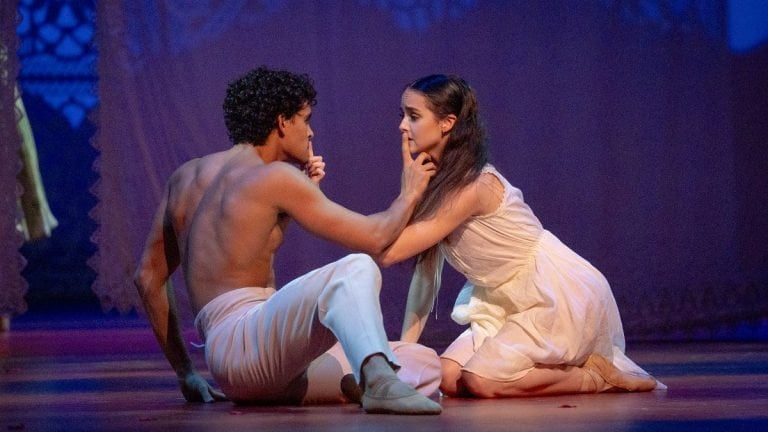
That audience had just seen a very fine account of Giselle, with the corps de ballet dancing immaculately – especially the Wilis in Act II – and the character roles performed with depth and understanding, most notably by Lukas B Brændsrød as Hilarion, a forester in love with Giselle, Elizabeth McGorian as Berthe, Giselle’s mother, Christopher Saunders as the Duke of Courland and Christina Arestis as Bathilde, his daughter. Leading the performance was the Giselle of Marianela Nuñez, dancing alongside William Bracewell, who was making his debut as Albrecht.
In the past, Nuñez’s dancing sometimes seemed too self-consciously exquisite and unspontaneous, but with Giselle she has now reached a level of maturity and experience that enables her to distil the role right down to its very essence. There is no superfluous fuss or exaggerated mannerisms, just dancing and acting that is honest and true, and a sincerity that touches the heart. The mad scene at the end of Act I, when Giselle discovers Albrecht’s betrayal, was notable for its simplicity and poignancy, and in Act II Nuñez’s redemptive dancing reached a level of gossamer lightness that was imbued with sadness and urgency.


As Albrecht, William Bracewell does not yet have the same directness of means as Albrecht, but he made a superb debut as the spoiled Count. His dancing, and his partnering of Nuñez, was magnificent (how thrilling to see such exemplary entrechat six so beautifully performed in his solo, and so firmly landed), and he played Albrecht’s character very much as an entitled aristocrat who slowly realises he has fallen deeply in love with a peasant girl. I was struck, during Act I, by how intensely Bracewell’s Albrecht wanted to engage Berthe in conversation, desperate to gain her approval. Later, in Act II, we saw a man devastated by the death of Giselle, and in their sustained series of duets and solos, Bracewell brilliantly conveyed Albrecht’s increasing exhaustion at the hands of the deadly Wilis, who intend to pursue him until he dances to his death.
Myrtha, Queen of the Wilis, was performed with edgy strength by Claire Calvert, her pas de bourrées a breath of icy, nocturnal air. Joining her, like two avenging angels, were Annette Buvoli and Hannah Grennell as the Wilis Moyna and Zulma. Adolphe Adam’s music, played by the Orchestra of the Royal Opera House and conducted by Vello Pahn, sounded splendid.


When this production was new in 1985 (it was, incidentally, the first live performance of Giselle I ever saw, led by the wonderful Fiona Chadwick and Stephen Jefferies), The Royal Ballet scheduled just four couples in the leading roles. Since then, Peter Wright’s staging has showcased an array of wonderful dancers, and from now until the end of March, the company will be offering no fewer than 11 casts. Although this might be a few too many, there are further debuts to look forward to. It seems there is no shortage of dancers wanting to take on the challenge of the leading roles in one of the oldest ballets in the repertoire.