Review: Tanztheater Wuppertal’s Sweet Mambo… Oh, dear Pina, I fear we are lost

Lucía Piquero sees Tanztheater Wuppertal in Pina Bausch’s Sweet Mambo, showing the best and worst of us… and we love it.
| Title | Sweet Mambo |
| Company | Tanztheater Wuppertal |
| Venue | Sadler’s Wells Theatre, London |
| Date | 11 February 2026 |
| Reviewer | Lucía Piquero |
There is something quite powerful, but also quite heartbreaking, about how Pina Bausch’s work seems to be equal parts intensely alienating and, at the same time, (impossibly) like seeing ourselves in the mirror in our darkest, often most embarrassing, moments. She takes us, still now, through a journey where we see the best of us, the worst of us, the weirdest… and we love it.
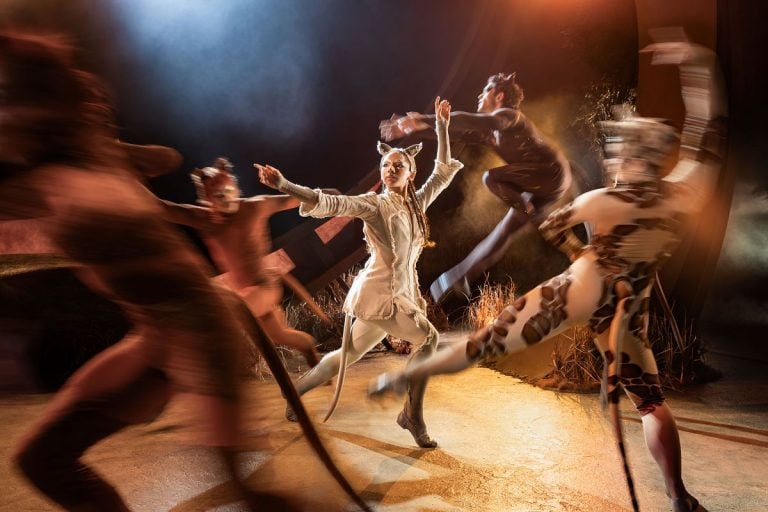
In Sweet Mambo, a piece she created for a smaller part of her company in 2008, seven women and three men show us what they are in dancing, in gesture, in name, in interaction. From the soft, stylised movements which often comprise the women’s solos, to the raw detail of tender gestures such as a kiss or an embrace.
The opening image is a stunning Naomi Brito giving us a soft sound bath while veteran Tanztheater Wuppertal dancer Andrey Berezin occasionally kisses her arm. She stops and moves away from the kiss, first smiling, then not so much. Nothing is free of nuance in here, making it more honest and more uncomfortable. I feel it in my body every time one of the men touches, pulls, or even comes into the personal space of the women. The programme says this work was to show the power of the women in the company, but somehow by the end of the first half, and even noting the humour and the irony, I feel far from empowered, and really not hopeful at all.

In a scene between Nazareth Panadero and Aida Vainieri they reminisce about adventures on tour, but end up talking about the men who were outside one hotel. I think this work would fail the Bechdel test (do we have one of those for dance?!). I think my feminist perspective will come as no surprise to anyone, but Sweet Mambo, by the interval, feels more like an ode to patriarchy than female empowerment. Perhaps that’s the point though – look at us (don’t forget us, they repeatedly ask), but also look at what we have to deal with, men pushing and pulling our bodies, invading our space.
In one of the most heartbreaking scenes, Julie Shanahan is stopped from running to her friend by Berezin and Alexander López Guerra… After the scene with Panadero, Vainieri realises she can “just talk to herself”—then we see her, then Julie Anne Stanzak, dancing for and with themselves. Bausch’s usual long-reaching arms and detailed gestures combined with sweeping turns and more internal movement make several appearances, and just when we think they are free and turning holding their lovely long dresses… the men come in and push them, seemingly to keep them with the impulse to turn.


While in the first half we mainly see the back curtain moving in the breeze, with one very large curtain also coming from the side on one occasion, dwarfing Stanzak and hence making her more human, the second half sees more chaos and more curtains moving, covering the whole of the stage. We get slightly modified repetitions of the solos, with the men also getting their own moments, somehow more vigorous and dynamic than the women’s. Shanahan is the protagonist of a hilarious attempt at “sign” language, more of a witty body language, which really has the audience laughing out loud. Brito gorgeously moves inside the big curtain to the sound of a version of Cry Me a River. Panadero uses her preferred complaining language – Spanish – to tell us that she is very, very sick, then, again in English, she feels empty, then she philosophises that the young cannot know what they do and the old cannot do what they know. Vainieri plays a form of bowling with glasses. And all through these we see a series of desperate humans running around, finding some comfort at points in each other, at points in their own thinking or feelings (Shanahan ‘is so soft’, Helena Pikon sings a beautiful song about birds that only touch the floor to die).
It’s not new that Bausch confronts the encounters of the genders through uncomfortable scenes, but somehow here the women feel more exposed, more vulnerable. And I need to acknowledge that I don’t quite connect with it as much as I do with her other works, that I don’t feel hopeful, and I really wanted even just a small win for the characters. Perhaps this is more realistic in holding that mirror to our current society, and even though we keep on dancing, I cannot help but think that we are indeed lost.
What power Bausch’s work holds still is that she can do this to us just through an amalgamation of pedestrian behaviour, surreal scenes and raw honesty. We will have to seize Stanzak’s advice and just say “brush” when we are at parties, so that our face looks relaxed and smiley.


Lucía Piquero Álvarez was born in Asturias, Spain, where she trained in Classical Ballet and read for a BSc in Psychology. She moved to London where she trained in contemporary dance (LCDS), also getting an MA in Choreography (Middlesex University). Lucía has been an independent dancer and choreographer since 2007, her choreographies have been presented internationally and she has been commissioned by choreographic centres, national companies and festivals.
She was lecturer and head of the Dance Studies Department at the University of Malta, and Senior Lecturer at Dance City (Newcastle), and is currently lecturing at Trinity Laban and English National Ballet School. She completed her PhD at the University of Roehampton. Her main research interest is on embodied emotion and cognition in dance, she has presented in conferences and directed workshops and practice research projects internationally, and published articles and chapters in diverse platforms as well as her own monograph.