Review: The Joffrey Ballet brings choreographer Yuri Possokhov’s Eugene Onegin thrillingly to life

Scott C Morgan sees Yuri Possokhov’s Eugene Onegin with a new lush, cinematic score by Ilya Demutsky – with dashing José Pablo Castro Cuevas and masterful Victoria Jaiani.
| Title | Eugene Onegin |
| Company | The Joffrey Ballet |
| Venue | Lyric Opera House, Chicago |
| Date | 4 June 2026 |
| Reviewer | Scott C Morgan |
Shots fired!
Ukrainian choreographer Yuri Possokhov has entered into a serious artistic duel with the dance world’s go-to ballet adaptation of Alexander Pushkin’s iconic 1831 Russian verse novel Eugene Onegin.
Possokhov’s new story ballet, confidently titled Eugene Onegin, is now making an impassioned case for itself with the Joffrey Ballet at the Lyric Opera House in Chicago. This Joffrey co-production follows on the heels of its world premiere with San Francisco Ballet this past January.
Possokhov’s Eugene Onegin can clearly be read as a reaction to the late South African choreographer John Cranko and his ballet adaptation of Onegin. Since its 1965 Stuttgart Ballet debut, Cranko’s Onegin has become a repertory fixture of ballet companies around the world.
But this month, diehard dance fans can cast their own verdict on these dueling ballets. Possokhov’s Eugene Onegin runs in Chicago through June 14, while American Ballet Theatre revives Cranko’s Onegin at New York’s Metropolitan Opera House from June 23 to 27 (the Wiener Staatsballett also revives Onegin this November).
German-American choreographer John Neumeier, a Cranko protege, has also created an adaptation of the story with Tatiana for Hamburg Ballet in 2014. As seen in its 2016 DVD release from C Major Entertainment, Tatiana often comes across as a postmodern deconstruction of Eugene Onegin, thanks to its mid-20th-century Soviet-era updating with surreal flourishes such as fictional dancing couples who embody romantic novels.
But of course, the most famous stage adaptation to contend with is composer Pyotr I. Tchaikovsky’s 1879 opera Eugene Onegin. Written with his co-librettist friend, Konstantin Shilovsky, and his brother, Modest, Tchaikovsky wrangled Pushkin’s sprawling, self-referential poetic chronicle of his own time into a straightforward series of fictional narrative scenes for the stage.
Eugene Onegin tells the story of a disaffected titled aristocrat whose sophistication and handsome appearance catch the eye of his neighbor, the bookish Tatiana Larina. In an impulsive act, Tatiana pours her heart out to Onegin in a feverish overnight letter-writing session, only to have her affections condescendingly rebuffed by him. Complications further ensue when a misunderstanding and petty jealousy prod Onegin into a deadly duel with his dear poet friend, Vladimir Lensky (who is also the fiancé of Olga, Tatiana’s sister). Several years later, when Onegin returns to Russia, the romantic tables are turned. Onegin falls instantly in love with Tatiana, who has now aristocratically married higher up to the much-older Prince Gremin.
Cranko’s Onegin is deferential to Tchaikovsky’s opera, largely following its existing storytelling template. Onegin was also famously set to a patched-together score of lesser-known Tchaikovsky music, all arranged and orchestrated by Kurt-Heinz Stolze.

By contrast, Neumeier and Possokhov found Soviet-born composers who were brave enough to create original ballet scores despite the looming specter of Tchaikovsky’s beloved opera. While composer Lera Auerbach (a previous Neumeier collaborator on The Little Mermaid) created a spikier, more modernistic score for Tatiana, composer Ilya Demutsky (a collaborator on Possokhov’s Anna Karenina)unabashedly went neo-Romantic for Eugene Onegin with a lush, cinematic score. This was instantly apparent when the Lyric Opera Orchestra performed a sweeping overture, confidently conducted on opening night by Joffrey Ballet music director Scott Speck.
From the start, Possokhov shows his willingness to embrace more of the novel’s tangential details and scenarios. This is especially possible with the fine, stylized silhouette stagecraft of scenic designer Tom Pye and projection designer Finn Ross (pay close attention to their symbolically smart uses of dead tree branches and roots at key moments). There are also periodic projected English translations and recorded narration of Pushkin’s poetry compiled by scenario librettist Valeriy Pecheykin to comment on the action.
Act I opens at the funeral of Onegin’s wealthy uncle, showing the reticence of this previously carefree man who must now journey to the country to take over the stewardship of his inherited lands. Possokhov later depicts Pushkin’s written nightmare premonition for Tatiana (complete with monstrous, animal-headed humans and a movable bed on wheels) on the eve of her dramatic name-day celebration, when Onegin and Lensky have their duel-inducing spat.


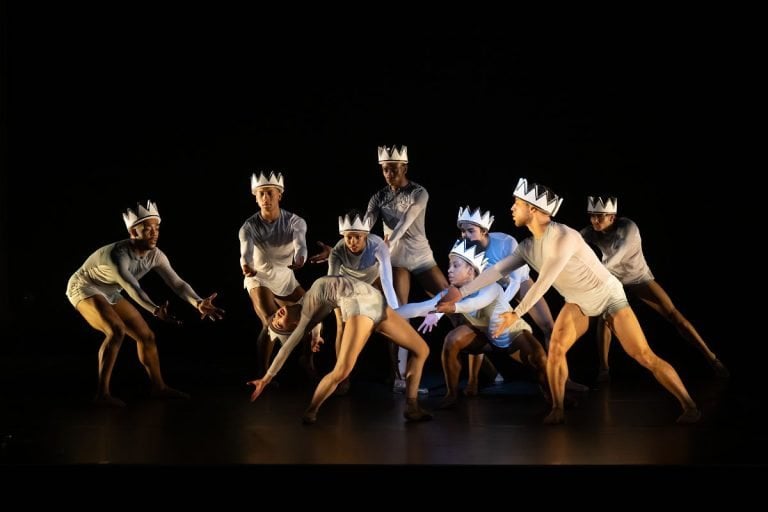
Possokhov also takes note of Pushkin’s lengthy descriptions of the changing seasons by having factions of the corps de ballet sequentially dance in interludes as abstracted “Spring Spirits,” “Summer Spirits,” “Autumn Spirits,” and “Winter Spirit Couples.” Costume designer Tim Yip provides plenty of flowing, sheer-fabric outfits that suggest delicate blossoms, hearty leaves, dying greenery, and snow flurries. Meanwhile, lighting designer Jim French creates the appropriately spectral sheen for each season.
Could these seasonal interludes be included to symbolically show the progression of time and the characters’ relation to nature’s constant changes? Or do these arguably meandering modern dance moments exist to cover for scenic and main-character costume changes?
Or perhaps these seasonal spirits could be emblematic of Possokhov’s refusal to populate intimate character scenes onstage with the corps de ballet as generalized villager folk (an early notable feature of Cranko’s Onegin).
For the dramatically important letter-writing sequence, Possokhov finds a different and equally valid approach to Cranko’s famed Tatiana pas de deux with a “dream dance Onegin” who steps out of her bedroom mirror.
Possokhov keeps these unrequited lovers separate from each other, with Tatiana imagining a receptive Onegin dancing a solo while she writes at her desk. Onegin then grimaces at reading Tatiana’s gushing letter, all the while imagining her dancing a solo with girlish abandon.
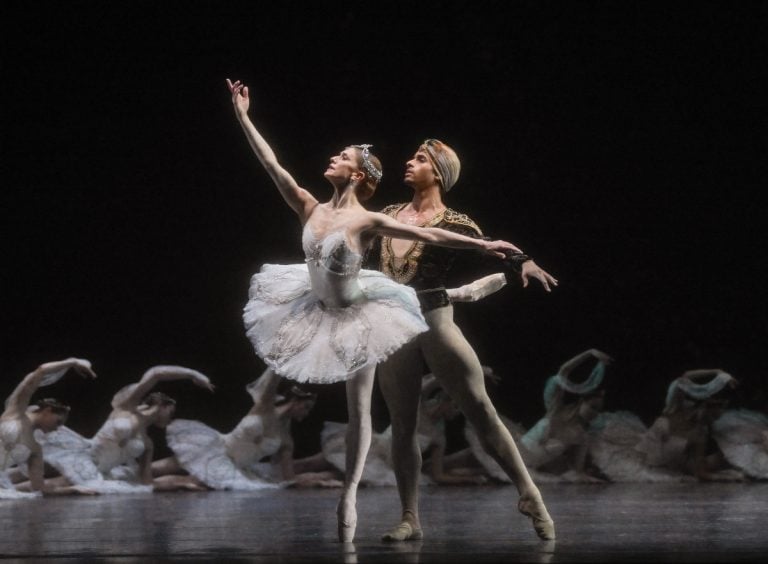
The opening night Joffrey Ballet cast of Eugene Onegin was more than up to the dramatic and choreographic demands so skillfully laid out by Possokhov. It was always emotionally clear what the characters were feeling, from the bold expressiveness of the dancing to the subtle facial expressions hinting at their inner thoughts.
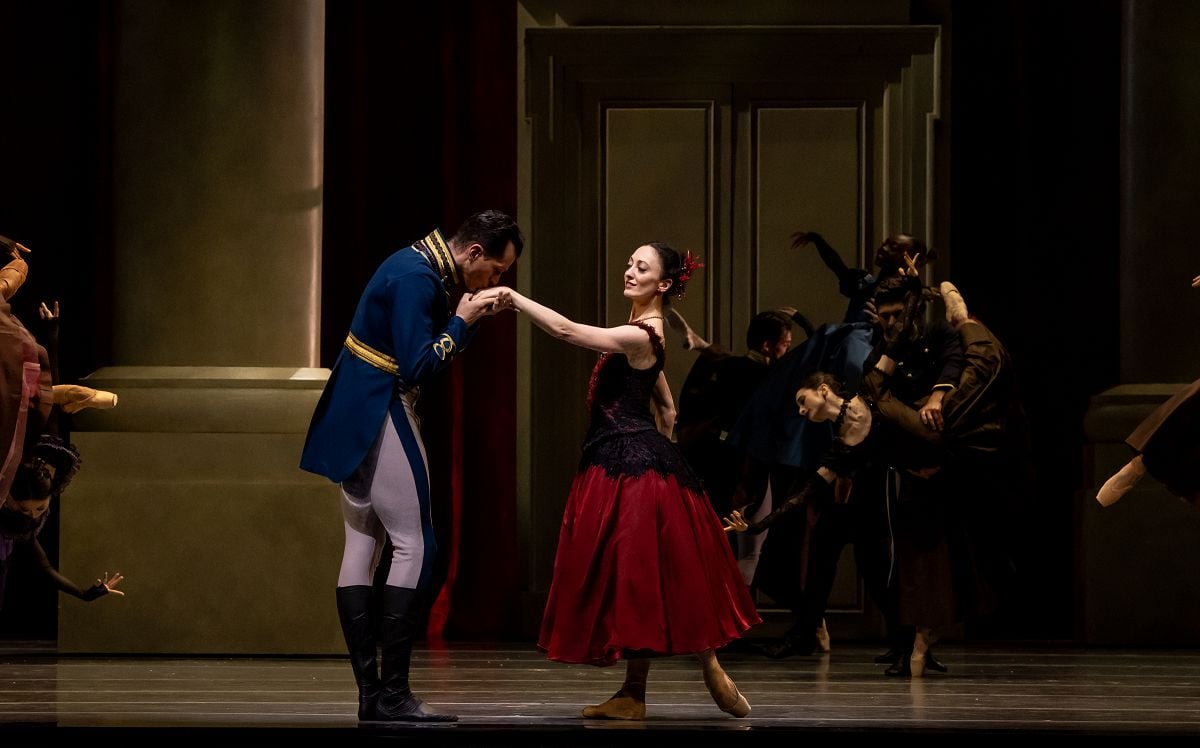
As Tatiana, Victoria Jaiani once again showed her mastery of a character’s dramatic journey onstage. Jaiani starts out as a lovestruck country girl, then she believably transforms into a grand society woman who literally becomes the embodiment of the belle of the ball. It’s a nice touch that Possokhov has the St. Petersburg ballroom dancers of Act II clearly taking their lead from Jaiani’s elegantly charismatic Tatiana as she is partnered with the tall and strapping Prince Gremin, played by Dylan Gutierrez.
Jaiani was also powerfully paired with the dashing and youthful Onegin of José Pablo Castro Cuevas, so sleekly costumed by designer Yip in black suits to match his character’s suave sophistication and dark brooding. Cuevas gives a great impression of a young man full of assurance, only to have the rug emotionally pulled out from under him as his tragic mistakes start to crash down upon him.


As Lensky, Xavier Núñez gave an impassioned performance as the emotional poet who is over- abundantly in love with Anais Bueno’s flirty Olga. Núñez and Bueno’s more than meet Possokhov’s joyous early partnering demands, providing a nice contrast to the more respectfully staid early pairings of Jaiani’s fascinated Tatiana and the more diffident Cuevas.
Núñez is also strong in Lensky’s more contemplative solo moments, pondering his mortality. Meanwhile, the initial mourning duet for Lensky between Bueno’s Olga alongside Jaiani’s Tatiana is full of touching grief – until Olga quickly finds someone else, just as in Pushkin’s novel.
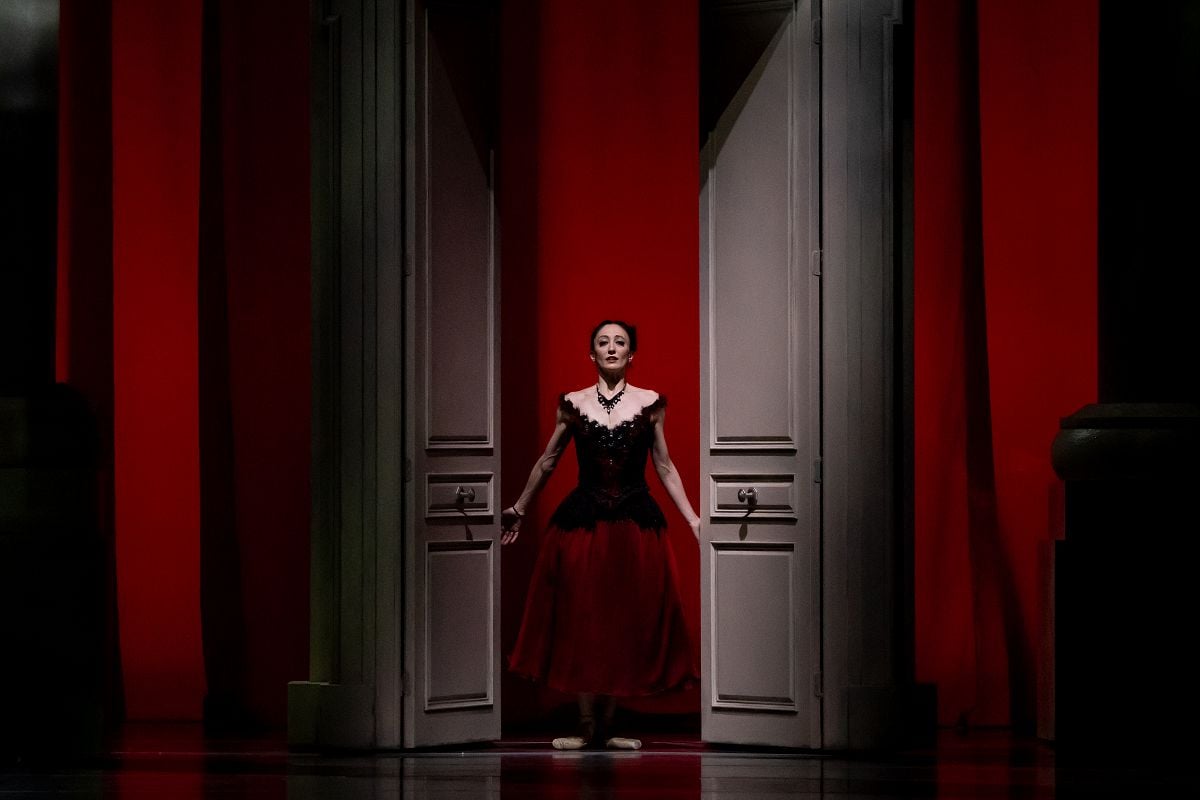
Jaiani and Cuevas skillfully imbue Tatiana and Onegin’s final duet with loads of passion mixed with loss and regret. Possokhov could have easily ended his Eugene Onegin with the haunting image of Jaiani’s Tatiana literally closing the doors on this painful past chapter of her life.
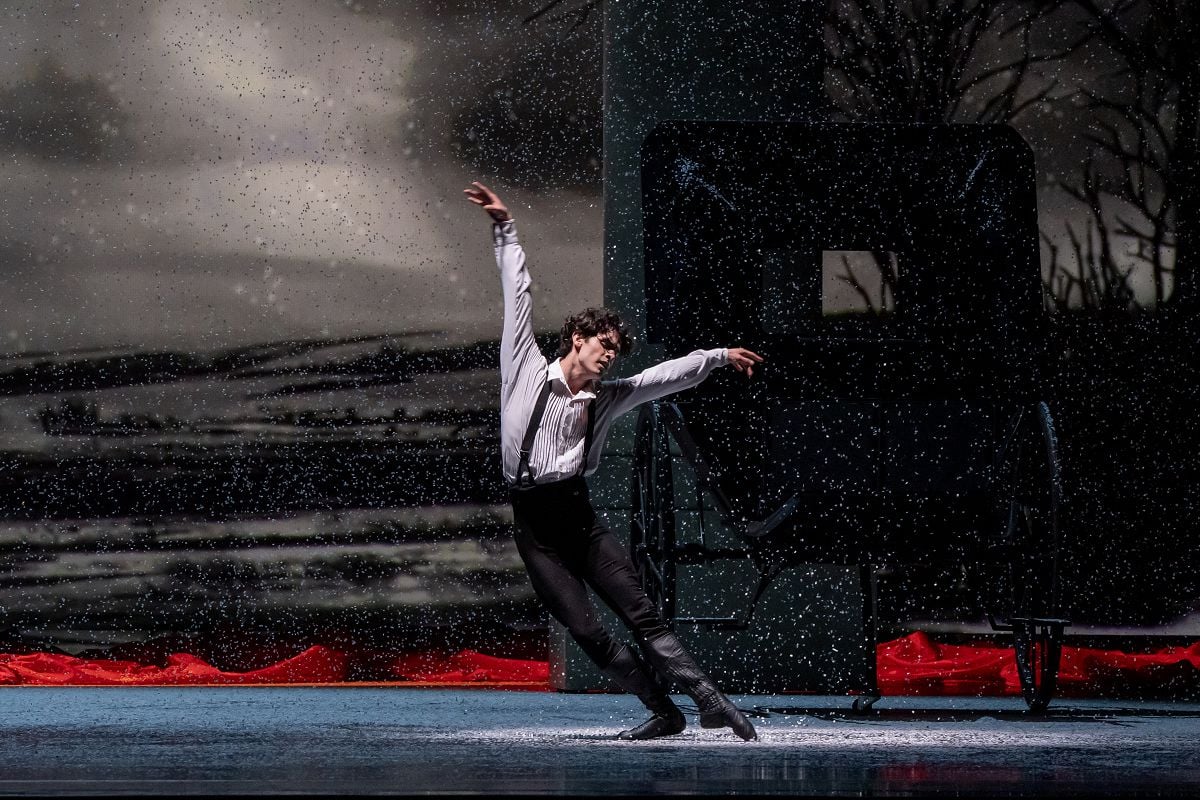
But Possokhov gives Onegin the final big dance moment in a busy snowstorm of movement. I’m not sure if the extra dancing “Winter Spirit Couples” were entirely necessary to accompany Cuevas amid the barrage of falling onstage snow.
But having Onegin face nature’s harsh winter weather certainly piles on to the personal tragedy of Onegin’s restless and lonely spirit, once again retreating to designer Pye’s rotating horse-carriage set piece that crops up throughout the ballet. This is truly one heartbreaking conclusion, but entirely apt as Possokhov makes the case for his ballet adaptation of Eugene Onegin to come out on top.
Time will tell if Possokhov’s Eugene Onegin ends up usurping the prominence of Cranko’s Onegin in the ballet world. But for now, it’s great that Neumeier’s Tatiana and Possokhov’s Eugene Onegin are robustly providing more story ballet reinterpretations of Pushkin’s great novel.
The Joffrey Ballet’s Chicago premiere of Eugene Onegin continues through June 14, at the Lyric Opera House, 20 N. Wacker Drive, Chicago. For more information, visit joffrey.org.

Chicago-based Scott C. Morgan is an avid opera and theatergoer. He is a frequent freelance contributor to the Windy City Times, and previously served as that publication’s freelance theater editor from 2008 to 2018. He also worked primarily as an arts writer for the Daily Herald in suburban Chicago from 2004 to 2022.
He has raised donations as an endurance race runner for AIDS Foundation Chicago via its charity training program Team to End AIDS from 2011 to 2023, and also co-hosted two Opera Tunes fundraisers at Chicago’s famed Sidetrack Video Bar in 2019.