Review: Last and First Men with Neon Dance – a great deal of patience is required

Graham Watts sees Last and First Men and finds that the extreme slow pace of the choreography tends towards tedium after the initial fascination has worn thin.
| Title | Last and First Men |
| Company | Neon Dance |
| Venue | The Coronet Theatre, London |
| Date | 26 February 2026 |
| Reviewer | Graham Watts |
Last and First Men was the title of Olaf Stapledon’s sci-fi novel, written in 1930 but set two thousand million years in the future, whereupon evolution had created eighteen versions of humankind. By which time, due to wars and environmental catastrophe, the succeeding versions of the species have colonised first Venus and then Neptune.
Stapledon’s dystopian novel provided inspiration for a 16mm black and white film by the late Icelandic composer Johann Jóhannsson, showing various angular perspectives on strange, primitive statues in the former Yugoslavia. Jóhannsson also composed the electronic soundtrack, together with Yair Elazar Gottman, which featured the mellifluous narration of Tilda Swinton, in words that I have assumed are drawn from Stapledon’s novel. Jóhannsson’s only film sadly gained additional poignancy since he died from a drug overdose (aged just 49) before it was ever shown.
These elements, in turn, formed the backdrop for Neon Dance’s eponymous dance work, choreographed by Adrienne Hart, in association with her three dancers (plus Makiko Aoyama). It’s an interesting concept to illustrate a pre-existing film by overlaying it with live dance but one that I’m afraid wore thin well before the end, although I freely confess that my attitude may have been different, if armed with the prior knowledge of Stapledon’s Last and First Men. Describing two thousand million years in just 65 minutes ought to have been a whistle stop tour but instead the whole affair moved at a glacial pace.

It was nonetheless a welcome bonus to be reacquainted with the mesmerising performance quality of Fukiko Takase, working alongside Kelvin Kilonzo and Aoi Nakamura, also excellent dancers with exceptional control, but I struggled to find excitement in their choreographic content, which ranged from Takase’s bunny hops, pointe work in those huge boots and much lying on the floor; collective imagery that seemed at odds with the notion of an eighteenth human species, two thousand million years into the future!
I expect that an understanding of the novel would have helped piece together the many movement motifs and regular costume changes beyond the enigmatic clues provided in Swinton’s narration. The strange costumes, including huge platform boots, extra bones that rose up from the legs or became arm extensions, and some form of cylindrical chute-like mask joining two faces together, obviously referenced the different stages of human development on the way from earthling to Neptunians on the verge of extinction.
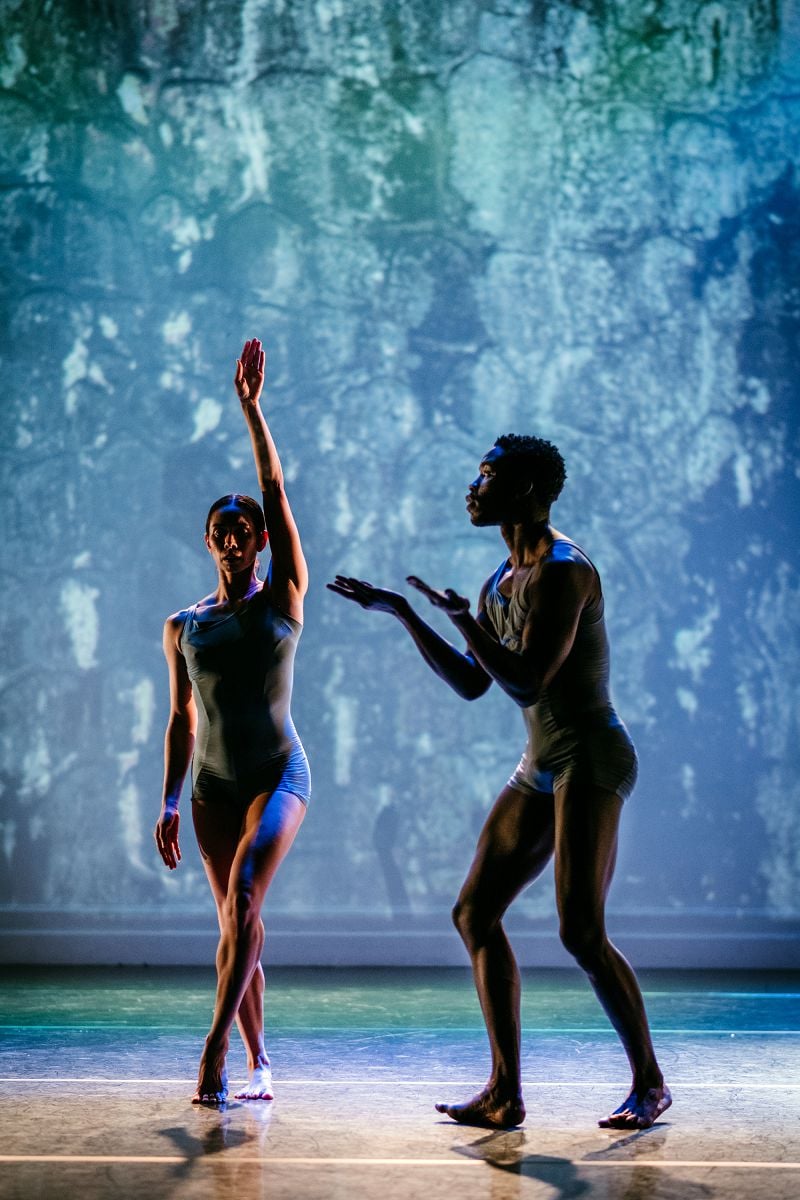


Without prior knowledge of Stapledon’s book or Jóhannsson’s film, the multimedia integration felt as if lots of random ingredients had been thrown into Neon Dance’s melting pot and I struggled to make connections between the live performance, the film and Swinton’s words and the extreme slow pace of the choreography tended towards tedium after the initial fascination had worn thin.
As a danced interpretation of the film, this performance had travelled around Europe since its first preview in the Science Museum in May 2023, officially premiering in Berlin, the following February, but I doubt that it has found a more atmospheric venue than the Coronet Theatre, the reimagined and restored Grade 2 listed theatre in London’s Notting Hill, which emphasised and enhanced the work’s melancholic feel.
Swinton repeated the exhortation to “listen patiently” and a great deal of patience is required. There were moments when it seemed that the art on show comprised a sculptural exhibition of living bodies set against a slow-moving film of stone sculptures in the background and there were fleeting moments of beauty in that amalgam, enhanced by the regular passages featuring that unmistakeable voice.

Graham Watts is a freelance writer and dance critic. He writes for The Spectator, Tanz, Shinshokan Dance Magazine (Japan), Ballet Magazine (Romania), BachTrack and the Hong Kong International Arts Festival and has previously written for the Sunday Express, Dancing Times, Dance Europe, DanceTabs, London Dance, the Edinburgh International Festival and Pointe magazine (USA). He has also written the biography of Daria Klimentová (The Agony and the Ecstasy) and contributed chapters about the work of Akram Khan to the Oxford Handbook of Contemporary Ballet and on Shobana Jeyasingh for the third edition of Routledge’s Fifty Contemporary Choreographers.
He is Chairman of the Dance Section of The Critics’ Circle and of the UK National Dance Awards and regularly lectures on dance writing and criticism at The Royal Academy of Dance, The Place and (until the war) for Balletristic in Kyiv. He was a nominee for the Dance Writing Award in the 2018 One Dance UK Awards and was appointed OBE in 2008.