Review: Compañía Marco Flores in Rayuela concludes the London Flamenco Festival 2026

Graham Watts sees the ‘distinctive and highly personal flamenco choreographer and performer’, Marco Flores in Rayuela, dance deconstruction in the context of flamenco.
| Title | Rayuela |
| Company | Compañía Marco Flores |
| Venue | Sadler’s Wells East, London |
| Date | 29 June 2026 |
| Reviewer | Graham Watts |
The annual London Flamenco Festival ended in an unusual place with a men-only performance that was both intriguing and mystifying. Having taken over the theatre at Sadler’s Wells in Islington, as usual, for the best part of a fortnight, the festival came to a conclusion at the other end of London on the former Olympic Park, a stone’s throw from the Stadium that is now home to West Ham United.
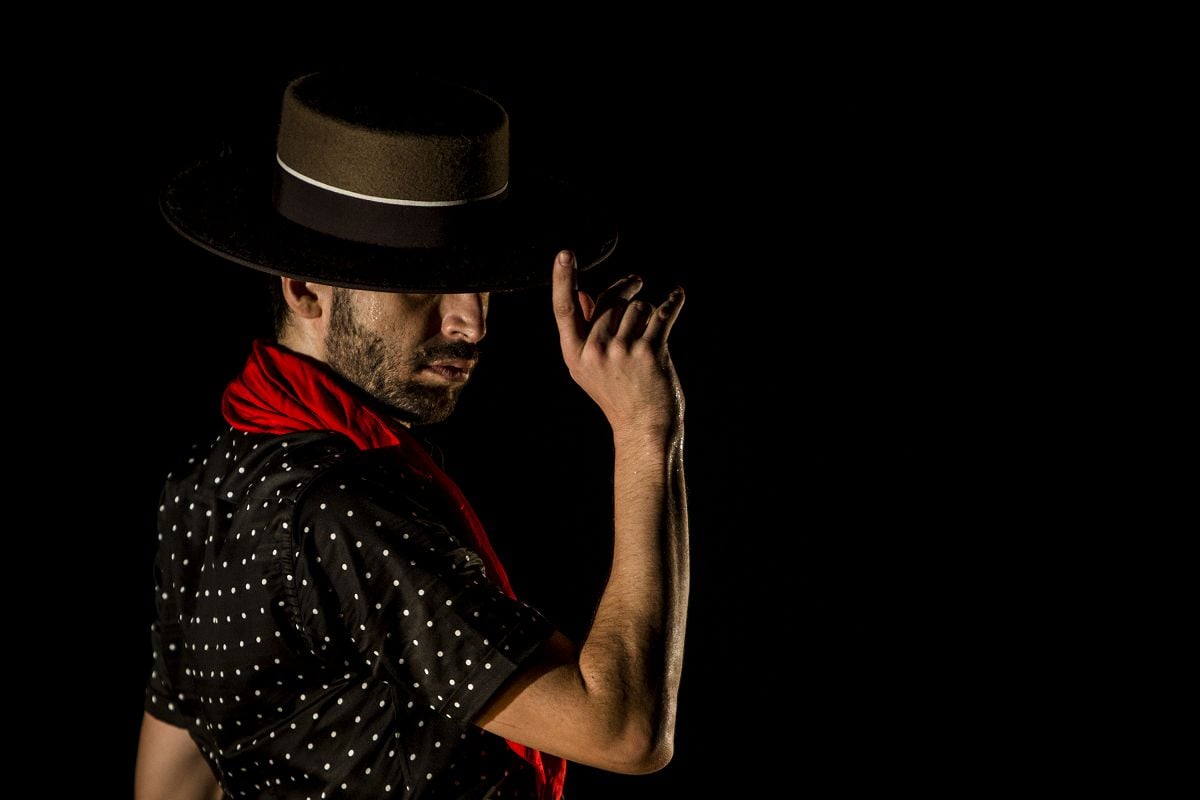
Marco Flores is a distinctive and highly personal flamenco choreographer and performer, a freestyler who brings a contemporary, non-flamenco expressiveness, including an essence of queer identity, to his work. He has fronted his own company since 2010, but formerly he collaborated with Manuel Liñan, and that same pioneering emphasis of pushing the boundaries of flamenco is inherent to his work.
Another of his regular collaborators is the great bailaora, Olga Pericet, and her influence is present in Rayuela where she provided choreographic advice and costume design. I can’t help but think that a brief interlude of her performance would have been a refreshing contrast to the unremitting maleness of the programme.
It appears that there were two inspirations for the title. Rayuela is both the name of a popular children’s game (apparently similar to hopscotch) and the title of a 1963 novel by Argentine writer Julio Cortázar, a stream-of-consciousness work that has multiple endings and poses unanswerable questions. While I struggled to find any obvious reference to the children’s game, the link to Cortázar’s book seemed clearer with Flores both opening and closing the 75-minute show, hunched over and staring at the floor as if looking for an errant contact lens.
What makes Rayuela, the novel, so beguiling (and also possibly infuriating) is that it can be read in different ways, either in a linear progression through 56 chapters or according to a table of instructions, literally “jumping” through and across the chapters (missing one out) like a literary game of hopscotch.
This explanation is important because I detect that this is how Flores has constructed his Rayuela, as a series of chapters that can be interchanged and rearranged to form a performance of the same ingredients but differently ordered. Dance deconstruction in the context of flamenco.
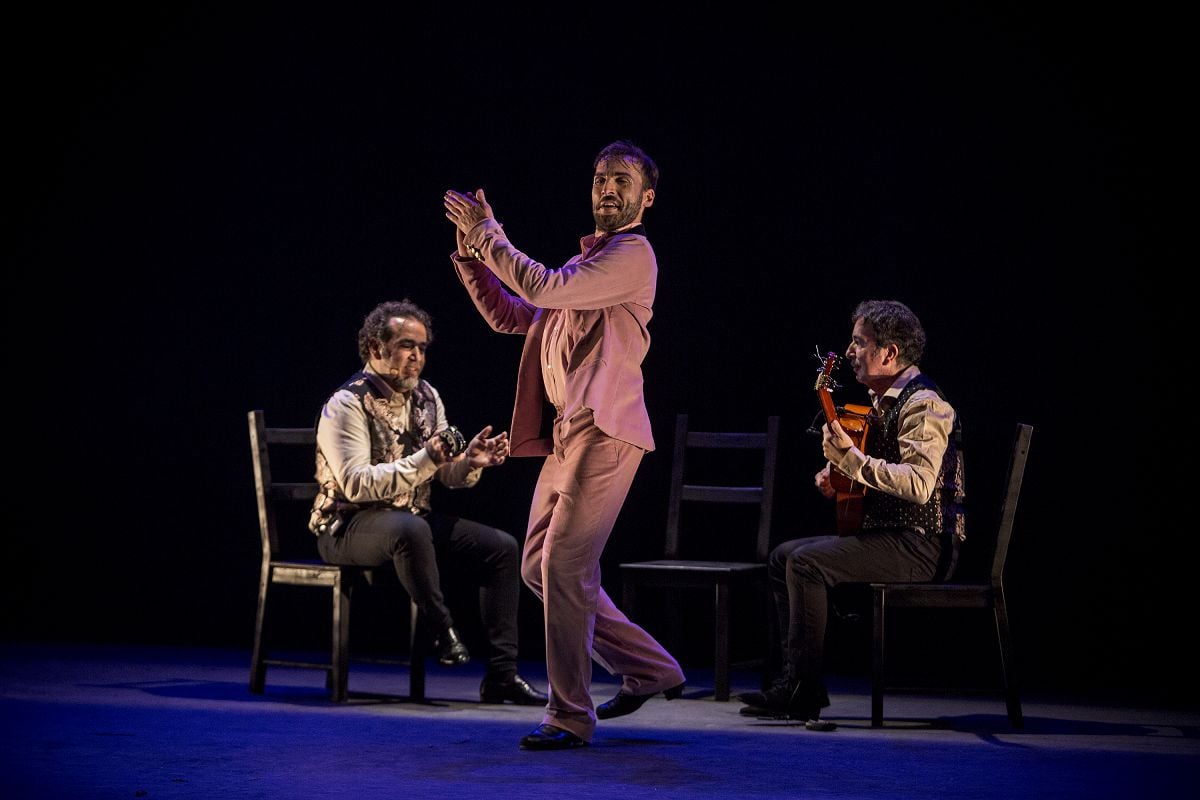
Flores is a captivating and charismatic entertainer with a highly refined flamenco technique, including the ability to handle castanets fluidly in tempo with the fast rhythms of his feet, and an innate, flexible musicality that allows his movement, the tapping of the castanets, and strong zapateado to swerve into the rhythms of his two colleagues, the outstanding guitarist, José Tomás, and Manuel de la Nina, a cantaor with impressively varied vocal techniques and range. Both Tomás and de la Nina had opportunities to showcase their virtuoso skills in solos that were embedded into the programme. Original music by Alfredo Lagos was an added bonus.
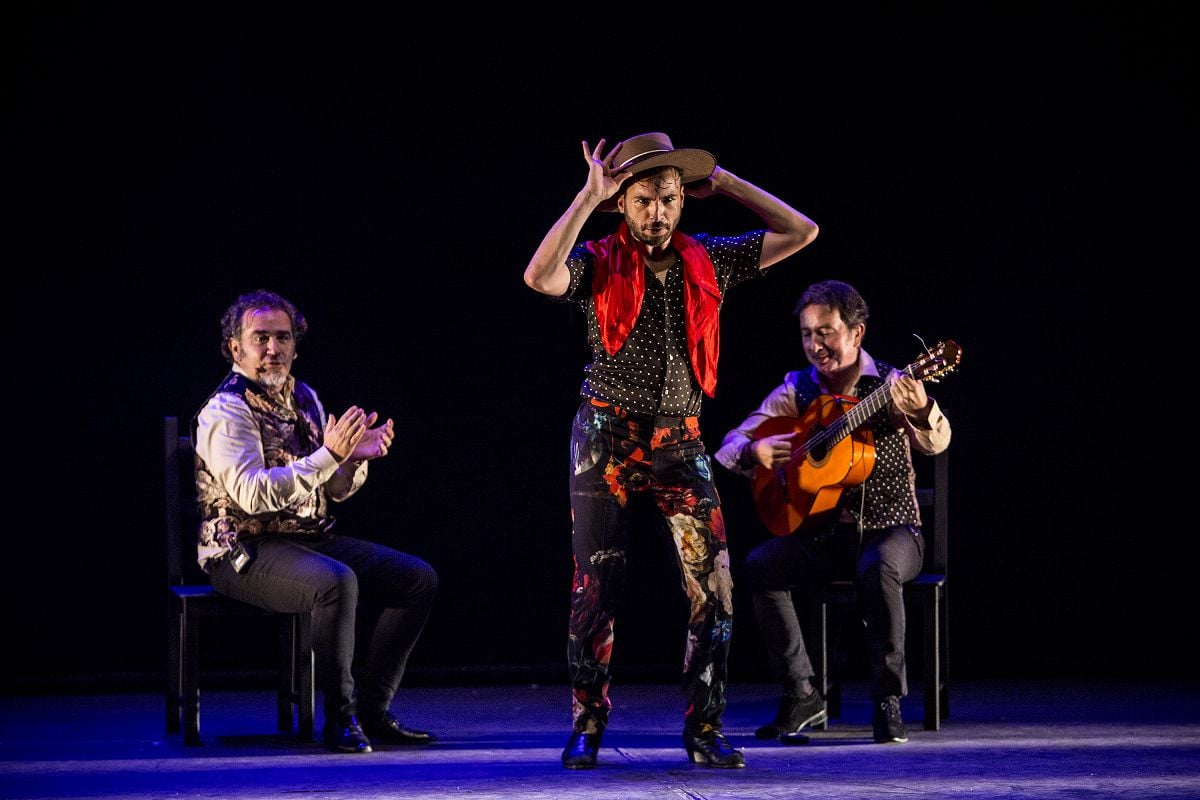
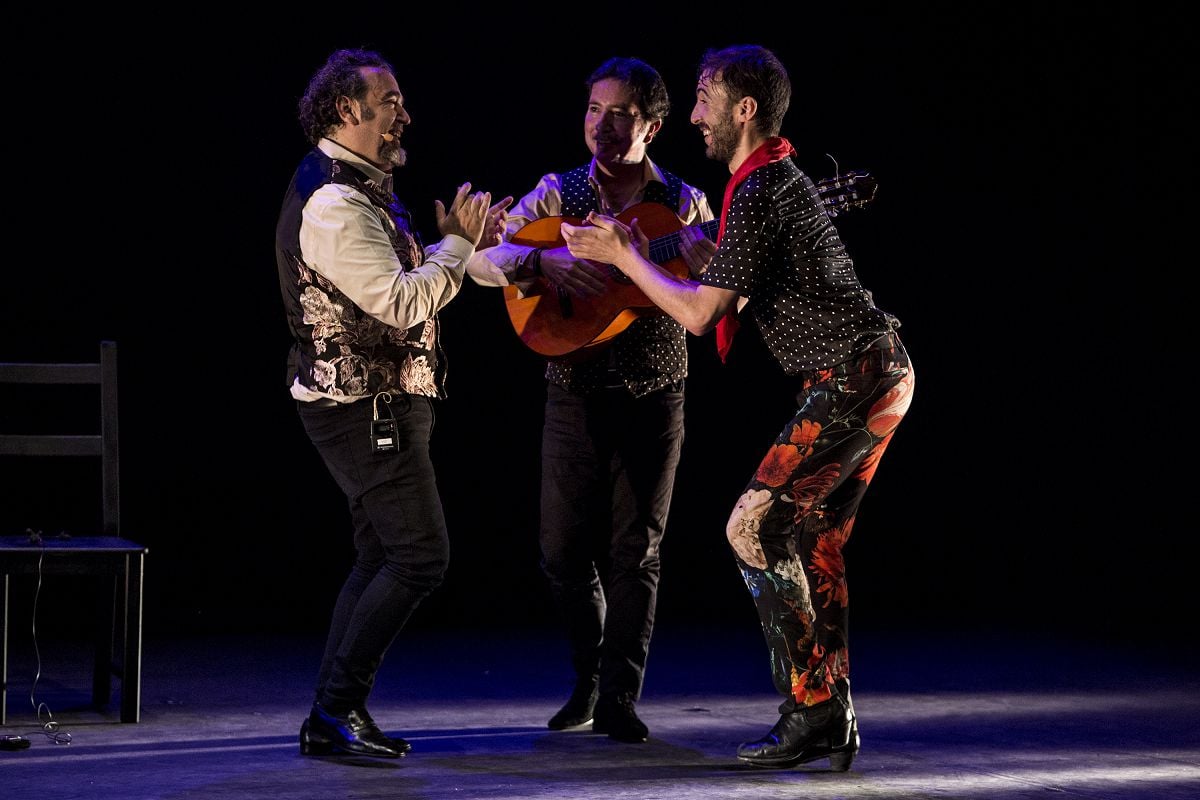
The intimacy of this small show worked well in spite of the cavernous size of the Sadler’s Wells East Auditorium (it feels like one needs mountain wear to climb the steep stairs and escape), and this had much to do with Ada Bonadei’s impactful lighting designs. Augmenting Pericet’s costume designs was a suit by Paul Smith for Flores to wear during his Déjate de Milongas number.
The most impressive elements were the various conversations between the trio, especially when Flores was matched against either Tomás or de la Nina, in which cases without exception the spiritual magic of flamenco became evident in their apparent improvisations.
The spirit of flamenco invariably leads a show to build an exciting momentum that ends with a flourish, but Rayuela was counter-intuitive to that norm, gradually winding down to the full stop of Flores once again searching for that missing contact lens!