Review: EMERGENCE with Joss Arnott Dance – the pure enjoyment of movement… I was knocked sideways

Graham Watts sees Joss Arnott Dance and the University of Salford dancers in EMERGENCE and came away from The Place feeling very upbeat about the future of contemporary dance.
| Title | EMERGENCE |
| Company | Joss Arnott Dance |
| Venue | The Place, London |
| Date | 12 June 2025 |
| Reviewer | Graham Watts |
Every now and again, dance comes along that knocks me sideways with its freshness and introduces me to something entirely new. And that was the case, here at The Place – the home of London’s contemporary dance scene – with this triple bill presented by the intriguing partnership of Joss Arnott Dance, a contemporary dance company based in the North-West, and the University of Salford’s MA Dance programme in Performance and Professional Practice. The partnership has been around for seven years and so I confess to being a little embarrassed that this was my first experience of its output.
The first thing to hit me about the evening was that it is a simple but brilliant idea to put these 20 students into the true environment of a professional dance company (Joss Arnott Dance) for a UK tour, rather than contrive something bespoke for a postgraduate company run by the university itself. It’s a great idea.
This triple bill brought together three works at a scale that is unusual for contemporary dance, each sharing the pure enjoyment of movement. Opening with Chimera by Sofia Nappi, followed by the enigmatically entitled 153 8s by SAY, the choreographic duo of Sarah Golding and Yukiko Masui and then – after an interval – the longest work, Euphoria made by Arnott and his assistant Lisa Marie Robinson in collaboration with the dancers. Robinson has previous experience with this set-up since she was a student in the Emergence ’23 cohort.
It was very easy to forget that I was watching dancers at a pre-professional level of experience since the quality was excellent throughout each piece, both in terms of the frequent ensemble work, often at the scale of all 20 dancers, and in the more individual sequences of solos and smaller groups. Euphoria hung ensemble sequences around more solos than I could count, and they were all exceptional. Singling out anyone seems superfluous but I was particularly taken by the movement quality of London Contemporary Dance School alumnus Lewis Cole, who already seems destined for a professional career with National Dance Company Wales; Chinese dancer, Luying Xu whose movement possessed a surprising quality of gentleness and power; and Taiwanese dancer, Tzu-Hsien Wang, who performed in a fascinating hybrid of styles that was thoroughly absorbing. Looking back at the performance a few days later, I found it difficult to distinguish the work of Sama Daw and Alessandra Felci but they were certainly both excellent!
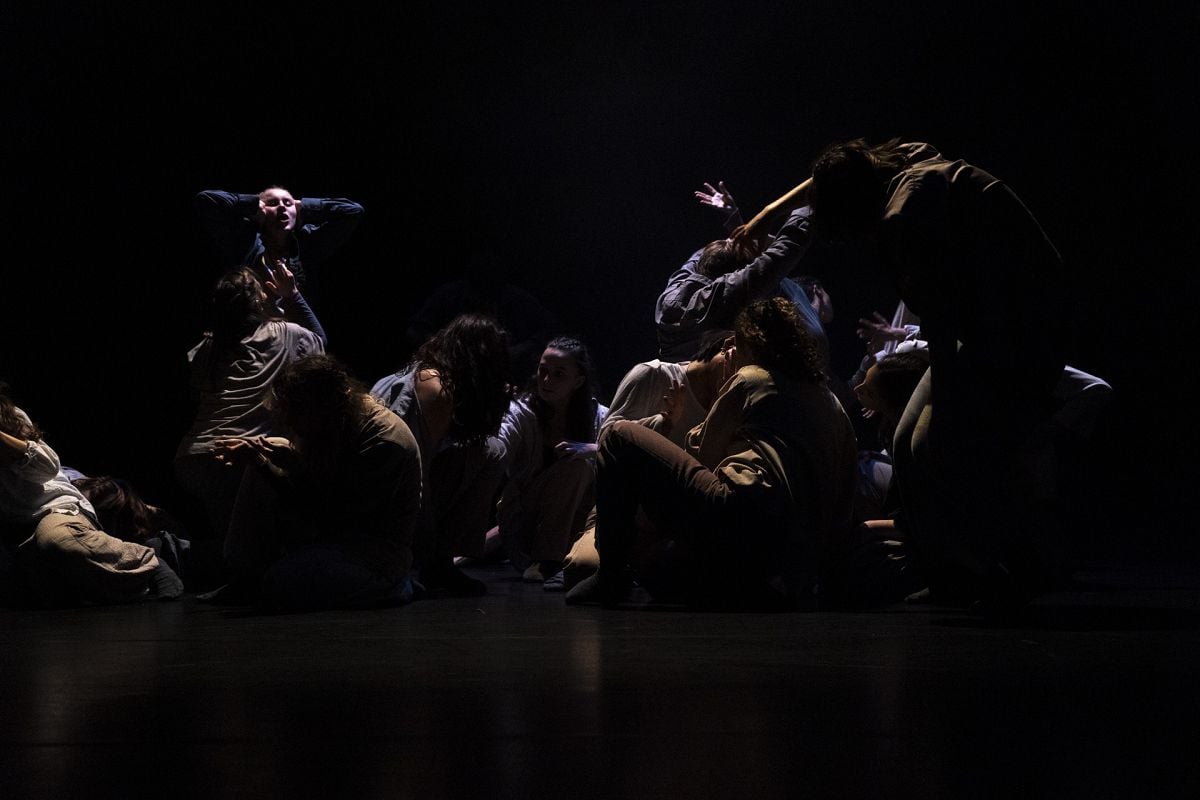
Italian choreographer, Sofia Nappi – the artistic director of KOMOCO – drew on the diverse cultural backgrounds of the dancers to create a work inspired by the Chimera of Greek Mythology – a creature that mixes lion, goat and serpent – with a view to creating a fusion of dance styles, in the choreographer’s words to create ‘a dynamic ensemble that’s more than the sum of its parts, much like the mythical creature.’ The end product is a playful and powerful piece that showcases the dancers’ individual identities within the group community. Creating the chimera, the movement was fluid like a snake, unpredictable as a goat, and powerful as a Lion. I loved it.
153 8s is a work that has been inspired by music, specifically four original tracks created by separate musicians that SAY regularly works with. Golding and Masui appear to approach their work by thinking how they would personally groove to a track. Like the other choreographers for this programme, the opportunity to work with so many dancers as a group is rare and SAY made full use of their resource by double-casting with ten dancers in each group. It’s hi-energy, pulsating dance that made me want to Shazam the tracks so I could listen to them again. If I were a few years younger, I would have wanted to join in!
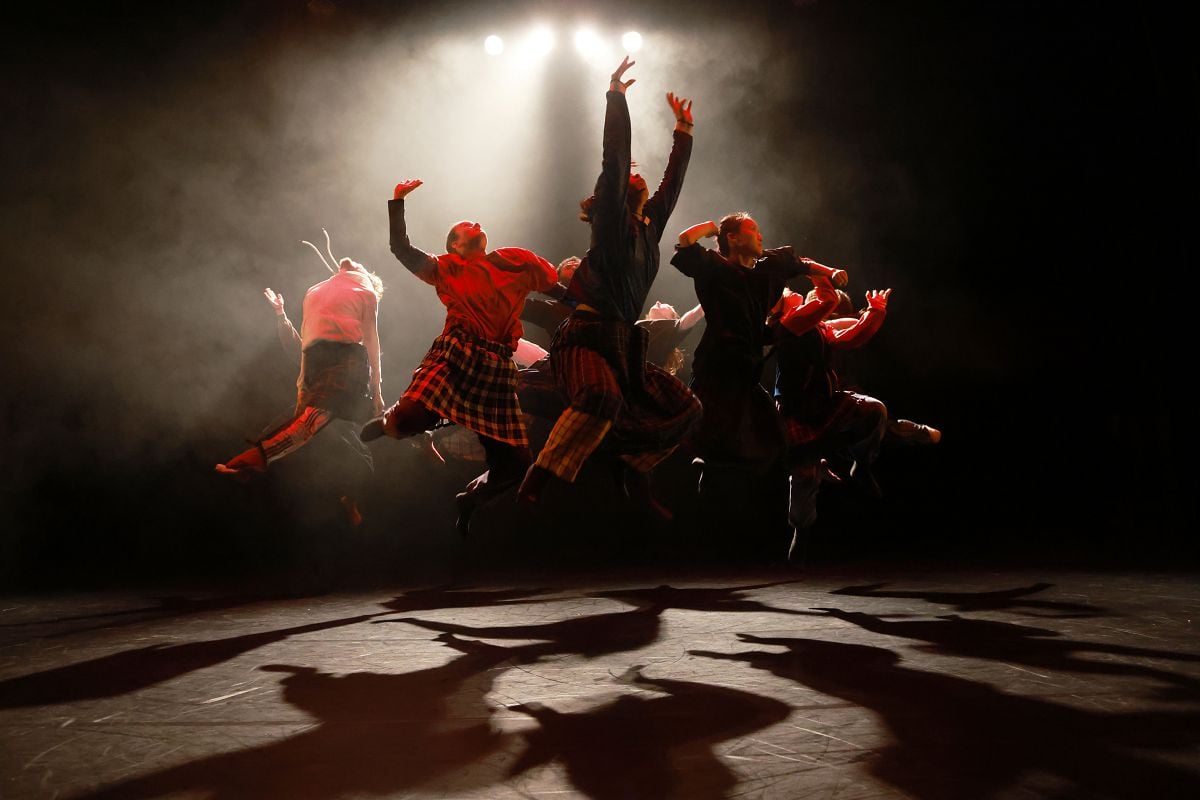
Euphoria is also created on original music (by James Keane) and it seems that Arnott and Robinson specifically encouraged the individual dancers to express themselves in the creative process of those aforementioned solos. Keane’s score is remarkably eclectic, bringing in so many different genres, including classical references (there’s even a riff on the Charlie Chaplin song, Smile – originally an instrumental piece for the film Modern Times). It was a remarkably professional piece that frankly I would not have been surprised to see a company of the strength of Rambert performing!
I came away from The Place feeling very upbeat about the future of contemporary dance, if this level of performance is what can be achieved by postgraduates; but also feeling rather sad because the number of dancers on view is almost certainly more than the number of jobs that are available in the contemporary dance world. I wish them all well.
As a postscript, this postgraduate performance offered a full, free and very detailed brochure-style programme, which puts the big companies and venues to shame for their post-pandemic cost-saving device of the ubiquitous cast sheet by QR code!

Graham Watts is a freelance writer and dance critic. He writes for The Spectator, Tanz, Shinshokan Dance Magazine (Japan), Ballet Magazine (Romania), BachTrack and the Hong Kong International Arts Festival and has previously written for the Sunday Express, Dancing Times, Dance Europe, DanceTabs, London Dance, the Edinburgh International Festival and Pointe magazine (USA). He has also written the biography of Daria Klimentová (The Agony and the Ecstasy) and contributed chapters about the work of Akram Khan to the Oxford Handbook of Contemporary Ballet and on Shobana Jeyasingh for the third edition of Routledge’s Fifty Contemporary Choreographers.
He is Chairman of the Dance Section of The Critics’ Circle and of the UK National Dance Awards and regularly lectures on dance writing and criticism at The Royal Academy of Dance, The Place and (until the war) for Balletristic in Kyiv. He was a nominee for the Dance Writing Award in the 2018 One Dance UK Awards and was appointed OBE in 2008.