
[Review] Dimitris Papaioannou’s INK – spectacular imagery but is it worth that waste of water?
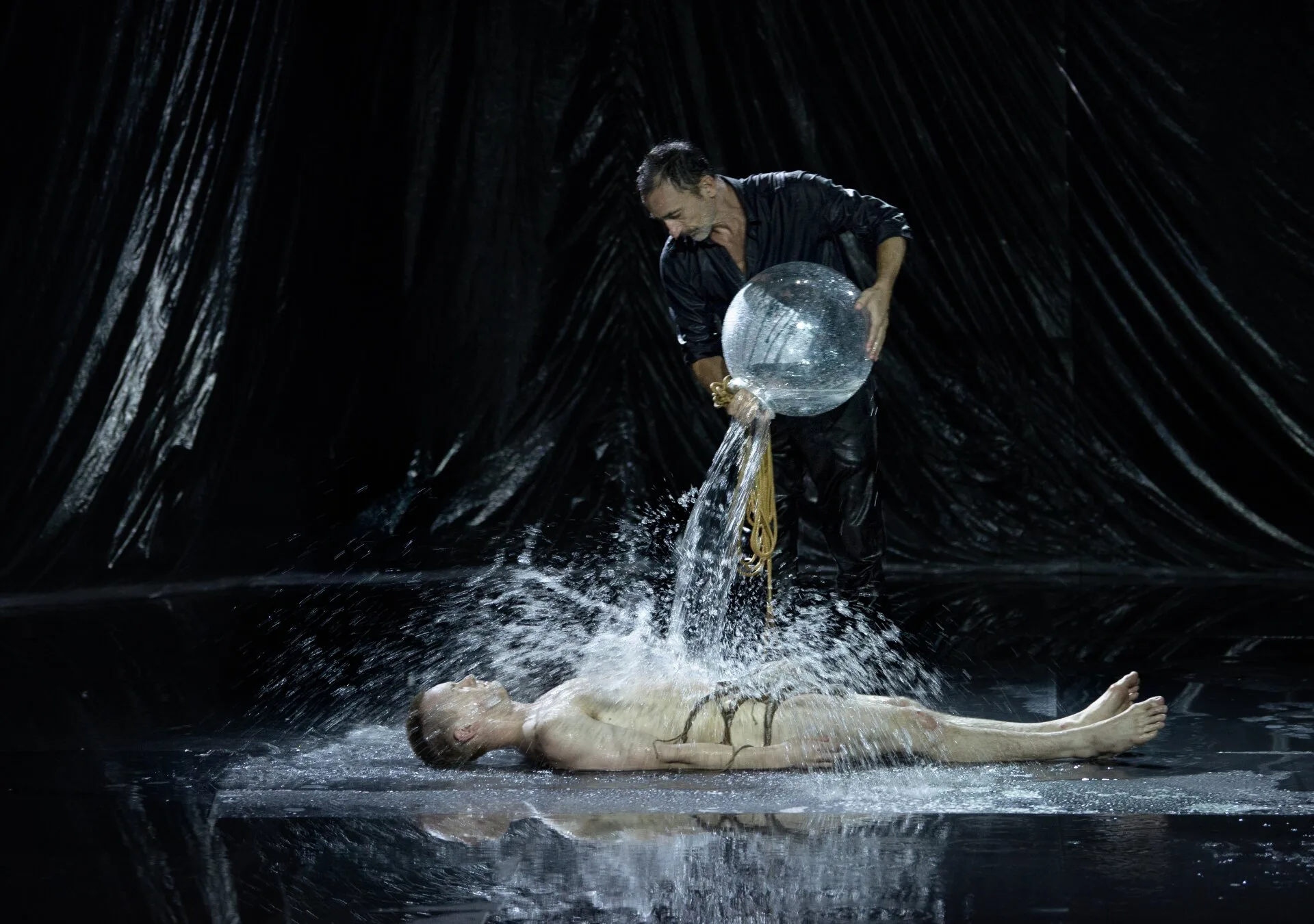
Graham Watts sees Dimitris Papaioannou’s INK in London but thinks that it contains “only occasional glimpses of his undoubted brilliance”.
| Title | INK |
| Company | Dimitris Papaioannou |
| Venue | Sadler’s Wells, London |
| Date | 28 February 2023 |
| Reviewer | Graham Watts |
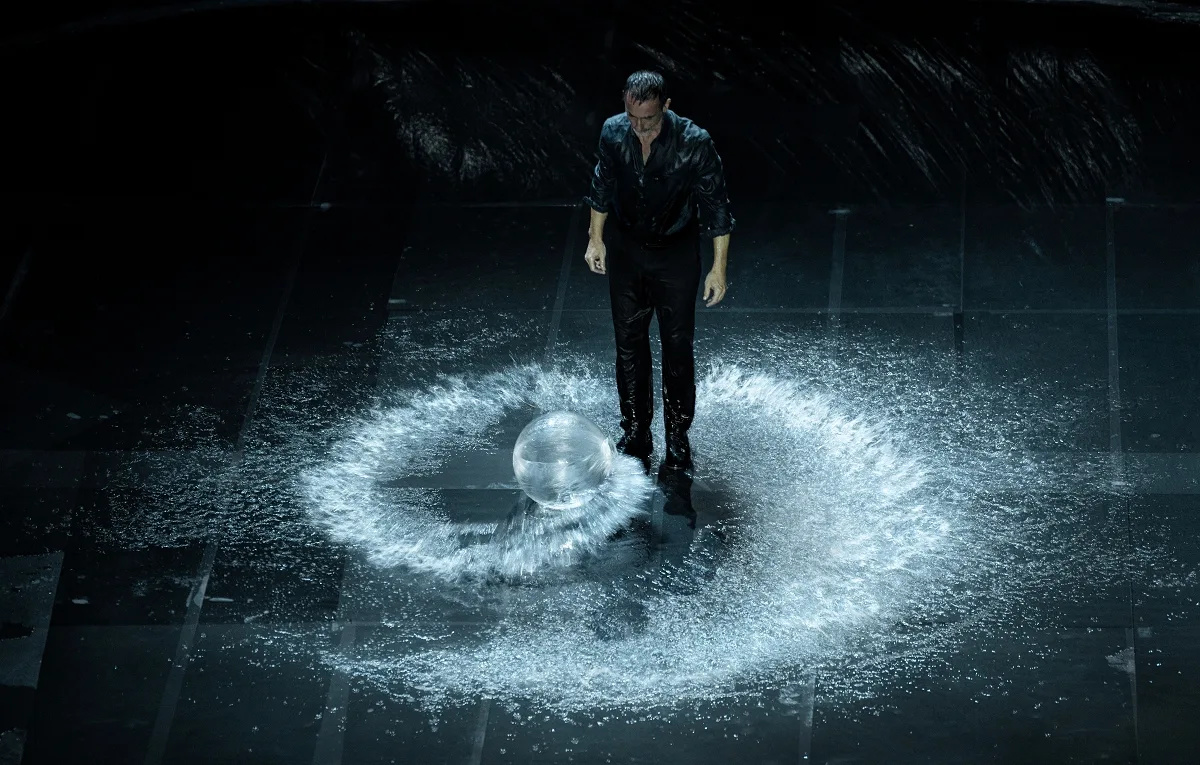
It is over a decade since Dimitris Papaioannou last appeared on the stage (in the duet Primal Matter) and – now approaching his 60th birthday – he has vowed that INK will be his last hurrah as a performer. I don’t say dancer since there is little movement in INK that I would describe as dance. By the way, the title is derived from the dark-coloured liquid released by most octopi. INK is, however, a world of water that opens with a huge arc of spray jetting out of what seems like a fire hose (or something similar); grey, reflective curtains contain the water, which sluices around on the Sadler’s Wells stage.
This stage is no stranger to water – I can think of Pina Bausch‘s Vollmond and Cloud Gate Dance Theatre‘s Moon Water as examples – but I remember none with such an ongoing torrential downpour. There is something unfortunate and ironic about washing one’s hands in the theatre’s conveniences and being reminded of how many baths can be filled by leaving a tap running and then witnessing a tonne of water (that’s 1,000 litres) being swished across a stage in the name of art. Some of it is apparently recaptured and reused for future performances but the operative word here is ‘some’. I wonder how many baths could be filled by the water that is lost? And is that profligate waste of water a good thing, even in the name of art?
Papaioannou’s stage presence is described as the ‘Dressed man’, wearing dark shirt and trousers, which are drenched from the get-go, whereas the only other performer, Šuka Horn, is the ‘Nude man’ and true to the description he is naked throughout the performance (although Papaioannou is often alone on stage). Papaioannou made INK with Horn during lockdown in 2020 when they lived in neighbouring apartments, in Athens.
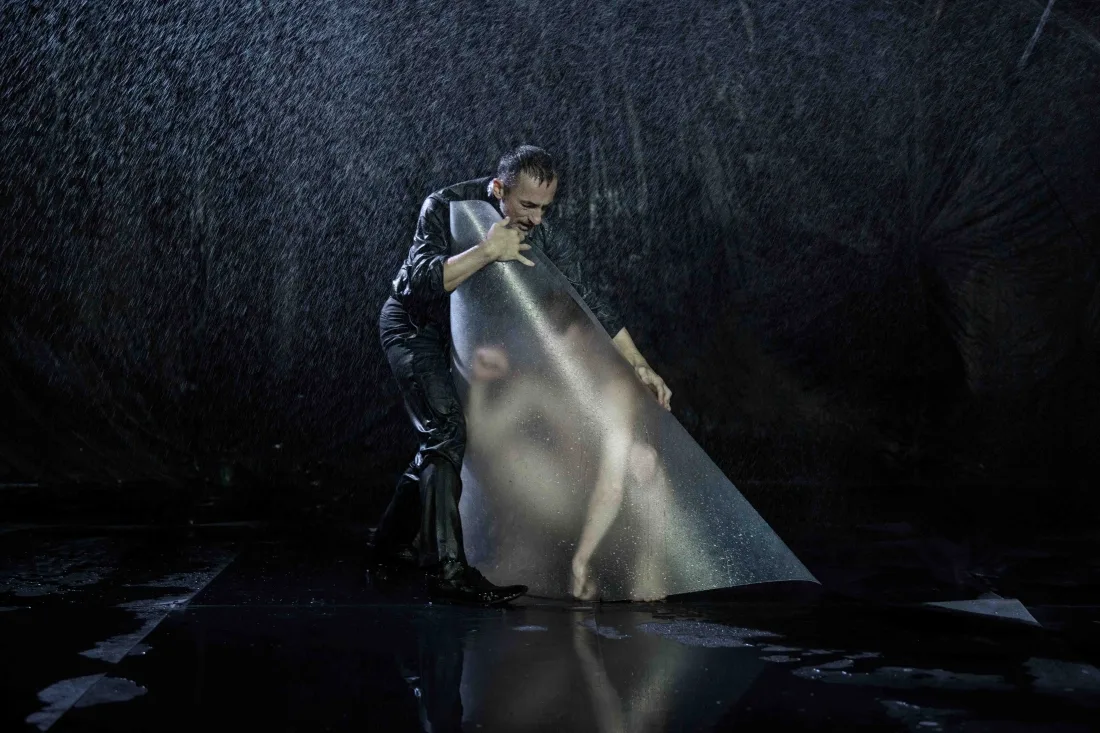


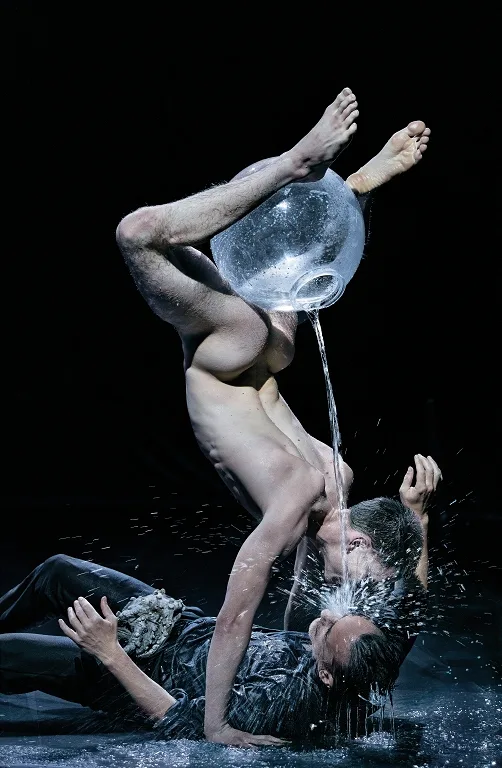

There appears to be some metaphysical relevance to this contrast of the clothed and unclothed man, perhaps in the context of birth and rebirth, but the physical interaction between the two men was mostly dreary and heavy-going, particularly in the leit motif of Horn being wrapped in a rigid plastic sheet, rolled into a tube, their marginally homoerotic male grappling accentuated by sliding about in the water in sequences that outlived any fascination that they may have had.
The other issue with so much water, particularly in such close proximity to electricity, is that it invites technical difficulty and the opening being delayed by 10 minutes and a hose not appearing to work as intended (to be quickly replaced by another) seemed to suggest that there were some problems. A spherical bowl with a small aperture was often filled from the hose and Papaioannou swirled the water around with his hand, which when withdrawn left the bowl circling the stage, spewing out even more water as it went on these haphazard journeys. Other props included something that looked like an octopus being temporarily used as a merkin to cover Horn’s genitalia and some mechanical fish that flopped about distressingly, their tales flapping around in the puddles: at one point, Papaioannou stamps on a fish and the whole shoal started to flap again (thankfully, the preamble to the show told us that no animals were harmed in the creation of the performance).
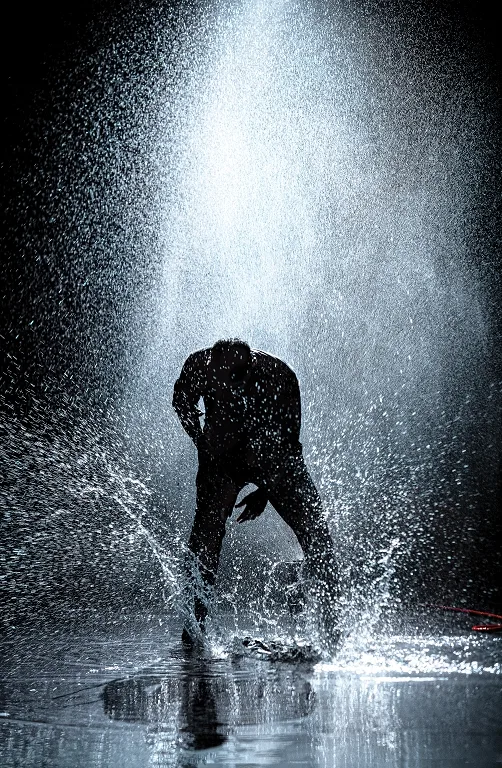
The upside of all that water is that it brought some occasional spectacular imagery. There were times when the gushing sprays branching out against the silvery grey background seemed almost like an impressive New Year’s Eve firework display; and an image of Papaioannou holding up the spherical glass bowl to gradually force back the jets of water was one of several money shots for photographers. These – and other – images were unquestionably beautiful but not, in themselves, adequate compensation for 65 minutes that were mostly more wearisome than fascinating. Papaioannou has brought some impressive and innovative performance art to this stage in the past (one thinks of The Great Tamer, Transverse Orientation – where his collaboration with Horn began – and Since She for Tanztheater Wuppertal) but I’m afraid that INK contains only occasional glimpses of his undoubted brilliance and, to my mind at least, it is certainly questionable whether it is worth that waste of water.

Graham Watts is a freelance writer and dance critic. He writes for The Spectator, Tanz, Shinshokan Dance Magazine (Japan), Ballet Magazine (Romania), BachTrack and the Hong Kong International Arts Festival and has previously written for the Sunday Express, Dancing Times, Dance Europe, DanceTabs, London Dance, the Edinburgh International Festival and Pointe magazine (USA). He has also written the biography of Daria Klimentová (The Agony and the Ecstasy) and contributed chapters about the work of Akram Khan to the Oxford Handbook of Contemporary Ballet and on Shobana Jeyasingh for the third edition of Routledge’s Fifty Contemporary Choreographers.
He is Chairman of the Dance Section of The Critics’ Circle and of the UK National Dance Awards and regularly lectures on dance writing and criticism at The Royal Academy of Dance, The Place and (until the war) for Balletristic in Kyiv. He was a nominee for the Dance Writing Award in the 2018 One Dance UK Awards and was appointed OBE in 2008.



To my shame, I confess to having been dazzled by the beautiful effects of the lighting on the water and did not reflect on the environmental responsibility that we all must share. I was concerned for the theatre and the audience in the stalls at times, but, how typically ‘human’ of me, I did not consider the environmental costs.
The work may have more depth than was perhaps initially apparent. Was it a love story, Dimitris was asked in the post show Q&A. Having replied in the affirmative, he went on to discuss , referenced personally, how control and ultimately destruction was a trait of relationships. The carnal gorging on the fish, ripping out red chunks that by the end were collected on the front of water tank, suggested the kind of self indulgence that may, if one was to be critical, could be said to characterise INK as a whole. However, the creation and perfornance of such a physically and technically challenging work was and is a terrific feat. I also reflected on the complete absence of dance, but physical theatre has often been the main action in some creators work, DV8 comes to mind.
This isn’t DV8 level work.