
Review – La Bayadère at La Scala with Nicoletta Manni and Kimin Kim
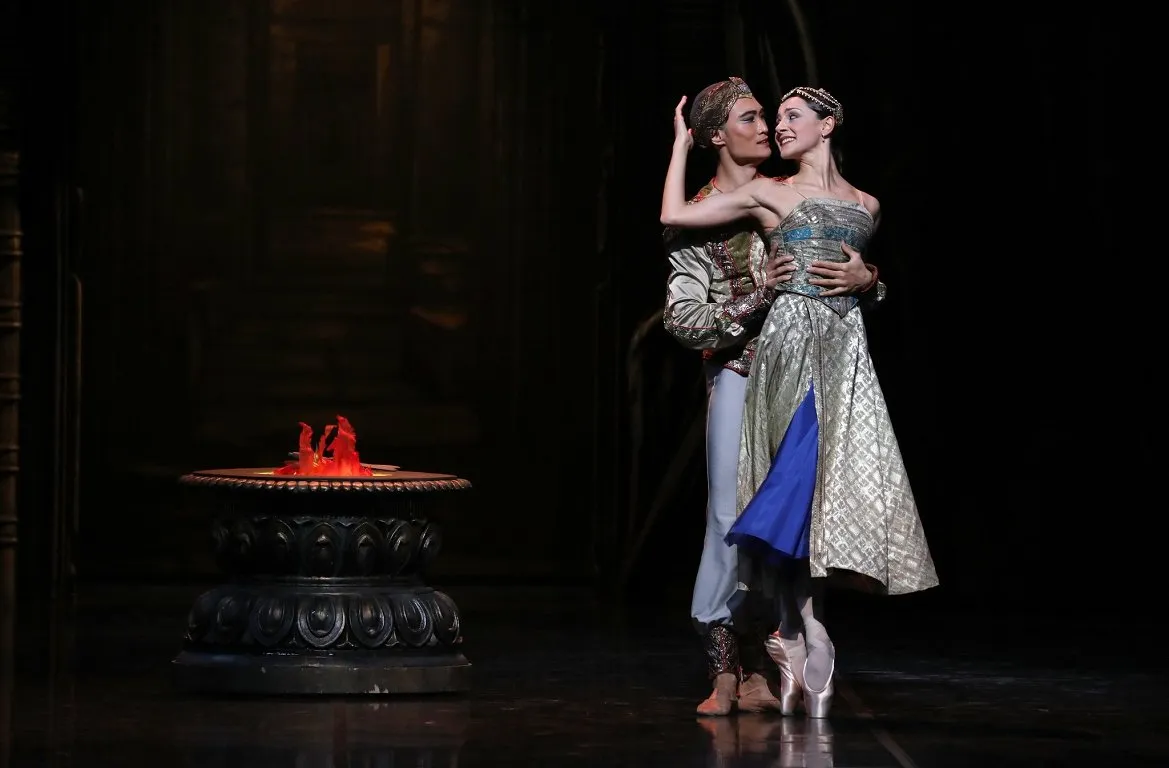
His first entrance saut de chats provoked audible gasps, he hovered in the air for his effortless double cabrioles during the engagement celebrations of the second act, Nureyev’s eccentric solo before the descent of the shades saw him repeatedly landing in textbook fifth position, and the manège of double assemblé turns in his ‘shades’ act variation elicited thunderous applause. And so was Kimin Kim’s debut at La Scala as Solor in La Bayadère.
Happily, the Korean principal dancer with the Mariinsky Theatre is not just a box of circus tricks, though the wow-factor was appreciated. His seemingly disarticulated shoulders – allowing him a generous Russian port de bras – together with his soft jumps and high cheekbones made for an elegant and regal presence. His acting was subtle and well-judged, though I wonder whether it carried to the back of the auditorium. He has a slender physique yet is a strong partner and an attentive and capable one too. Maybe some of his multiple turns went off-axis, but he completed them all with panache. Truly satisfying.

La Scala‘s étoile, Nicoletta Manni, was more touching than I remember from the premiere of this production at the end of 2021. That was a tense time with the opening performances cancelled for yet another Covid outbreak, corps numbers were inevitably reduced (the parrot dancers went from twelve to eight to six), and dancers were still regaining strength after lockdowns. Now Manni entered as Nikiya with great assurance and demonstrated aplomb after aplomb. She was sensually flexible then explosively energetic with the flower basket during the engagement scene, and the scarf variation (which saw her come a cropper two years ago) was perfect, both to the left and the right, finishing each time with a double pirouette. If the attempted stabbing of Gamzatti wasn’t believable, then that is a criticism of much of the pantomime which tended to be minimal, almost apologetic, yet with Ludwig Minkus’ score – played excitingly and with great momentum under the exuberant baton of Kevin Rhodes – it would be hard indeed to overdo it, especially with the dramatic climaxes for the ‘kill’ gestures.
Alice Mariani who does one of the ‘kill’ gestures just after the failed stab attempt, was technically impressive as Gamzatti, though her usually highly expressive face didn’t come across. Maybe the fault of the lighting? Marco Filibeck fills the stage with blinding white light to the front of the stage, and the whole scene seems flat. One advantage of white light is that Luisa Spinatelli‘s exotic colour combinations for the costumes jump out, but there must be a happy compromise of depth, atmosphere and colour preservation. The Shades scene in the final act suffered from bland lighting. If compared to John B Read’s meticulous line-by-line reveal with a mysterious blue/turquoise tint in Natalia Makarova‘s version, this was truly dull. Happily, the corps de ballet was magical (no wobbles) and at the end of their opening section the applause rivalled that of Kimin Kim.


The drum dance is challenging for ballet dancers who haven’t had training in character dance but Caterina Bianchi and Christian Fagetti gave it their all and wile it wasn’t the Bolshoi it was rousing nevertheless. Domenico di Cristo has a big personality and as the Fakir was riveting throughout, both in the drum dance and during the opening scene.
Fakirs and temple dancers, Brahmins and the Manu dance. La Bayadère was a typical product of an age fascinated by Asian culture – just as a few decades earlier, Donizetti had been obsessed with that far off land… Scotland. While no one minds a Scottish variation in Coppélia, the Chinese and Arab variations in Nutcracker can be tricky, and in the current political environment it’s important to navigate with sensitivity. But La Bayadère is a minefield. At La Scala, the blackface “danse des negrillons” has become the children’s dance, the dead tiger is no longer paraded (though the snake is still killed by whacking it against the floor), the elephant is a giant children’s toy, but priests and temple dancers abound. And there’s a Bronze Idol too.
Mattia Semperboni as the Idol, one of the most anticipated variations of the ballet, was competent though lacking in chutzpah. The three Shades variations went downhill, with an excellent Agnese Di Clemente (who had also shone in the ‘Manu’ jug dance), followed by an uncertain Camilla Cerulli, and finishing with Gaia Andreanò who lacked assurance and grace.
Nicoletta Manni had a triumphant evening, but this was Kimin Kim’s night, and in his applause I detected an element of protest – it is rare that La Scala invites guest dancers nowadays, and certainly the audience was making sure that the theatre management could hear that star dancers from around the world are welcome in Milan.

Graham Spicer, aka ‘Gramilano’, is a writer, director and photographer based in Milan. He was a regular columnist for Opera Now magazine and wrote for the BBC until transferring to Italy. His articles have appeared in various publications from Woman’s Weekly to Gay Times, and he wrote the Danza in Italia column for Dancing Times magazine. Graham was the historical advisor on Codice Carla, the 2023 documentary on Italian ballerina Carla Fracci.
Graham also works as a dance photographer, and his photos have appeared in many books, theatre programmes, and magazines, including Dancing Times, Dance Spirit and Ballet2000, as well as all the major Italian newspapers.
He is a member of the Dance Section of The Critics’ Circle.



Thanks for a very enjoyable review. I’ve never seen the Nureyev Bayadere or the La Scala dancers in person. I did see Kimin Kim in Makarova’s staging at ABT in 2019. He was an absolutely stupendous Solor. It’s good to know he is still fabulous!