
Review: New York City Ballet at Copenhagen’s Tivoli Gardens

Matthew Paluch sees the New York City Ballet in Copenhagen: “high-octane, sassy physicality”.
| Title | New York City Ballet repertoire |
| Company | New York City Ballet |
| Venue | Tivoli Gardens |
| Date | 17, 18 August 2024 |
| Reviewer | Matthew Paluch |
I’ve been known to cross the Atlantic many a time for a New York City Ballet (NYCB) hit… so in comparison, a visit to Copenhagen is basically around the corner.
NYCB performed seven shows of two programmes at the Tivoli Concert Hall between 14–18 August, and I attended both shows on the Saturday and Sunday allowing for two casts of Programme A and one of Programme B.
The company was last in Copenhagen in 2018, and this visit sees it present seven different works.
Programme A opens with Balanchine’s Serenade (1934) and the 32-minute masterpiece is structured in four movements: Sonatina, Waltz, Russian Dance and Elegy. This of course relates to Tchaikovsky’s Serenade for Strings in C, Op. 48 (1880), with a switch of the third and fourth ordering, and anyone lucky enough to dance this piece will surely experience a spiritual journey.
I never tire of the complete ballet, but especially the group work of the Sonatina. Have we ever seen such rich corps de ballet work since? The choreography allows one to analyse the Balanchine dancer – the undeniable balance of fearlessness and the strength to back it up.
There are two key aspects in the performance – the ongoing speed and presentation of preparation, enabling the dancers to always be on, if not slightly ahead of the music, and a differing approach to projection. This I noticed in an arabesque tableau, and thought, ‘Do the arms look dead?’ But then realised that Balanchine dancers feel projection differently.
To explain, I don’t believe they like to stay still for too long, and their projection emanates from the chest, encouraging the notion of next, forward. So in some ways, the arms are an afterthought, or an extension of suspension rather than its lead intention.
The two principal men, Peter Walker and Aarón Sanz were in fine form, with Walker bringing masses of movement to his score.
Emilie Gerrity (Dark Angel) was in constant conversation with the conductor and orchestra, and Indiana Woodward (Russian) continues to define her place in the senior ranks of the company’s history. She is so alive in all she does and doesn’t lack a millisecond of clarity.
Sara Mearns (Waltz) seems to be in another phase of her esteemed career – the experienced ballerina. Her younger self perhaps showed more abandon, whereas now, there’s evident consideration as part of the equation. Any initial reservation dissipated as the ballet progressed, and by the end of the work her resignation, in both the role and ballerina embodiment (I proffer), was heartbreaking. A deep partnered cambré seemed to exude transcendental awareness, and this only comes with experience and profound connectivity to the art form.

Following is Justin Peck‘s Pulcinella Variations (2017) to Stravinsky’s Pulcinella Suite with cubist-inspired costumes designed by Tsumori Chisato. For the record, we don’t have anything like this in London: someone using the danse d’école and its training to inform choreographic evolution.
We also don’t (really) see any Peck repertoire, but my NYC visits allow for more understanding of his idiosyncratic language. I enjoy his application of physics, something I’ve labelled the backdraft effect, where he launches dancers forwards and then immediately pulls them back. Elsewhere he’s often exploring the possibility and speed of alignment in motion. All the regulars are there in abundance, but he also seems to favour a croisé without opposition, as in ‘same arm as leg’. It works because of its opulence.
Pulcinella Variations begins and finishes with court style movement and patterning, and the filling has numerous solos and two pas de deux. Peck is an extremely musical choreographer, but he doesn’t let it dictate every aspect of his work. At times his dancers are on the beat, at others, they glide over the rhythm which allows for an understated sense of virtuosity not often encountered.
The first cast in Copenhagen was top-notch, and included Sara Adams, Miriam Miller, Tiler Peck, India Bradley, Emma Von Enck, Preston Chamblee, Jules Mabie, Chun Wai Chan and KJ Takahashi.
For me, most outstanding were Adams – luxurious execution; Von Enck – effervescence personified; and KJ Takahashi – undoubtedly the new NYCB firecracker.
Mabie is a very interesting, tasteful dancer, but it feels like he needs to develop his confidence in performance. He has the making of a danseur noble no doubt.
To Tiler Peck! One of the world’s pre-eminent ballerinas… but why? I believe it comes down to core strength. Her axis and the power within it means that all her attention can be focused on execution and nuance. She seems permanently on top of the work, never showing a moment of question. This could feel predictable but somehow doesn’t, as what she offers is so sumptuous in coordination and dynamic range.
And is it little wonder the cast dances so well when performing to such a sophisticated, wide-ranging composition as Stravinsky’s Pulcinella Suite? I think not.

The final ballet was another Igor moment. This time, Balanchine’s Stravinsky Violin Concerto (1972). Stravinsky composed the score in 1931, and it begs the question: where would ballet be without him? Let’s not go there…
I don’t know the piece well, but it’s rapidly becoming my ‘new favourite ballet’. The music is a riot, as is the dance, and the overall structure works around two main pas de deux.
Each principal dancer in the opening section has some high–spirited airtime with a gang of cohorts, often entering and exiting the stage in a nonchalant, stalking fashion.
The two duos are the substance of greatness. They are often nonsensical in both content and structure, which means one is permanently glued to the unpredictable action. There’s a predatory play theme interwoven throughout that recalls the mating rituals one sees in nature. It feels like Balanchine went full evolutionary circle when he was developing his dance language and choreographic style – from Neanderthal to sophisticated and back again. Pointe-shoe-jammed-under-partner’s-chin wouldn’t work anywhere else, but here it does. The same goes for thumbs up port de bras and coquettish little kicks a-plenty. You can afford to be nonsensical if what you’re offering is newness itself, as there isn’t a comparative framework at hand. I found myself beaming throughout, sometimes laughing out loud at the audacity of the content. What a hoot.
As for the dancing… just wow. Peter Walker returned even more cathartic than before, and Emilie Gerrity offered another fresh take on unadorned pizzazz.
Seeing both Unity Phelan and Taylor Stanley took me back to that place I know so well – the reason I adore NYCB. Phelan is an anomaly, as she has a body type that should struggle with speed and precision, but she doesn’t. And her flexibility means that we can witness extremity in the correct context (for once!) which, as an experience, can’t be beaten.
Stanley seems born for Balanchine, as he taps into the avant-garde, jazz aspect of the lexicon like nobody else. And even though he’s completely immersed in his choreography, every so often he’ll pop a pose even more realised than one can imagine, or punch the audience with a knowing stare. It’s a modernist revelation in action.
Sunday evening offered an alternative cast of Programme A.
Serenade was led by Mira Nadon, Emma Von Enck, Miriam Miller, Chun Wai Chan and Davide Riccardo, and was a handsome cast to say the least.
Miller (Dark Angel) brought big dancing and glamour, Enck (Russian) explored every movement to its fullest, and Nadon (Waltz)… well many things. She seems to inhabit both the past and present simultaneously, respecting and understanding the choreography while very much beginning to shape her personal journey within it. Who knows where she’ll take it in 5 years’ time?
Chun Wai Chan must have the best proportions in the business, and Davide Riccardo seems engrossed in the possible drama his role might offer. It was a strong, second interpretation by all.
Pulcinella Variations was danced by some different cast members, but not entirely. The new arrivals included: Meaghan Dutton–O’Hara, Sara Mearns, Unity Phelan, Mary Thomas MacKinnon, Gilbert Bolden III, Andres Zuniga and Harrison Coll. And I must admit that on a second viewing, the costumes seem a little unnecessarily absurd.
The first pas de deux suits Mearns’ languishing style of adagio (she originated the role) and Zuniga makes a definitive presence with his clipped, articulate movement. I also very much enjoyed MacKinnon’s dancing; someone I had already noticed in previous performances. She has a buoyant ballon and an omnipresent power in all her movement, which suggests she could handle more featured work.
Stravinsky Violin Concerto closed the evening again, led by Ashley Laracey, Peter Walker, Mira Nadon and Aarón Sanz. Walker we saw previously, but the other three are new.
Nadon seems to be having the time of her life, and why not? She’s in her early twenties and getting to dance these illustrious roles. I see something so feline in her movement quality, where energy builds before she pounces into the next step or phrase. And as we know, ballet is so much more than just grand jeté, but her execution is the stuff of urban legends; effortlessly sky-high from seemingly nowhere.
I’m already a big Laracey fan, so need no convincing. She’s limbs for days, and shows line and use of space felt all the way at the back of the house. Laracey feels old-school NYCB, in the sense that she doesn’t oversell and lets the movement language do most of the talking. It’s a potent combination.
Sanz did an acceptable job but currently lacks arresting individuality in the role. He and Nadon also need to do further partnering research, as certain sections felt more rough than extreme.


Programme B opened with Jerome Robbins‘ Fancy Free (1944) which seems like an appropriate American export to tour with. Add into the equation the Leonard Bernstein score, and it’s a done deal.
It’s the story of three sailors ‘on the town’ and how they don’t really learn from their scallywag ways.
Robbins’ choreography is always watchable, with such distinct style and originality – it’s what other makers dream of creating, I imagine.
Bernstein’s music acts as major inspiration with its unpredictable phrasing, but in reality the lack of roundness can get a little exhausting after a certain point.
The cast – Daniel Ulbricht, Harrison Coll, Sebastián Villarini–Vélez, Lauren Collett, Indiana Woodward, Malorie Lundgren and Lars Nelson – all did a super job, and reaffirmed the clarity of movement NYCB dancers offer.
Robbins choreographs personalities with ease, and this is never more evident than in the solos for the three sailor protagonists – explosive, romantic and ironic. And the double tour to the splits – performed by Daniel Ulbricht – can’t be underestimated.
Fancy Free isn’t my favourite Robbins piece, but I can completely understand why it’s been programmed, and the fact it’s 80 years old and still timeless says a lot.
Opening the second part was Balanchine’s Allegro Brilliante (1956) and what a total humdinger of a performance. We had the honour of Tiler squared in the principal roles – Tiler Peck and Tyler Angle.
Does any other ballet have the same level of energised opening as Allegro Brilliante? The extraordinary score (Tchaikovsky’s Piano Concerto No 3) starts, and when the curtains open the four soloist couples are already in the throngs of feverish allegro in a circle.
The dancing throughout was sublime, but Tiler Peck is a megastar. It’s even difficult to comprehend her level of skill – she’s perfect, and I’m not overexaggerating. She doesn’t seem to perspire, her movement is like smoke – you almost don’t see it, but it knows exactly where it’s going – and this is how things unfold.
I realised partway through that the ladies’ costumes don’t even have time to settle in between executions. Yes, the dancers may momentarily suspend, but the chiffon doesn’t have time to finish its journey before the body has moved on. This notion is the essence of Balanchine and New York City Ballet – don’t blink because you’ll undoubtedly miss something. I won’t forget this experience for a while.


Following was Christopher Wheeldon‘s This Bitter Earth (2012) danced by Unity Phelan and Chun Wai Chan to the Dinah Washington/Max Richter score. They look gorgeous, individually and together, and their rendition brings a chicness to the pas de deux. Created on Wendy Whelan, I feel there’s an approach lacking as it currently stands though. Whelan had an economic way of moving. She’d get to the point quickly rather than languish or oversell the journey. This individuality obviously inspired Wheeldon and the movement he created on her (think Polyphonia from 2001), and at times the simplicity and internal intention required seemed to be superseded by more performative execution. It’s not about copy and paste, but performances should be more informed as the work evolves.
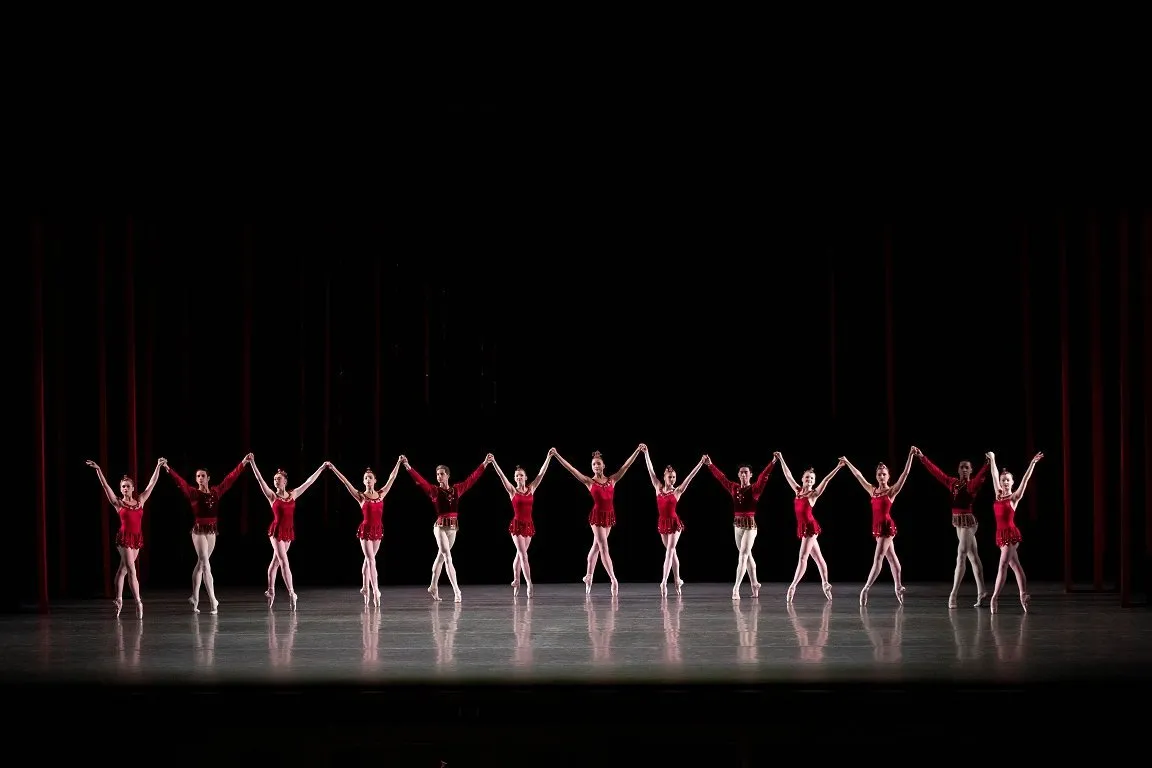
Closing the bill was Balanchine’s Rubies (1967) from the full-length Jewels. Choreographed to Stravinsky’s Capriccio for Piano and Orchestra, it’s the epitome of what to expect from ballet in New York – high-octane, sassy physicality.
If the company brought a hawk-eyed répétiteur then there’ll be notes. For me the female corps de ballet felt a little too blasé on the Saturday evening but redeemed themselves on the Sunday matinée, so perhaps I’ll leave it there, but there’s a difference between nonchalance and unfocused.
The principal cast however was a different story (at both performances). Isabella LaFreniere as the Soloist lady is the real deal. She didn’t miss a mark and offered both spotless execution and buckets of knowing wit. Megan Fairchild and Anthony Huxley are the current, go–to first cast for the principal couple, so they know their way around the fiendish choreography. They’re both pocket rockets and clearly enjoy dancing together. Fairchild is a risk-taker who moves like there’s no tomorrow, and Huxley finds a pitched balance between aloofness and athleticism.
The audiences at all performances were on their feet at the end, and the dancers relished the fact that their work was going down well. Bravi also to the Tivoli Copenhagen Philharmonic for providing playing that wouldn’t sound out of place at Lincoln Center helped, one assumes, by the two NYCB conductors: Andrews Sill (Associate Music Director) and Andrew Litton (Music Director) in residence.
Watching NYCB is both a pleasure and an ongoing education. The Tivoli Concert Hall is a wonderful venue, even if slightly surreal when leaving after the show and finding yourself immersed in candy floss and fairground rides. I can’t wait to get back to New York to see more work by this one-of-a-kind company at my Mecca.


Matthew Paluch was awarded a place at The Royal Ballet School in 1990 where he graduated in 1997. His first four years as a professional dancer were spent working with London City Ballet, Scottish Ballet, K-Ballet and English National Ballet, becoming a full-time member of ENB until leaving in 2006.
Matthew graduated from the Royal Academy of Dance, Professional Dancers’ Teaching Diploma in 2007, and was formerly on faculty at The Royal Ballet School. He completed his Masters in Ballet Studies at Roehampton University in 2011, has been a freelance writer since 2010 and currently works in the Law Sector.
He is a member of the Dance Section of The Critics’ Circle.




Wow wonderful blog layout How long have you been blogging for you make blogging look easy The overall look of your site is great as well as the content
Your blog is a beacon of light in the often murky waters of online content. Your thoughtful analysis and insightful commentary never fail to leave a lasting impression. Keep up the amazing work!