Review: The Female Gaze with Kammerballetten in Copenhagen

Matthew Paluch is glad to be back in Copenhagen to see Kammerballetten’s The Female Gaze at Takkelloftet of The Royal Danish Opera House.
| Title | The Female Gaze |
| Company | Kammerballetten |
| Venue | Takkelloftet, The Royal Opera House, Copenhagen |
| Date | 16 August 2024 |
| Reviewer | Matthew Paluch |
2024 is my second viewing of Kammerballetten in Copenhagen and I’m glad to be back.
The programme this year is called The Female Gaze and includes four works by female choreographers presenting their “interpretation of the significance of classical dance [*] and music… in our modern society”
The evening opened with a musical interlude, Beethoven’s Largo assai ed espressivo played by Trio Vitruvi and the drama of the piece set the tone of the evening.


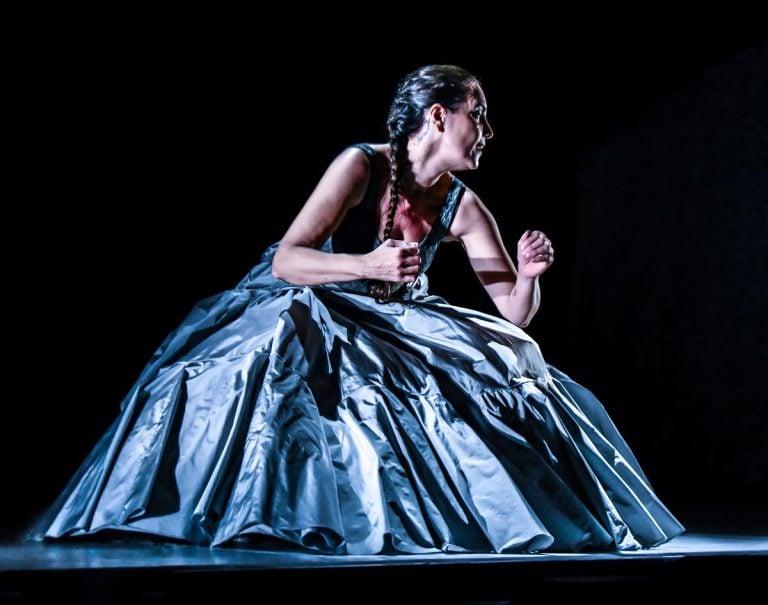
The first dance work was The Guests by Ella Rothschild, with a stellar cast of Pina Bausch dancer Nazareth Panadero, Doug Letheren and Rothschild herself. When work is created by, and on this calibre of artist the results will undoubtedly be important. The piece is dance theatre in nature including spoken word, gesture, movement phrases and props – a large rug, chair, atmospheric lamp and six family portraits hanging on the back wall.
Rothschild deals in nostalgia, and in the best possible way. She’s capable of communicating familiarity through movement, and I don’t mean just through obvious relationships, but rather the actual essence of how they might feel to the people involved.
As a dancer, Rothschild is quite something – sensitive yet with a powerful dynamic and with eyes that pierce wherever she looks. She’s also a consummate communicator of the exhaustion life can entail, seen through weighted bones and lethargic posture.
Letheren understands Rothschild’s agenda, bringing both poise and distress to his characterisation. As for Panadero, there are no words. Someone of her experience and depth needs only breathe and whatever work she’s in takes on another dimension of relevance.
The choice of Schubert, beautifully played by Trio Vitruvi, brings an addictive contradiction to the proceedings. Moments of chord-based anxiety, and others allowing Rothschild’s (at times absurd) poignant narrative to flow through the space.
One sitting isn’t nearly enough, as this is a work of gravitas, layers and longevity. And successfully said without the in-ya-face performative checklist of modern dance requirements we see all too often nowadays.


After the interval came Samantha Lynch’s Rascal, danced by Stephanie Chen Gundorph and Sebastian Pico Haynes of the Royal Danish Ballet. Having read the blurb, the notion of father/daughter connection felt communicated… but I wonder how I would have contemplated things without the prior knowledge. Lynch catches arresting moments of intimate dependency in partnering phrases, but elsewhere it feels predominantly on the busy side. The most powerful points seemed to advocate stillness or lingering… and I’d go more in this direction.


Following was the solo work I could’ve been green… by Esther Lee Wilkinson, danced by Liam Redhead (also of the Royal Danish Ballet). This is an interesting work that made me change my mind, as from the outset I wasn’t too sure. Redhead appeared as a talking cross between a Yeti and Cousin It (of the Addams Family) and aspects felt initially too Tryhard, but then things developed. The piece has spoken word moments of philosophical pondering, and though it sometimes verges on the preachy side, it feels worthwhile nonetheless – an attempt at discovering something more substantial. And out of these musings come dance interludes that definitely have merit; an outburst of infectious euphoria shown via vast, travelling jumping phrases or a nature-based meltdown emphasised through the application of green tears. Redhead makes the piece with his charismatic persona and generous dancing, but Wilkinson is responsible for giving him the idiosyncratic platform to do so.


Closing the programme was Emma Portner’s Elephant danced by Portner and Toon Lobach. The work looks at personal struggle in relation to the physical self and gives Portner an opportunity to communicate who she is. And who’s that? A mystical, important creative IMHO. The language is dense and not void of some recognisable, contemporary dance tropes, but there’s one major difference – Portner is the real deal. Therefore we see rapid gesture with purpose and subtlety, and convulsions to elucidate the intention of the maker or the individual they’ve become. Lobach is of course a dancer in his own right, but in this work he seems to support and elevate Portner’s presence, especially during the intricate partnering they puzzle and explore through together.
Portner is an enigma, and the epitome of a thinking dancer. I always disliked the term as it suggests that some don’t, but when observing Portner it makes total sense. Her intention in creation and movement is palpable, and her carriage is simultaneously proud and weathered. This performance was the first time I’ve seen her live, and it didn’t disappoint. In fact, it reaffirmed what I already knew – Portner is from another planet, and we’re all still light years away.
Bravo to all involved, and especially to Kammerballetten artistic director Alexander McKenzie and associate director Emma McKenzie. What they do has great value and has produced some of the most interesting modern work I’ve seen this year thus far. In closing, here are two thoughts for deliberation – I wonder how a venue change might feel. Something a little warmer with better acoustics to let the extraordinary playing soar even more? And as much as I enjoyed myself, I didn’t see any classical dance/ballet [*]. Wilkinson’s offering was the closest in relation to language and phrasing, and considering its mission statement I’d like to see Kammerballetten put its money where its mouth is as the genre, and its evolution need them to. ASAP.

Matthew Paluch was awarded a place at The Royal Ballet School in 1990 where he graduated in 1997. His first four years as a professional dancer were spent working with London City Ballet, Scottish Ballet, K-Ballet and English National Ballet, becoming a full-time member of ENB until leaving in 2006.
Matthew graduated from the Royal Academy of Dance, Professional Dancers’ Teaching Diploma in 2007, and was formerly on faculty at The Royal Ballet School. He completed his Masters in Ballet Studies at Roehampton University in 2011, has been a freelance writer since 2010 and currently works in the Law Sector.
He is a member of the Dance Section of The Critics’ Circle.