Review: London City Ballet’s Resurgence – energising and optimistic, sensitive yet bold
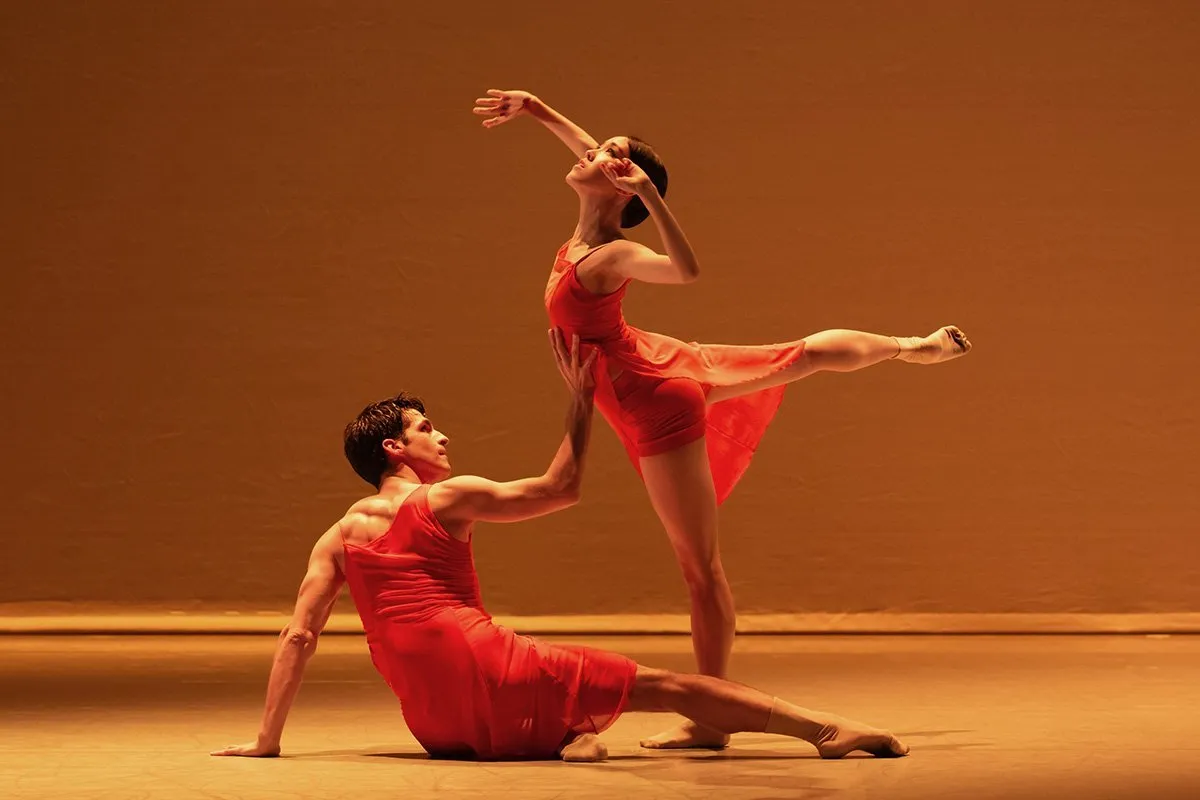
Lydia Wharf sees London City Ballet’s London debut with ‘Resurgence’ – LCB seems to have struck upon a delicate equilibrium here – one that honours its past without being weighed down by it.
| Title | Resurgence |
| Company | London City Ballet |
| Venue | Sadler’s Wells, London |
| Date | 12 September 2024 |
| Reviewer | Lydia Wharf |
There’s a phoenix rising from the ashes in the world of UK dance. London City Ballet has re-emerged after an absence of some 28 years, boasting 13 dancers, one very special guest, and an ambitious programme of five works, including two from Kenneth MacMillan and one from Olivier Award-winning Arielle Smith. The evening opens with a belter from prolific UK ballet-maker Ashley Page and concludes with a brand-new production from the group’s Artistic Director, Christopher Marney. This most mixed of bills has briefly toured ‘the regions’ in the UK and toured to China before delivering its debut at its London home, Sadler’s Wells.
A retrospective montage of images opens the evening, taking us on a whistle-stop tour of LCB’s former life. From humble beginnings to full-length ballets, Founder and Artistic Director Harold King created and sustained a company that was one of a handful of employers for UK ballet dancers, a London-based company touring high-quality productions across the country and overseas. In his own inimitable style, King was absolutely central to the development of the company, seen in this footage with the company’s highest-profile backer, Princess Diana. He is sadly missed, but his legacy is felt keenly here.
And so, to the dancing. Cutting through nostalgia with a full company number that feels like a statement of intent, Ashley Page’s Larina Waltz is 100% a crowd pleaser – the men look sharp in black, the women flash crystalline in pointe shoes and tutus, the movement is a physical articulation of Tchaikovskys’ confident classical score, Consisting mainly of pas des deux, all of which are performed with care and a lovely cadence, it’s a short, jubilant opener that reminds me that it’s ages since I went to the ballet.
Second up is the evening’s star turn from Alina Cojucaru – a ballerina with serious gravitas. She’s gorgeously gossamer in this revival of MacMillan’s Ballade, a chamber work made for one woman and three men. It originally premiered in Lisbon in 1972 and has lived on the shelf ever since. Reconstructed by Samara Downs using Benesh notation this lovely, most nuanced of works has been given new life by LCB with the support of the MacMillan Estate, and I’m here for it. A spare, white set with a white table upstage left provides a blank canvas for the four dancers, also all in white. What ensues is a playful study of interactions, a game of sorts. Cojucaru is deliciously low-key, allowing the men to make their ‘plays’ but keeping her own cards close to her chest, her character never obvious or over-played. She moves effortlessly, flitting across the stage with ease, followed or lifted by her suitors, and her insouciance creates an ambiguity that leaves ample space for the imagination to play. The work feels fresh and spacious, it prompts some great performances; all the more incredible to think that it’s taken over 50 years to bring it back to British audiences.
Arielle Smith, the only female choreographer on this bill, presents perhaps the most modern of the evening’s work. Heavy emphasis on ‘perhaps’. Five Dances is exactly as billed. Both literally – the five dances each unravel with different textures and tones – and figuratively, meeting the programme description ‘uplifting and joyful’. Bright washes of colour, expansive use of stage space and varied dynamics all round make this an enjoyable new work… but is it really modern? Whilst the dancers demonstrate some enthusiastic fluidity in the upper body, there’s otherwise a rigidity of the spine and a telltale reluctance to visibly exhale that prevents the dancing from feeling anything other than essentially balletic in form. A bitter discordance adds bite to John Adams’ score, but I struggle to find anything particularly challenging in the movement material. It’s all so…. well…. beautiful. To her credit, Smith doesn’t set out to disrupt or confront – her aim here is to celebrate the magic of live performance – but, as a fan of conceptual contemporary dance, I can’t help but feel that there’s an opportunity missed here. What a chance to give this audience something to really shake them; to think about on their journey home.
The second movement of MacMillan’s Concerto is a pas de deux set to the Andante section of Shostakovich’s Piano Concerto No. 2, music so beautiful it’s almost painful to hear. Macmillian’s choreography adds gorgeous arcs, languid lines and a harmony between the two performers that feels deeply moving. It was originally created for Rudolf Holz and Lynn Seymour, the latter describing the choreographer as “transporting curving movements of concentrated simplicity – an arm slowly dropping, a leg stretching sensuously – into a joyous pas de deux.” It’s a very exposing work, and Isadora Bless and Joseph Taylor bring nerves of steel to the table here. Both are able to hold the audience’s attention with unfussy confidence. At times, their performance feels a little hurried and I notice that the tempo of the movement is actually quite fast. I wonder whether part of the challenge here is to create the impression of time and space that isn’t actually there – I imagine that Seymour was very good at that.
The final act of the evening is a full company work, Eve by director, Christopher Marney. It’s an interpretation of the bible story that’s easy to follow, but there’s no Adam here – this is an opportunity to explore the relationship between Eve and the serpent, played ably by Alvaro Madrigal, and it’s an absolute treat to see Cira Robinson in the title role. Robinson, a long-standing former member of Ballet Black, is a seasoned performer who can easily carry a main role. I’d argue that her skill is not wholly exploited here – there are no revelations or surprises, either about the characters or in the movement material. The staging makes for an exciting theatrical experience though, and there are some coups de theatre that made this a favourite for my 14-year-old guest.
For me, including his own work is a good curatorial choice for Marney. It’s a pleasant way to round off a programme which feels well judged – energising and optimistic, sensitive yet bold. London City Ballet seems to have struck upon a delicate equilibrium here – one that honours its past without being weighed down by it. I’ll be interested to see what the future holds.

Lydia wharf is an independent producer working in contemporary dance theatre, tending to specialise in practices of care, access and inclusion.
She works directly with a range of artists and companies, most recently BirdGang Ltd, Dance Umbrella, Julie Cunningham & Company and Stuart Waters. Lydia has a long, twisty relationship with dance, as performer, writer, advocate and producer.