Review: Diana Niepce’s The Other Side of Dance – “she’s a live sculpture in orbit”

Matthew Paluch sees Portuguese performer Diana Niepce, who suffered a spinal cord injury, exploring the dialogue between agency and vulnerability.
| Title | The Other Side of Dance |
| Company | Diana Niepce |
| Venue | The Queen Elizabeth Hall, Southbank Centre, London |
| Date | 16 October 2024 |
| Reviewer | Matthew Paluch |
The Queen Elizabeth Hall is a special place. It seems to literally hum with presence. As the lights dimmed for Diana Niepce: The Other Side of Dance the overall sense was one of collective ceremony – the audience were ready to experience something original, and we did.
The work is part of the ongoing Dance Umbrella Festival 2024 and continues the deeper message of being “a programme that puts emerging and diverse talent at its heart”.
Niepce is a Portuguese dancer, choreographer and acrobat who suffered a spinal cord injury from a trapeze accident and has since endeavoured to “present the non-normative body as revolutionary rather than victimised” – and she’s succeeding.
The piece sees Niepce supported by three ‘performer assistants’, and in fact this is how the work begins, with Niepce being dragged onto the stage by a leg and left motionless on the floor.
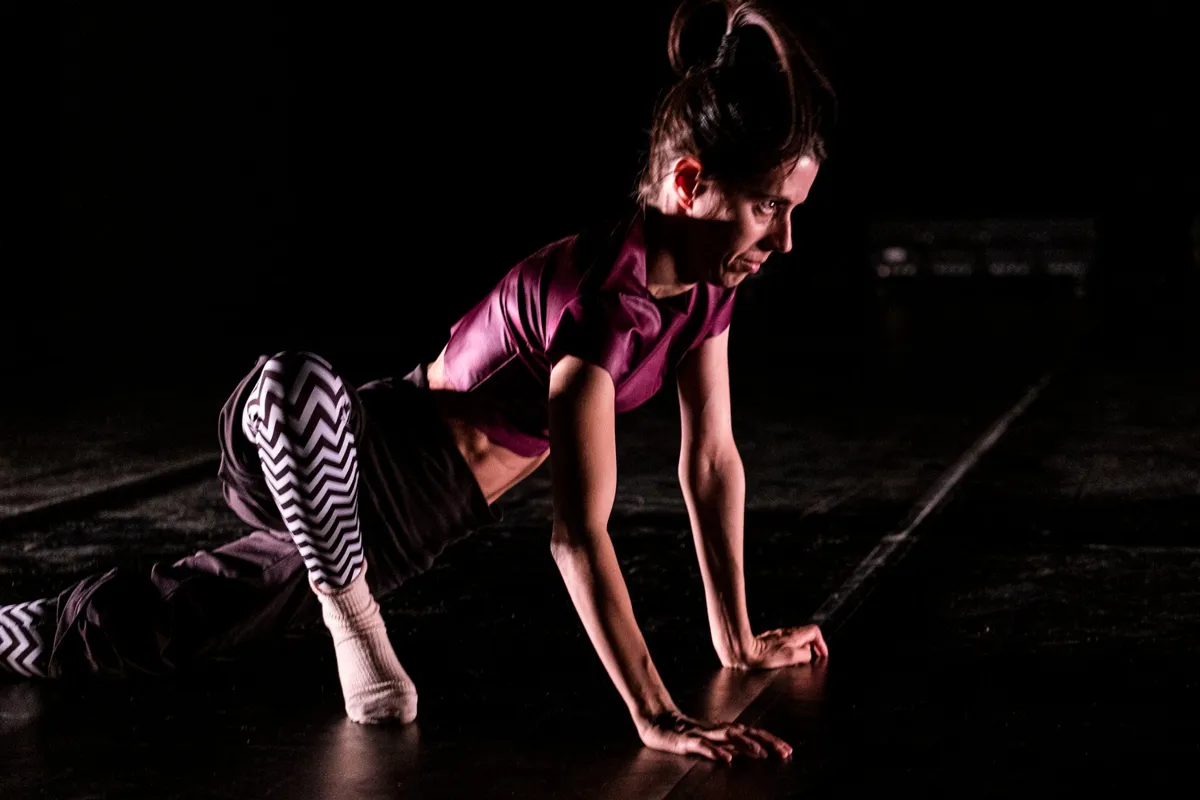
In the centre of the space is a large contraption from the seesaw family, but this isn’t used until the second section. In the first half Niepce explores her personal space and body, and through doing so introduces an overarching contradiction present throughout the work – the dialogue between agency and vulnerability.
She pushes away from the floor questioning her own upper body strength, sometimes showing accomplishment, other times communicating struggle. Her body harnesses great power in the core, and then she reminds us of necessity by dragging a leg in the direction that she wants and needs it to move in. This quiet, omnipresent physical dialogue makes for original viewing. As does Niepce’s strong eye focus and vertical, spiky ponytail reminiscent of an aerial of sorts. Moments of striking port de bras are comparable with petroglyphs – equally powerful in their two-dimensional form and the quiet mightiness Niepce imbues them with.

One of the ‘performer assistants’ places a harness on Niepce as she lays on the ground, and then helps her become as one with the aforementioned contraption. Another assistant acts as a counterbalance at the back as we see Niepce stand for the first time in the work. A V-shaped armrest allows Niepce to be in control of her whole body via her own arm strength, and she and the counterbalance assistant play with off-kilter positioning and form, sometimes overstepping the mark, failing and actioning an assisted reset to start the journey of exploration once again.
At a certain point the seesaw is used to lift Niepce skyward, initially vertically positioned she hangs and then drops quite suddenly onto a hooked arm. This action takes one aback, revisiting the agency/vulnerability dialogue with surprising impact.
The next aerial journey sees Niepce first sit, in an almost slumped manner before reclining into a horizontal positioning. All of this happens as the omnipresent assistant starts to rotate Niepce in slow motion revolutions. Carlos Ramos’ sparse lighting design highlights every sinew of Niepce’s lithe body, and she’s at once live sculpture in orbit. Her stillness against the slowness of the manipulated journey makes her presence even more felt, further supported by Gonçalo Alegria’s music, which is more intergalactic soundscape than predictable melody in its nature.
The assistant leaves Niepce airborne and still, and then she uses her own movement initiation and balance to lower herself to the floor with the gentlest of soft thuds. Her expedition continues as she invisibly melts into the floor as the lights dim… and then one realises the piece has come to an end.
It’s rare that I’m eager for more, but I was. At under 40 minutes, the piece doesn’t feel fully realised in its current format and could easily afford to include a third section. Here’s hoping Niepce has one waiting in the wings, as her work is doing what it set out to — changing the landscape of expected dance practice for many, but not everyone. Some people are already with her.

Matthew Paluch was awarded a place at The Royal Ballet School in 1990 where he graduated in 1997. His first four years as a professional dancer were spent working with London City Ballet, Scottish Ballet, K-Ballet and English National Ballet, becoming a full-time member of ENB until leaving in 2006.
Matthew graduated from the Royal Academy of Dance, Professional Dancers’ Teaching Diploma in 2007, and was formerly on faculty at The Royal Ballet School. He completed his Masters in Ballet Studies at Roehampton University in 2011, has been a freelance writer since 2010 and currently works in the Law Sector.
He is a member of the Dance Section of The Critics’ Circle.