Review: Nobodaddy – a new work by Sadler’s Wells Associate artist Michael Keegan-Dolan and his Teaċ Daṁsa company

Graham Watts sees Michael Keegan-Dolan’s new work Nobodaddy. 2 hours long but “to the credit of these excellent performers, it was time that largely flew by”.
| Title | Nobodaddy |
| Company | Teaċ Daṁsa |
| Venue | Sadler’s Wells, London |
| Date | 27 November 2024 |
| Reviewer | Graham Watts |
Nobodaddy is Irish physical theatre of the absurd. A collection of episodes that includes dance, folk, choral and pop concerts, cabaret, circus and straight theatre with both humorous and serious dialogue. It opened with a trio of men that I first took to be hospital porters and then security guards dispassionately discussing what to do (or not to do) with the comatose body of a woman who they alleged was “in this mess” because she had the wrong insurance policy.
This opening scene introduced the idea of death as a recurring theme throughout the work, beginning with that body and its incongruous angel wings and continuing through a collection of songs that often seemed to deal with mortality. Just as MÁM, the previous work by Michael Keegan-Dolan and his Teaċ Damsa team, was a live partnership with a musician (in that case, Cormac Begley) so Nobodaddy has a similar synergy, this time revolving around a live concert by London-based American, Sam Amidon (an accomplished singer, guitarist and fiddler).
The collaboration between Keegan-Dolan and Amidon sprung out of an earlier attempt to work together, in 2020, on a project entitled The Only Tune, which never made it to the stage due to the pandemic. Amidon’s folk songs were regular safe havens that punctuated the often-frenetic activity on stage. He was supported by six other musicians who moved seamlessly amongst the nine dancers in a thoroughly well-integrated performance ensemble. Dancers and musicians also came together as a well-drilled, effective and mesmerising choir. Other musical interludes included members of the cast giving regular samplings of Dana’s 1970 Eurovision Song Contest winner, All Kinds of Everything (Remind Me of You). This riff on memories sat alongside the theme of mortality.
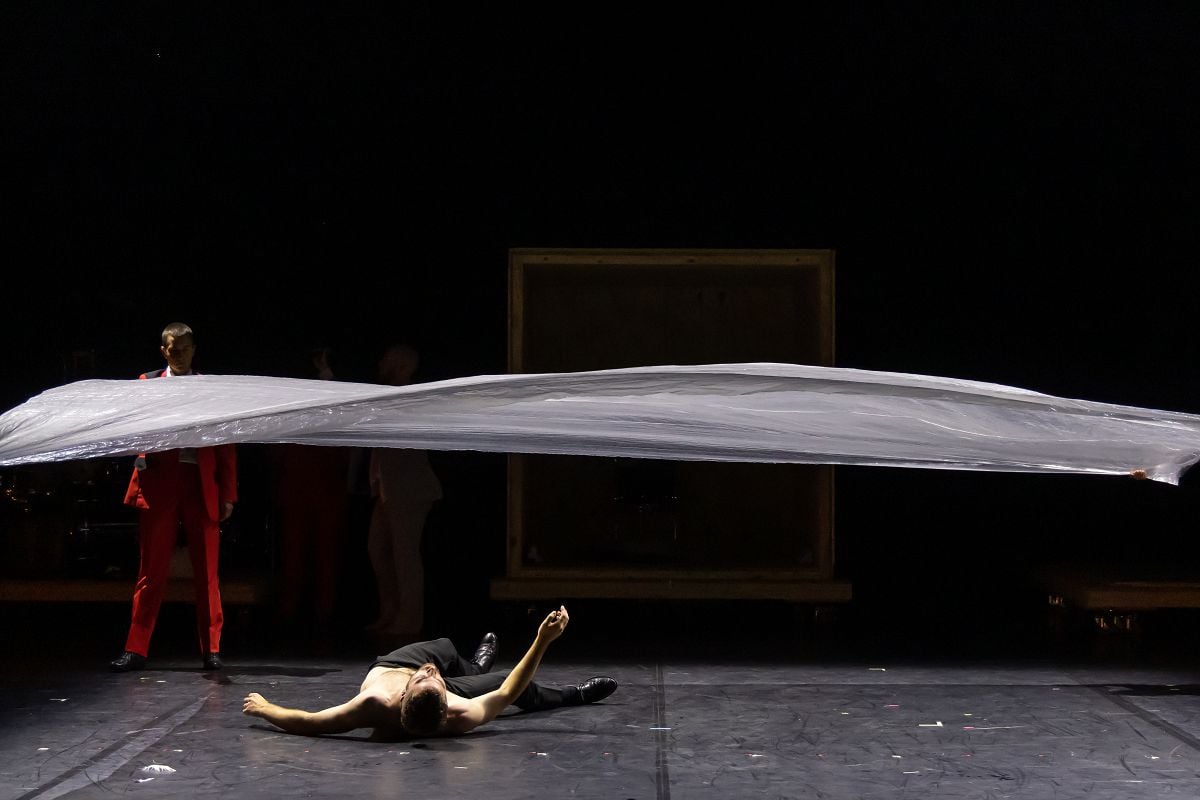
Perhaps in recognition of the harmony between dancers and musicians, the performers gradually took on a uniform cabaret-style costume of red suit with black collars and pocket flaps, and white frilly evening dress shirts, topped and tailed by bow ties and black shoes. These costumes – by Doey Lüthi – may have referenced The Miami Showband, an Irish group that was ambushed in 1975 while returning to the Republic from a gig in Northern Ireland, killing three members of the band.


Most of what we saw onstage needed such written explanation and it was only by reading the programme that I came to understand the deeper meanings in Nobodaddy, including that the performance was given in memory of The Miami Showband. Far from being a modern concoction, the joining together of “Nobody” and “Daddy” for the title apparently harks all the way back to the eighteenth century, coined by the English poet, William Blake as Nobodaddy (or Old Daddy Nobody), a vengeful murderous god. Since I read the programme after the event, I had no idea of any of these references while watching the show.
The body in that opening scene was that of Keegan-Dolan’s partner and muse, Rachel Poirier and she needed those minutes of peace to prepare for dominating much of the subsequent action, as both dancer and singer. She also used those angel wings to beat her fellow performers while they sat in a line confronting the audience from the front of the stage. Other seemingly random episodes, included a performer repeatedly climbing a ladder and falling onto a mattress while reciting some inaudible lines; a man stripping to his underwear and smearing his body with something that looked like butter before disappearing under a plastic sheet as if the self-imposed victim of a mafia hit; the cast sharing small pots of jam, into which each member dips their fingers; and another dancer ate a banana before throwing the skin into the audience! I’m glad that it didn’t hit me.
Teaċ Damsa means “House of Dance” and throughout these episodes there are vignettes of tremendous hi-energy dance, both superbly synchronised throughout the cast and providing individual characterisations for each performer in isolated solos and smaller groups.
It would take a small novel to explain all the goings-on in Nobodaddy, a work that is approaching two hours long without an interval (those with weaker bladders should beware). The work would be improved by a strategic edit (I think that fifteen minutes could usefully be pruned) but, to the credit of these excellent performers, it was time that largely flew by.


Graham Watts is a freelance writer and dance critic. He writes for The Spectator, Tanz, Shinshokan Dance Magazine (Japan), Ballet Magazine (Romania), BachTrack and the Hong Kong International Arts Festival and has previously written for the Sunday Express, Dancing Times, Dance Europe, DanceTabs, London Dance, the Edinburgh International Festival and Pointe magazine (USA). He has also written the biography of Daria Klimentová (The Agony and the Ecstasy) and contributed chapters about the work of Akram Khan to the Oxford Handbook of Contemporary Ballet and on Shobana Jeyasingh for the third edition of Routledge’s Fifty Contemporary Choreographers.
He is Chairman of the Dance Section of The Critics’ Circle and of the UK National Dance Awards and regularly lectures on dance writing and criticism at The Royal Academy of Dance, The Place and (until the war) for Balletristic in Kyiv. He was a nominee for the Dance Writing Award in the 2018 One Dance UK Awards and was appointed OBE in 2008.