Review: lots of young talent at La Scala Ballet School’s final show

Graham Spicer sees Accademia Teatro alla Scala Ballet School dancers in their last show of the year, showcasing the talents of the final year students.
| Title | La Scala Ballet School |
| Company | Accademia Teatro alla Scala Ballet School |
| Venue | Teatro Strehler, Milan |
| Date | 9 Aprile 2026 |
| Reviewer | Graham Spicer |
La Scala’s ballet school – which comes under the umbrella of the La Scala Academy, with training for singers, musicians, set designers, hair and makeup artists – gave its ‘end of year show’ at Teatro Strehler, a modern theatre with excellent sightlines and a large stage similar to that of Teatro alla Scala, where the school also performs.
As usual, it opened with Presentazione, devised by the director of both the school and the ballet company, Frédérick Olivieri. It is a mini-version of Harald Lander’s Études, and indeed, it uses the same music by Carl Czerny. Here, the final year students could be picked out – she’s the one who turns, he’s the one who jumps – and there were some notable talents to be seen. The presentation ends with a large stage picture of all the students from the eight years of the school, which never fails to pack a big emotional punch.
Then began a programme showcasing the leavers’ talents in the classical and contemporary repertoire.


The Paquita suite showed off the girls and the central couple, Maria Vittoria Bandini and Jorge Vela – she cool and serene, he bold and elegant. Though it was easier to see a future professional career in some more than in others, all were assured and professional in front of an audience, not just of mums and dads, but also of some important figures in Italian dance.

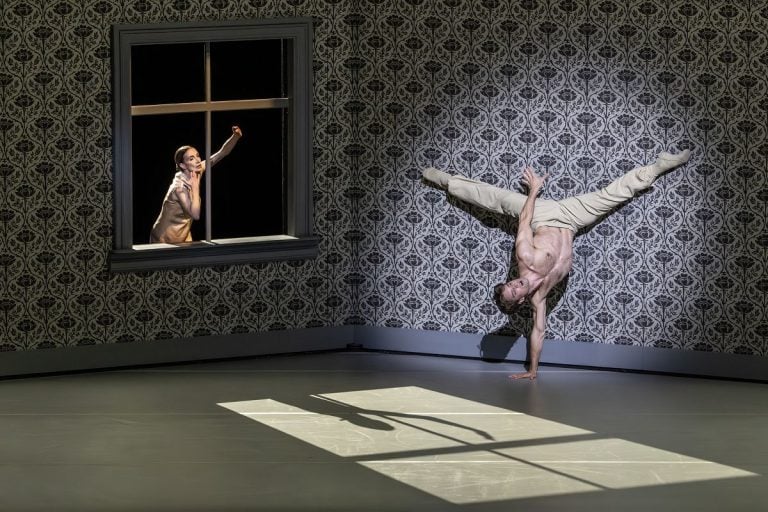
Mauro Bigonzetti‘s Rossini Cards entered the school’s repertoire last year. It is an entertaining piece that doesn’t really go anywhere but suitably has many solos and duets, a very slick look, and extremely effective lighting by Carlo Cerri.
A young man with a candelabra enters and takes off his shirt and trousers to remain in flesh coloured trunks – de rigeur in the popular Italian TV talent show, Amici, where even the male variation from Grand Pas Classique was recently performed in just tights. Recently I heard two women at La Scala complaining – quite seriously – that Roberto Bolle was too clothed. However, Bigonzetti created this piece in 2004, before the recent trend.
The section with the candelabra replaces the opening scene in the full hour-long ballet, where the dancers are lined up along the proscenium, and one falls into the orchestra pit, which I was looking forward to. Maybe the school insurance didn’t cover that.


A black cloth at midstage rises to reveal a long table surrounded by seated dancers, and to ‘Questo è un nodo avviluppato’ from Rossini’s La Cenerentola, they perform quirky, highly synchronised movements. The cloth lowers, but not before two of the dancers slip beneath it to perform a finely controlled duet, full of counterbalances that must have demanded considerable rehearsal time. Benedetta Boccini and Gabriele Calcagno danced the piece beautifully, with intensity and well-judged sensuality. In the original, she is topless, but obviously (thankfully) she wasn’t in this school’s show.
Having a dancer enter in front of the curtains to read one of Rossini’s recipes – the composer loved the ‘cucina’ – was probably a fun idea on paper, but it is tiresome in practice, even when delivered with conviction by Christin Saginario. In this ragbag of a work, Maria Vittoria Bandini was impressive in a solo, and Maria Clara Rocco in a pas de trois, both with softly expressive port de bras combined with strength.
The group finale to The Thieving Magpie overture was exhilarating, with the company running exuberantly across the stage.
However, the best was kept until last.

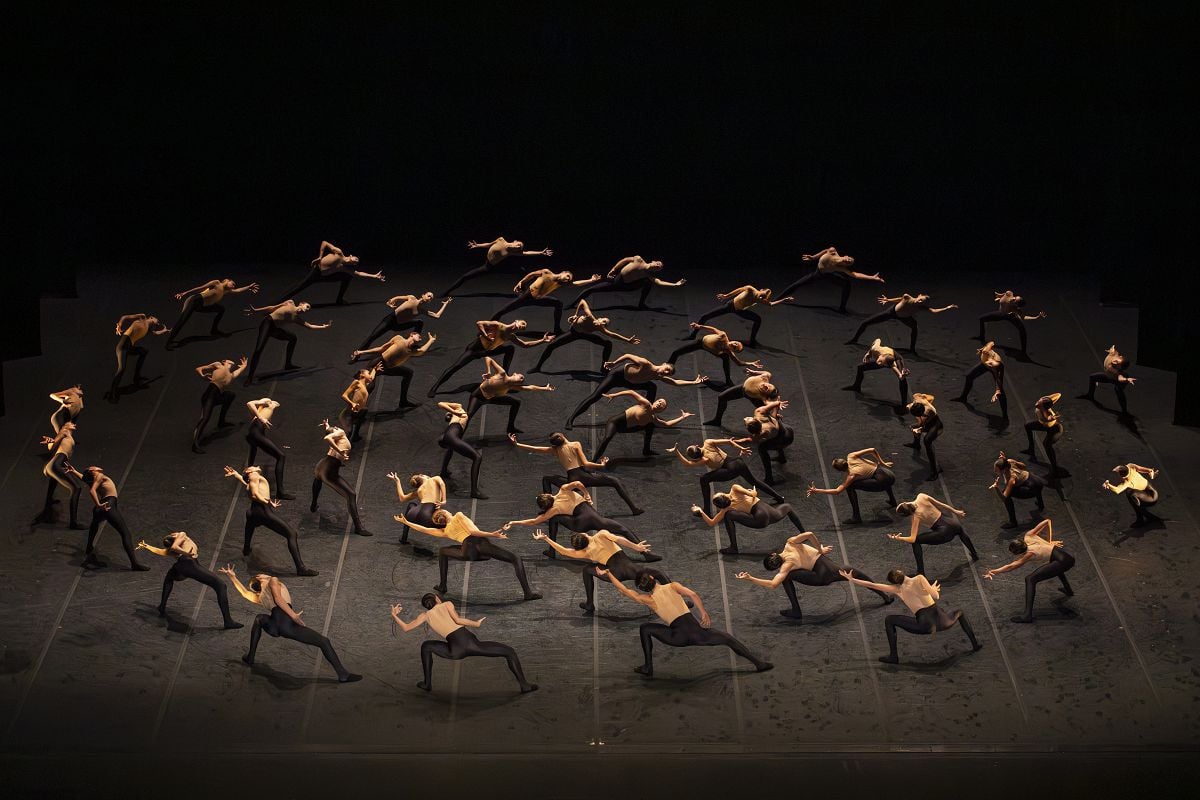
Shahar Binyamini began working on an initial version of Bolero X in Seoul in 2022, and it was later developed in 2023 in Vancouver with fifty dancers, and has since been performed around the world, including the Spoleto Festival in Italy last year. I imagine that La Scala’s academy drew students from the last three courses to reach the required number of dancers, here more than fifty.
The dancers are arranged around the three sides of the stage, on all fours, and are drawn towards the central performing area – without Maurice Béjart‘s famous table – and, as one moves forward, those nearby also edge towards the centre, like a pack of wild animals, before skulking back to their positions. One or two performers are centre stage until maybe two-thirds in there is a pitch invasion as the other dancers spread over the entire stage in concentric circles. Their movements are quite simple, but extraordinarily effective, and the students’ physical qualities and sense of group were superb.


There is one student who took the lead role in Bolero X, was featured in Presentazione and Rossini Cards, and is about to graduate this year – Michele Forghieri, a scene stealer in a natural way and certainly one to watch. The other dancer who stood out – maybe because she was heavily featured – was Maria Vittoria Bandini, who was impressive both on pointe and in the contemporary works.
I’ve followed many dancers from school to principal – Jacopo Tissi, principal at Dutch National Ballet, Martina Arduino, principal at La Scala – and with these young dancers, I’m eager to see what happens next.