Review: West Side Story at the Caracalla Baths in Rome – thoroughly enjoyable, but where was Robbins?

Donatella Bertozzi sees West Side Story in Rome with its strong and pervasive rhythmical sense of staging.
| Title | West Side Story |
| Company | Teatro dell’Opera, Rome |
| Venue | Caracalla Baths, Rome |
| Date | 5 July 2025 |
| Reviewer | Donatella Bertozzi |
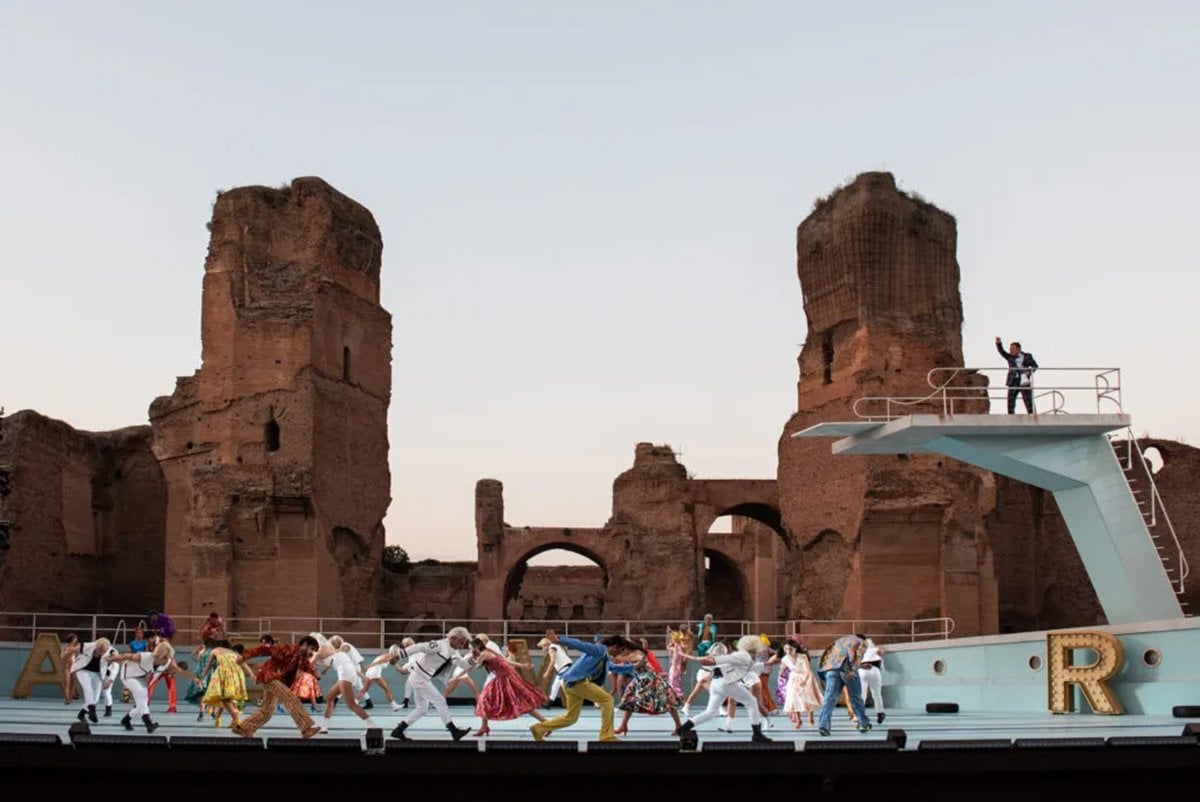
Rome Opera House’s new production of West Side Story is thoroughly enjoyable – well staged, well directed and very well conducted. On 5 July it opened the summer festival of opera and ballet, traditionally held at the open-air theatre in Caracalla (the ancient site of the monumental public baths built by the Roman Emperor of the same name in the second decade of the 2nd century AD), and it was genuinely appreciated by the large audience present.
The musical director of Rome Opera, Michele Mariotti, conducted his orchestra with nicely contained brilliant exuberance, extracting a genuine sense of enjoyment from his musicians for the multiple layers and perspectives offered by the jazz-infused musical score.

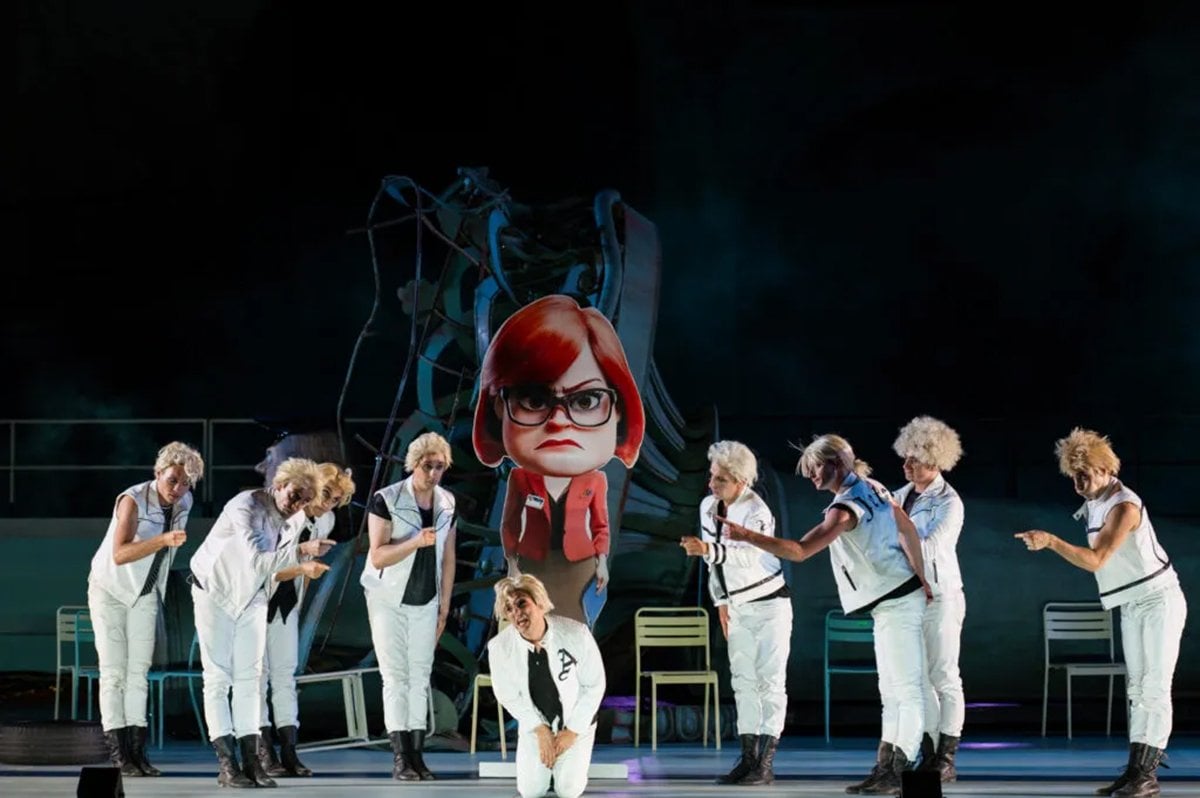
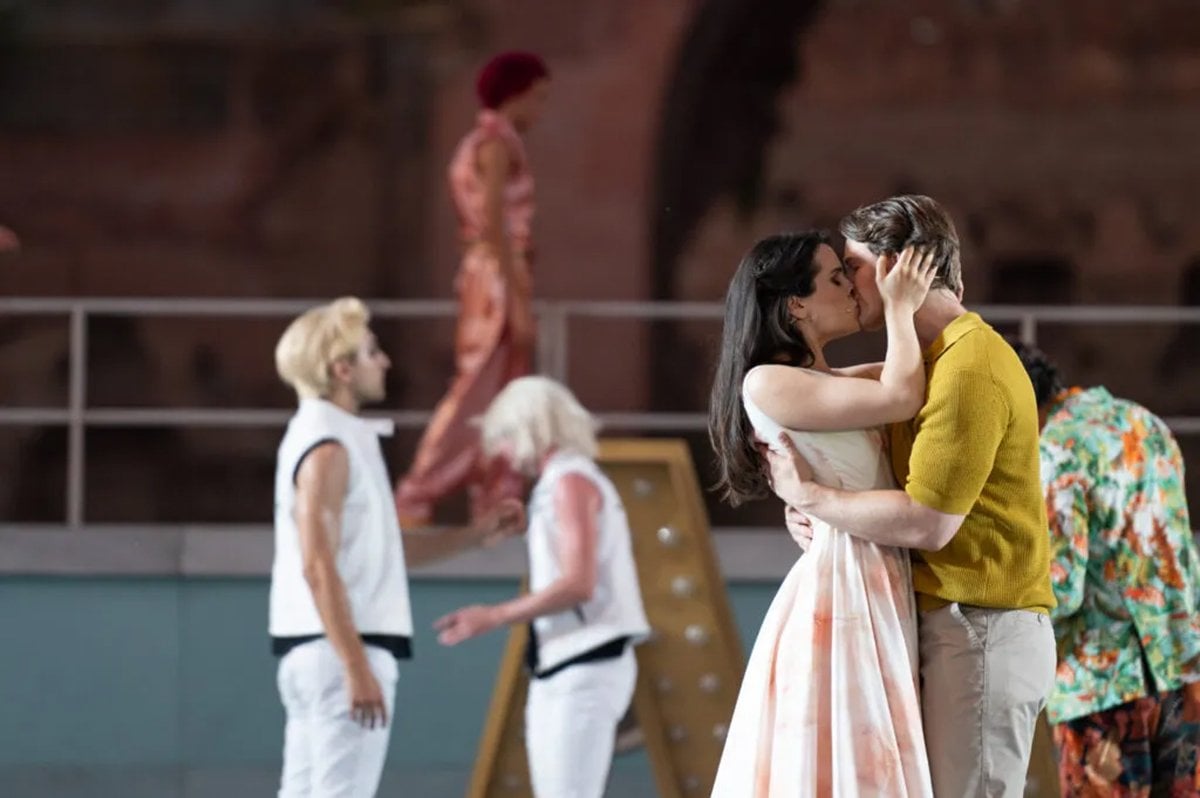
The cast of performers was carefully selected having in mind the triple range of skills – acting, dancing and singing – needed for interpreting each role, both protagonists and members of the chorus. Only a few truly excelled, namely Sofia Caselli as Maria, Marex Zurowski as Tony (the two were also very well matched) and Natascia Fonzetti as Anita, but all in all, the general level was good and, again, enjoyable. Damiano Michieletto, responsible for the stage direction, chose to locate the action not in a verisimilar mid-fifties “west side”, but in an empty and deserted old swimming pool, vaguely reminiscent of early forties architecture. A high diving board platform dominated the scene, offering a convenient symbolic alternative to Maria’s (and Juliet’s) balcony.
Sasha Riva and Simone Repele devised the dancing as a functional tool to advance the plot and succeeded in turning the forty-strong cast into a disciplined ensemble of competing gangs, with twenty extra dancers from the Rome Opera Ballet added when needed to enhance the dancing content.
Both Mariotti and Michieletto worked with a strong and pervasive rhythmical sense of staging and succeeded in incorporating the dance within the general frame created by the music and the action developing from the script (the original Laurents’ script with a few variations), producing a sense of accomplishment that permeated the piece throughout the two acts.
As is almost universally known, West Side Story is a modern-day version of Shakespeare’s Romeo and Juliet and it transfers the tragedy of the two young lovers of the title from the noble Montague and Capulet families in the fourteenth-century Italian town of Verona to the “mean streets” of mid-twentieth-century New York, where gangs of underprivileged youths of different ethnic and cultural backgrounds compete fiercely for control of small portions of desolate urban territory.
The original West Side Story was conceived and staged by a celebrated poker of talents – Jerome Robbins (choreographer-director), Leonard Bernstein (composer), Arthur Laurents (scriptwriter) and Stephen Sondheim (lyricist) – and found considerable success when it opened in New York, in September 1957. It went on gathering increasing acclaim over the nearly one thousand performances of its first run on Broadway and on tour and soon became an iconic milestone that (as Lenny Bernstein put it in a letter to a friend) “maybe changed the face of the American Musical Theater”.
Indeed, this thought of Lenny Bernstein’s has proved more than true over the subsequent years, especially after the 1961 film edition of the original Broadway show, also directed and choreographed by Jerry Robbins, which established the production as one of the most popular American musicals of all time – two Tony Awards in 1958, ten Academy Awards including ‘Best Picture’ and the newly introduced ‘Best Choreography Award’ for Robbins.
Despite the success of the première of this version of West Side Story, and my appreciation of it, one question kept hammering away in my head from shortly after the end of the Prologue: “Whatever happened to Jerry Robbins?”
He was very present and alive at the very beginning of the performance, when fingers snapping – a rhythmical root in both music and dance – introduces the music, the scene, and the action, marking the original inextricability of the different languages of the show. Then he… disappeared! And yet his name stands out on the posters advertising the current summer season at Caracalla in the phrases “based on an idea by Jerome Robbins” and “originally directed and choreographed by Jerome Robbins”. The reason why his name is so prominently mentioned lies in that historical and unavoidable inextricability.
When we study the story of how West Side Story came about, over a period of almost ten years, we find volumes of facts reporting how and why Jerry Robbins was crucial in the making of the project. Historically speaking, there is no such thing as “Leonard Bernstein’s West Side Story”. It is, of course, perfectly legitimate to use only Bernstein’s score of “West Side Story” and put it on stage, but it is crucially unfaithful to the original masterpiece of American Musical Theater.

Donatella Bertozzi, dance critic and journalist, has been writing about dance since 1980.
A keen watcher of all sorts of dance performances from an early age, while still completing her professional training as a dancer – studying both classical ballet and modern dance techniques in Rome and London – she began writing dance reviews for various daily newspapers. In 1986 she joined the Performing Arts desk of the Rome daily Il Messaggero as chief dance critic. Besides reviewing national and international dance performances, she was later asked to write a daily dance column covering dance events in Rome which she then went on to compile for twelve years (2002-2014). In 1988 thanks to a British Council scholarship she attended the London Laban Center, studying with Valerie Preston Dunlop, Clement Crisp and Alastair Macaulay.
In over forty years as a dance critic she has contributed to numerous Italian, and some international, magazines, tv and radio programmes and lectured extensively about dance and dance history.