Review: The Les Misérables World Tour arrives in Milan – a semi-staging of epic proportions
Graham Spicer sees Les Misérables in Milan during Cameron Mackintosh’s world tour of the 40-year-old musical – a luxury cast in an emotionally engaging performance
| Title | Les Misérables |
| Company | Cameron Mackintosh |
| Venue | TAM – Teatro Arcimboldi Milano |
| Date | 17 November 2024 |
| Reviewer | Graham Spicer |
Cameron Mackintosh‘s ambitious 15-country tour of Les Misérables to mark the show’s 40th anniversary is billed as “The Arena Spectacular”. Two months ago, it kicked off its 18-month marathon at venues like the 11,000-seat SSE Arena in Belfast and the 12,000-seat OVO Hydro in Glasgow. How fortunate then in Milan to have the same ‘arena’ show in a 2,400-seat theatre, the Teatro Arcimboldi, built to house the La Scala opera house during renovations 20 years ago.
I saw Les Mis when it first opened, 39 years ago at the Royal Shakespeare Company’s Barbican Theatre in London. It then transferred to the West End where it is still running, now at the Sondheim Theatre. Having seen it a couple more times over the past years, how delightful to find it in such good shape. The rhythm is tight, the symphonic orchestrations have moved away from the swoony (and dated) 1980s synthesised sound, and the ‘semi’ staging is of epic proportions.
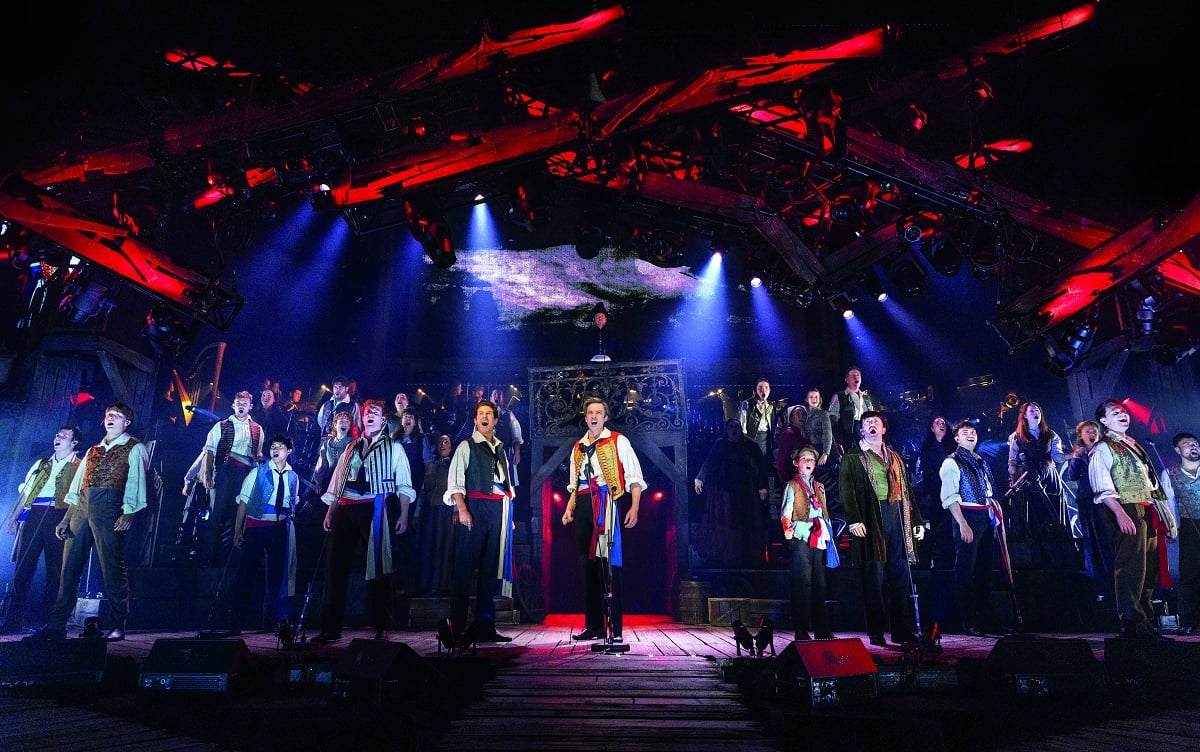
The cast of 40 arrive from under the raised orchestra, from the sides, and from above and find seating among Matt Kinley’s cleverly designed wooden ‘barricades’. The feeling is very 1970s-80s RSC, where a show is a group endeavour, a company piece, like Nicholas Nickleby directed by John Caird or The Comedy of Errors by Trevor Nunn. In fact, these two men directed the original version of Les Misérables. That team spirit atmosphere has been lovingly preserved by directors James Powell and Jean-Pierre Van Der Spuy for the tour, and the feeling spills out into the audience as we travel on the Les Mis journey together from 9pm until midnight.
Three large screens – which are used to project closeups of the cast for the arena shows – showed restrained but evocative images, usually in diffused black and sepia, which never once detracted attention from the action below. They were also used – rather as in Abel Gance’s film Napoléon – to give the red, white and blue stripes of the French flag, and in this staging there is no Les Mis march (one step forward, one step back) with the waving flag behind the group, but three red flags were produced from the 4-metre high walkway with the screens rippling red too, and the lights flashing their red contribution.
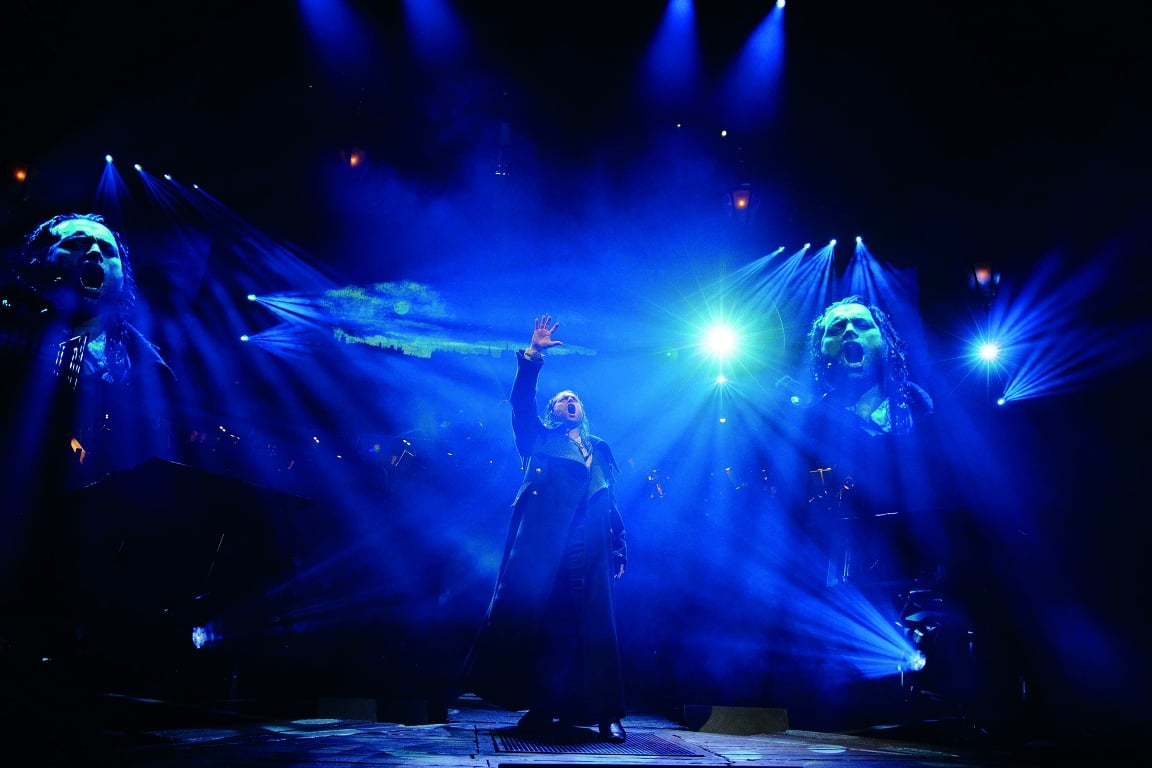
Oh, the lights. 40 years ago, colour-changing, moving-head lights were the stuff of science fiction. But now…! Well, Paule Constable and Warren Letton pulled out all the stops but knew when to hold back, keep still, be romantic, and then wow again. On entering the theatre, the set was hidden by giant gantries with lighting rigs that zigzagged across the stage. The musicians could be seen setting up behind and then, with the first chords from the orchestra, the gantries moved impressively upwards, changing inclination until they formed a roof. A roof that would be lowered to form more intimate spaces. How many 70s and 80s evocations again – it was a mash-up of Close Encounters of the Third Kind and Starlight Express.
An astute conceit of the production is to keep the idea of a concert staging by placing singers behind fixed floor mics dotted around the stage, even if they are wearing a headset mic. Also, the cast’s attention is usually more towards the audience than to each other, so even in a romantic duet they are rarely face to face. This convention stops the production from becoming a mess of styles, and the performance remains emotionally engaging while retaining its semi-staged credentials. And characters die on their feet – a light fades, the face is in shadow, the singer moves slowly upstage.
Mackintosh has sent out a luxury cast. The smaller parts are perfectly balanced with contrasting voices and accents, but it is the leading roles that stun. Killian Donnelly plays Jean Valjean and with perfect intonation, extraordinary breath control, and a variety of dynamics throughout his range, he scored some of the biggest ovations of a very loudly applauded performance. For ‘Bring Him Home’, he was placed at the end of a runway jutting out into the audience, with all lights on him – it felt as though there was a hidden firing squad ready to take him down if he fluffed the last ‘home’ (one of the most difficult attacks in all musical theatre). Donnelly hit it (and how!) and his backlit silhouette was caressed by applause.


Bradley Jaden was no less impressive as Javert, and he has a megawatt personality – his suicide scene was one of the most emotional moments of the show. Gavin Lee and Linzi Hateley brought well-honed comic business to the Thénardiers, and Jac Yarrow has humanity in his voice that made ‘Empty Chairs at Empty Tables’ especially moving. Channah Hewitt as Fantine occasionally had difficulty negotiating the passaggio of her voice but has a beautiful presence and velvety tone, and Beatrice Penny-Touré as Cosette was suitably fresh in voice and demeanour. Nathania Ong’s strident voice also dimmed to the softest of tones in her tomboyish Éponine, and James D Gish was impressive both vocally and physically as the student Enjolras who is the last man standing as his companions are picked off by both the French army and searing white beams of light.
I was at La Scala opera house just a few days previously, and the sung-through librettos and histrionic emotions and arias were similar in both theatres. Puccini, whose anniversary is being celebrated, certainly packed his operas with ‘hummable’ tunes and he sold out (indeed, sells out) theatres – so a close cousin, then, of Les Misérables composer Claude-Michel Schönberg. As Fantine sings, “There was a time when it all went wrong…”, and that, for me, is when no one was able to hum tunes any more as they left the theatre because composers were experimenting with music lacking a tonal centre. Gershwin & Co., however, continued to churn out the melodies.
Only six decades separate ‘opera’s-not-for-me’ Turandot and Les Mis, and already four decades separate Les Mis from this year’s Tony Award winner, The Outsiders. Puccini is not so far away after all.
Although the prices at Teatro Arcimboldi were not those of La Scala – stalls’ seats cost about two-thirds of those at Milan’s opera house – they are still not cheap, yet here there was a far younger crowd. It was a joy to see. Some of the La Scala opera regulars were in attendance, and maybe some of the Les Mis fans will hear those hit tunes from Puccini and venture into an opera house too.


Graham Spicer, aka ‘Gramilano’, is a writer, director and photographer based in Milan. He was a regular columnist for Opera Now magazine and wrote for the BBC until transferring to Italy. His articles have appeared in various publications from Woman’s Weekly to Gay Times, and he wrote the Danza in Italia column for Dancing Times magazine. Graham was the historical advisor on Codice Carla, the 2023 documentary on Italian ballerina Carla Fracci.
Graham also works as a dance photographer, and his photos have appeared in many books, theatre programmes, and magazines, including Dancing Times, Dance Spirit and Ballet2000, as well as all the major Italian newspapers.
He is a member of the Dance Section of The Critics’ Circle.