Interview: Kate Flatt, choreographer and movement director, on 40 years of Les Mis and Turandot
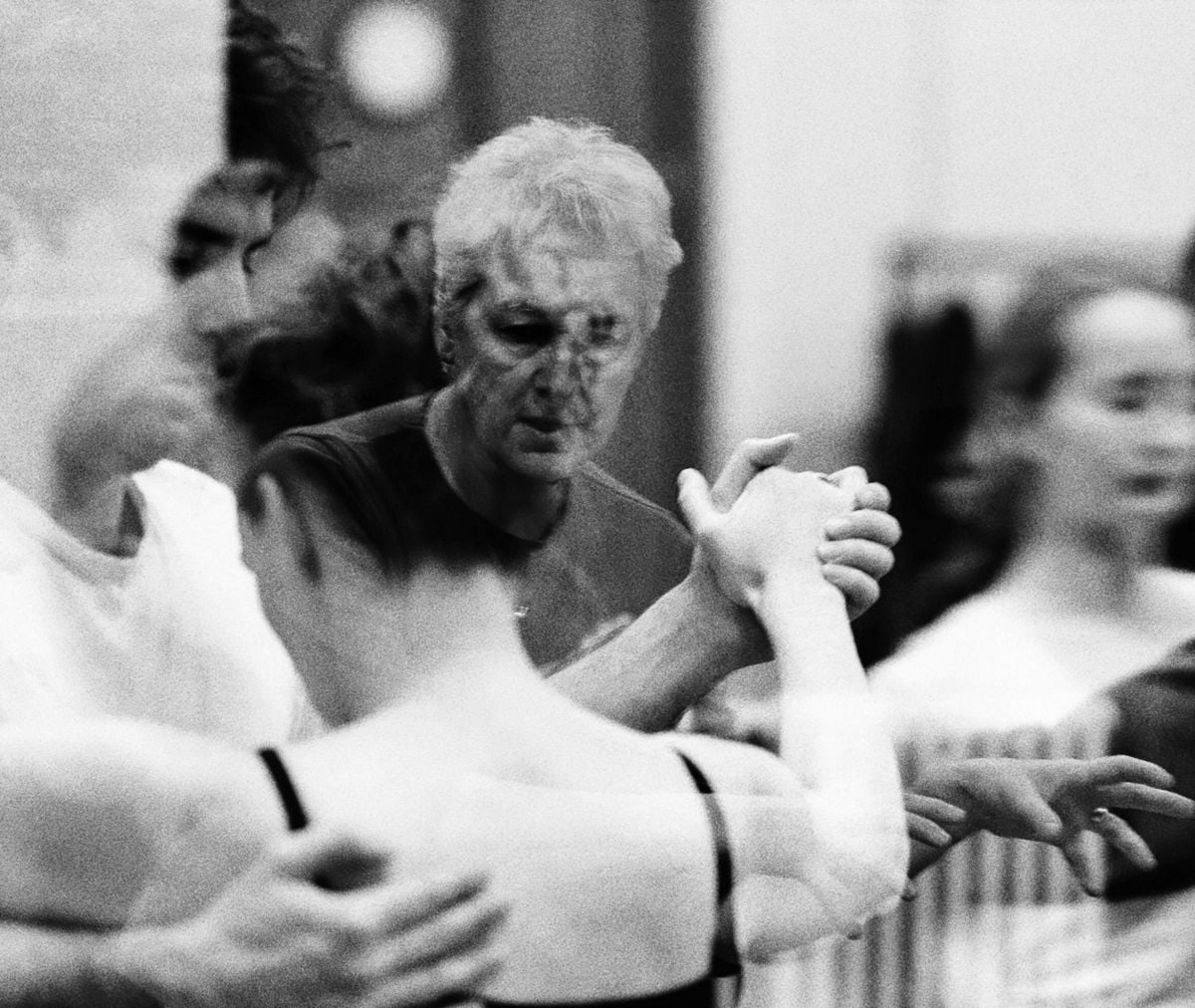
| Paul Arrowsmith talks to Kate Flatt – choreographer, movement director, mentor and dance educator – on her two long-running productions, the musical Les Misérables and the opera Turandot, and a life in the theatre. |
Les Misérables is celebrating its 40th anniversary. When you created the original musical staging, did you think that the production would endure?
Back in 1984, between August and October, Les Misérables was a creative and rather extraordinary experience to work on!! Such a talented bunch of singing actors – both principals and the ensemble were all superb. Working with John Caird and Trevor Nunn was a revelation. They were already very experienced and as a team dynamic in how they embraced the long novel and the challenges it offers. Herbert Kretzmer, lyricist, was also a revelation with his unique take on the depth in the work which was still being written as a musical. Although most of Claude Michel Schoenberg and Alain Boublil’s score existed, new songs and lyrics were being created and arrived in the rehearsal room to fill out characters’ stories. In the rehearsal process, towards the end of the eight weeks, many scenes were altered and changed right through the previews.
The initial reviews – for the Royal Shakespeare Company at the Barbican in London – weren’t that positive, were they?
The reviews were pretty damning… With so much investment, there was a lot riding on the show and its eventual transfer to the Palace theatre. It was very unusual then to have a subsidised company, the RSC, working with a commercial producer such as Cameron Macintosh. The awful reviews were a shock, but despite everything, the public simply loved it. The stories, music and cinematic staging resonated on every level, and Cameron discovered such crazy demands on the Barbican box office, and advance sales were so good, that the transfer to the Palace Theatre actually happened within three months of it opening at the Barbican. The rest is history! What followed were also many international productions. I went with the team to recreate the work in Paris, Germany, the Netherlands, and twice to Japan. I also worked on two UK national tours. The production went to Washington, then New York in 1987, where it won awards and its historic longevity began.
How did you approach the musical staging?
My role, as it emerged, was to devise ways to help the actors find the multiple characters that they played through movement and body language. I worked with lots of improvisation and initiated workshops on different scenes. I drew on work I had studied with Léonide Massine. His work, as taught at the Royal Ballet School, remains for me a wonderfully subversive influence on understanding non-classical use of the body, plus timing, rhythm and expressivity! He was so illuminating on bodily articulation, and the work I undertook focused on how the spine and use of weight inform narrative and character and can be used expressively.
There are no dance numbers as such in the musical – that would have been superfluous to the through-sung story – but I did lots of movement work for different scenes and characters (beggars, whores, the infamous gang, the unemployed, and the students …) throughout the show. The individual characters were carefully drawn from descriptive passages in the book. Hugo’s writing has an almost cinematic quality. I still use his vivid descriptions of a few of the ‘gang’ characters in movement workshops for actors and musical theatre performers.
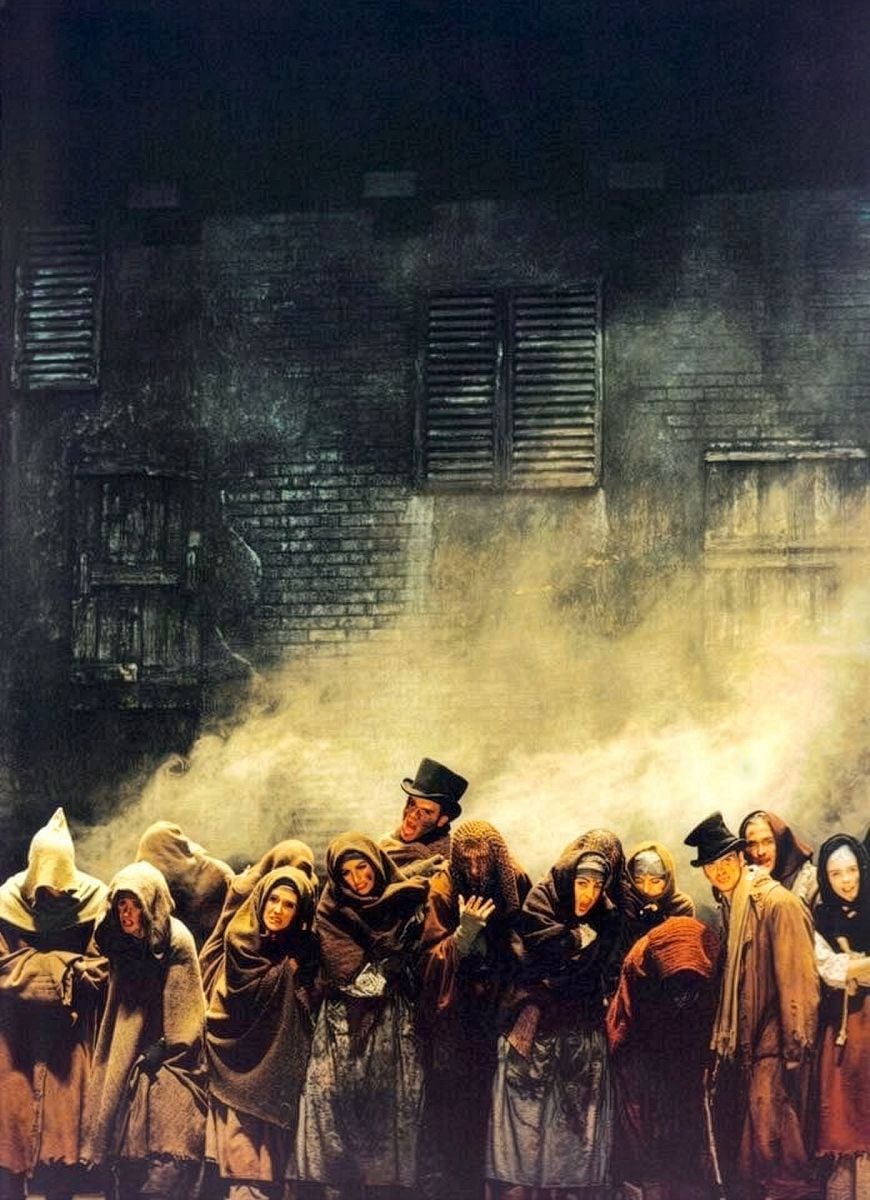
Other musical moments capture the collective anger and frustration of ‘les misérables’. For example, the number ‘At the End of the Day’ is about the anger of people without work. I recall saying to Trevor Nunn that it’s so hard to move when you’re angry. He responded with, “Can you find me an improvisation for that?” I asked the performers, through tasks, to find bound up energy… appropriate gestures to encompass the visceral rage for the brief walk down I organised, which finishes with the actors seeming to rage at the audience.
The research we all did into 19th-century Paris through Victor Hugo’s compassionate eyes revealed tough things about the desperate lives of ‘les misérables’. The whole company did research projects as well, before there was widespread use of the internet, with everyone required to present their findings on the lives of characters.
And a year older than Les Mis is the Royal Opera production of Turandot, revived again this month. Had you worked with the director Andrei Serban previously?
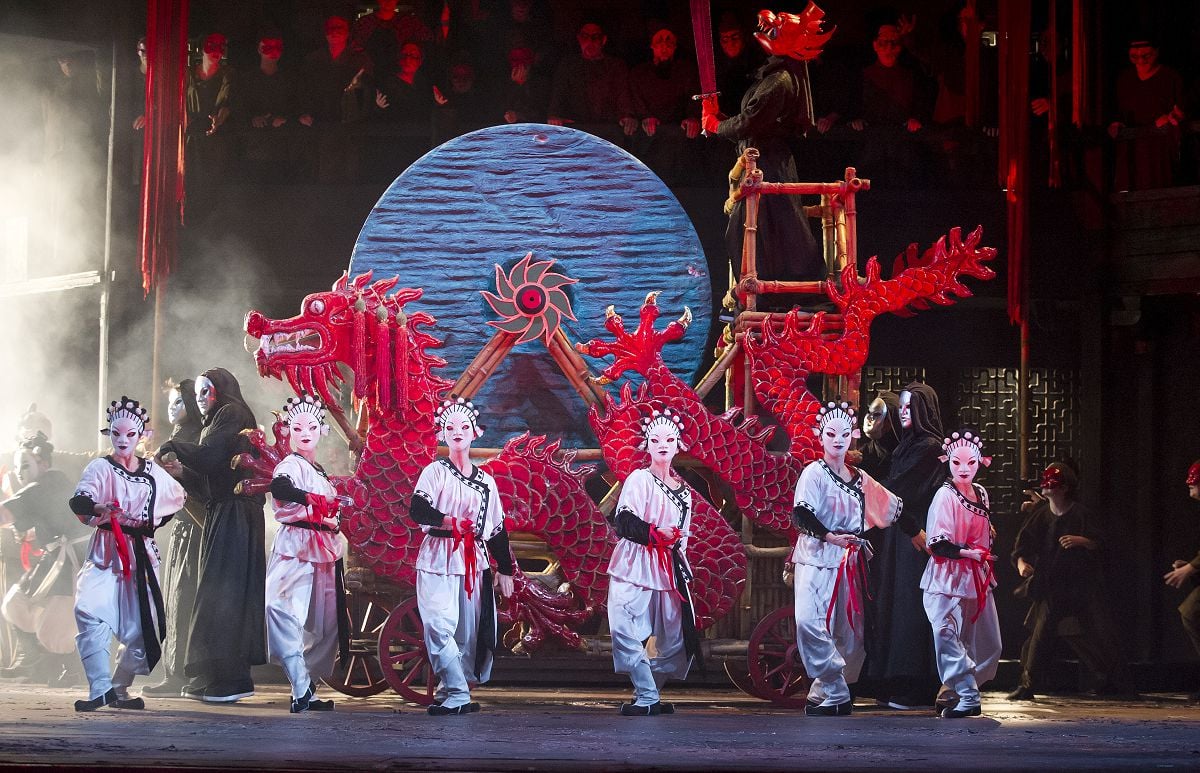
Turandot was also another creative revelation! I had worked with Andrei Serban twice, on his very successful Eugene Onegin and Merry Widow, at Welsh National Opera, so I was familiar with his changeable nature and intuitive flair. He has a wonderful sense of movement and feel for action, and making the stage very alive. I had worked with Andrei first in 1980, and the 1984 Turandot opened the Royal Opera season at the Los Angeles Olympic Arts Festival.
I’ve just worked with him again this summer on a version of Turandot for the Greek National Opera in the Herodias Atticus arena, just below the Acropolis in Athens. The production used several elements of the choreography from the London Turandot, reconfigured with the Greek dancers. I also worked with Georgia Tegou, the Greek associate choreographer I chose to share the considerable task involved.


It’s a production where the dancers carry much of the action – how did that come about?
Well, having worked with Andrei, I knew that he needed a world or language offered by the choreography. Back in 1984, I made a start on the choreographic material with ten very able dancers about a week and a half before he arrived to begin rehearsing the singers. Sally Jacobs, the designer, had spoken of setting the work in the ancient period of Chinese art, very apt.
My source for the movement was to return to the Tai Chi Chuan I had studied. The movement became a blend of energies and forces. I devised a lot of material that would work with various musical passages. Sally had also had the genius idea to put the chorus in balconies so that story is played out before them as a strongly participating audience. The dancers became a masked, choral commentary that is somewhat enigmatic as the story unfolds.
I remember picking out Mark Baldwin – post Rambert dancing days – in the ensemble in one revival. How do you go about getting dancers of his calibre?
I made a search for each revival to achieve a balance of highly experienced and younger dancers working together. I was so pleased that Mark found himself in a place to be able to join us. The cast lists do read like a who’s who of contemporary dance across the years, with dancers who’ve been with London Contemporary Dance Theatre, Rambert and Phoenix, for example, as well as long-term freelancers.
Does working in opera create many opportunities for choreographers or movement directors?
Choreographers and movement directors who work closely with the director are increasingly calculated into the mix of creative teams in opera houses across the world. The demands of visual excitement are important in contemporary stagings, which often incorporate dance as a significant element and need versatile dancers who are regularly employed in large-scale opera productions. Movement directors also work with the chorus, which can be 60 or more people, on stylised language or dances. I have several respected colleagues who contribute much. I have enjoyed working with the chorus on Britten’s Gloriana and Peter Grimes, both at Opera North.

You are not only involved in epic productions…
Apart from my work on plays at the National Theatre and Donmar Warehouse theatre [in London], I have made several smaller, self-produced works. One that reflects my love of traditional dance was Oss and Ox in 2014. This was an Anglo-Brazilian venture created with composer Adriano Adewale. It involved an encounter of two folk figures as life-size puppets, namely the old English ‘obby ‘oss and the Brazilian ox figure, Bumba meu Boi. Each was accompanied by a band, a dancer and community performers as they processed and did battle in the street with celebratory dances.
The Weather Machine, in 2018, was a way to introduce early years to the concept of climate change through live performance. The work is very light-hearted, with two dancing ‘operatives’ in bowler hats, inspired by Laurel and Hardy. The Machine is a fascinating object with switches and dials, on a rustic trolley, with sound effects, which behaves in a rogue manner, overheating, breaking down and having to be restarted, moving through the seasons in different ways.
You mentioned Léonide Massine – what was he like?
Having studied with him, he asked me to be his assistant on the revival of Le Beau Danube for the (then) London Festival Ballet. It was later revived for Joffrey Ballet. I also worked with him on Mam’zelle Angot for the Australian Ballet.


He was intriguing and by then in his mid-seventies. I went to learn Danube in his house and studio in Paris. I was 21, and between the studio sessions where I studied the material via an old Super 8 projector, he would arrive – after having a meeting with a lawyer or accountant – to rehearse me in all the various parts. His estranged wife lived three floors below the attic studio in the house in Passy. He was very demanding, had very high standards, but was also very funny and completely magic when he demonstrated moments of his role from Beau Danube.
You trained at the Royal Ballet School, but what was the original spark that aroused your interest in dance?
My grandmother, who lived with us, complained I made too much noise going up and down stairs and ballet classes were suggested. I loved dancing from the outset and felt at home in a dance studio from the first lesson.
You also describe yourself as a mentor and dance educator – what does that involve?
Mentoring can be about being an ‘outside eye’ and supporting a developing choreographer through the process of learning to trust their own intuition, taste decisions and finding of their own flair…
Words of wisdom for anybody wanting to enter the profession …
It’s not about you. Be generous and leave your ego at the stage door.
Besides Turandot, what else have you on the horizon?
Workshops for aspiring choreographers, mentoring, and movement coaching for singers at the Royal College of Music in London. The Doorway Project is my professional development opportunity for directors and choreographers, working together. It is a crucial dynamic in text-based theatre and opera production.
Your views on the UK arts landscape, funding, state of major companies, career opportunities…?
Times are really tough. The funding cuts have been punishing. And programming is very difficult too. It’s a huge problem. There has been a massacre of arts education in schools, although better news on that has just been announced. I can’t say that Arts Council England is exactly user-friendly – a lot of hoops to jump through…
You are a gardener too – which is harder, getting a cast of dancers or a garden to go in the right direction?!
Oh, dancers all the way! I’m a fair-weather gardener with very pale green fingers.
© Kate Flatt
www.kateflatt.com

Kate Flatt’s credits include Three Sisters, Dream Play, Albert Speer (NT); Dr Faustus, T’is Pity She’s a Whore, Skellig (Young Vic); Hamlet (Old Vic), Kreutzer Sonata (The Gate); Fiddler on the Roof, and the original Les Misérables (West End and worldwide). Kate’s opera choreography includes Turandot, Aida, William Tell (ROH); Gloriana, Peter Grimes (Opera North), The Carmelites, Verdi’s Requiem (ENO).
Dance theatre works include Undivided Loves (Phoenix Dance) and self-produced projects include Soul Play, Ballroom of Joys and Sorrows, Oss and Ox, Step Ladder and a Goat, and The Weather Machine. Kate is a Rayne Foundation and Churchill Fellow. She was awarded an OBE in 2020.
As an experienced choreography teacher and mentor, she has written Choreography – Creating and Developing Dance for Performance (2019) and Movement Direction – developing physical narratives for performance (2022).

Paul Arrowsmith has been watching dance for 45 years after Peter Wright’s Sadler’s Wells Royal Ballet was his baptism in dance in the UK. He wrote for Dancing Times between 2010-22, reporting from China, Greece, Italy, France, Switzerland, Germany and Denmark, along the way interviewing Alessandra Ferri, Akram Khan and Miyako Yoshida among many. He has a particular interest in design for dance and has profiled the work of Natalia Goncharova, Jürgen Rose, John Macfarlane and Anthony McDonald. Paul collaborated with Sir Peter Wright on his memoires Wrights & Wrongs and in 2016 was programme consultant for the BBC documentary, The Ballet Master: Sir Peter Wright at 90.