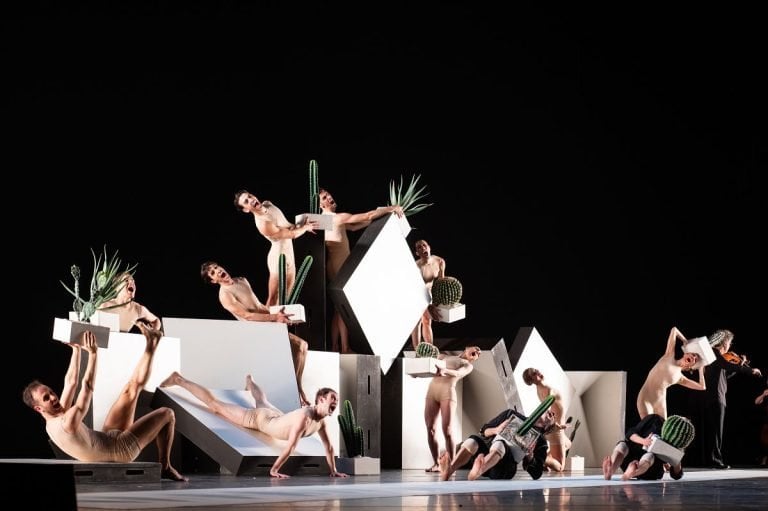
Review: Sidi Larbi Cherkaoui’s ‘Vlaemsch (chez moi)’ – a love letter to Flanders
Graham Watts sees Sidi Larbi Cherkaoui’s Vlaemsch (chez moi) with an outstanding ensemble of dancers.
| Title | Vlaemsch (chez moi) |
| Company | Sidi Larbi Cherkaoui/ Eastman |
| Venue | Sadler’s Wells, London |
| Date | 18 September 2025 |
| Reviewer | Graham Watts |
This production brought back memories of another Flemish takeover at Sadler’s Wells, from almost 20 years ago, when Ballet Vlaanderen (more commonly known back then as Royal Ballet Flanders, which gets a brief reference in this show) presented William Forsythe‘s Impressing the Czar. Apart from the obvious Flemish connection, there are many reasons for these reminiscences, not least that Sidi Larbi Cherkaoui – the creator of Vlaemsch (chez moi) – was director of Ballet Vlaanderen for seven years (2015-22); and that both dance works have a significant association with art history.
That 2008 performance of Impressing the Czar was delayed by 45 minutes due to technical difficulties and the opening of Vlaemsch (chez moi) was also held up, albeit for just a couple of minutes. There were some further (minor) technical glitches as one singer’s microphone malfunctioned and surtitles translating the French and Flemish song lyrics seemed a little hit-and-miss in their appearance. Mostly there, but sometimes not.
It was that kind of show, full of technical, human and visual complexities, including a grey set on two levels, with a basic structure like a section through a pitched-roof building attached to a tower of some kind; the stage littered with oddities like a huge human skull on top of an open book and a curtained room, whose occupants were revealed from time-to-time.
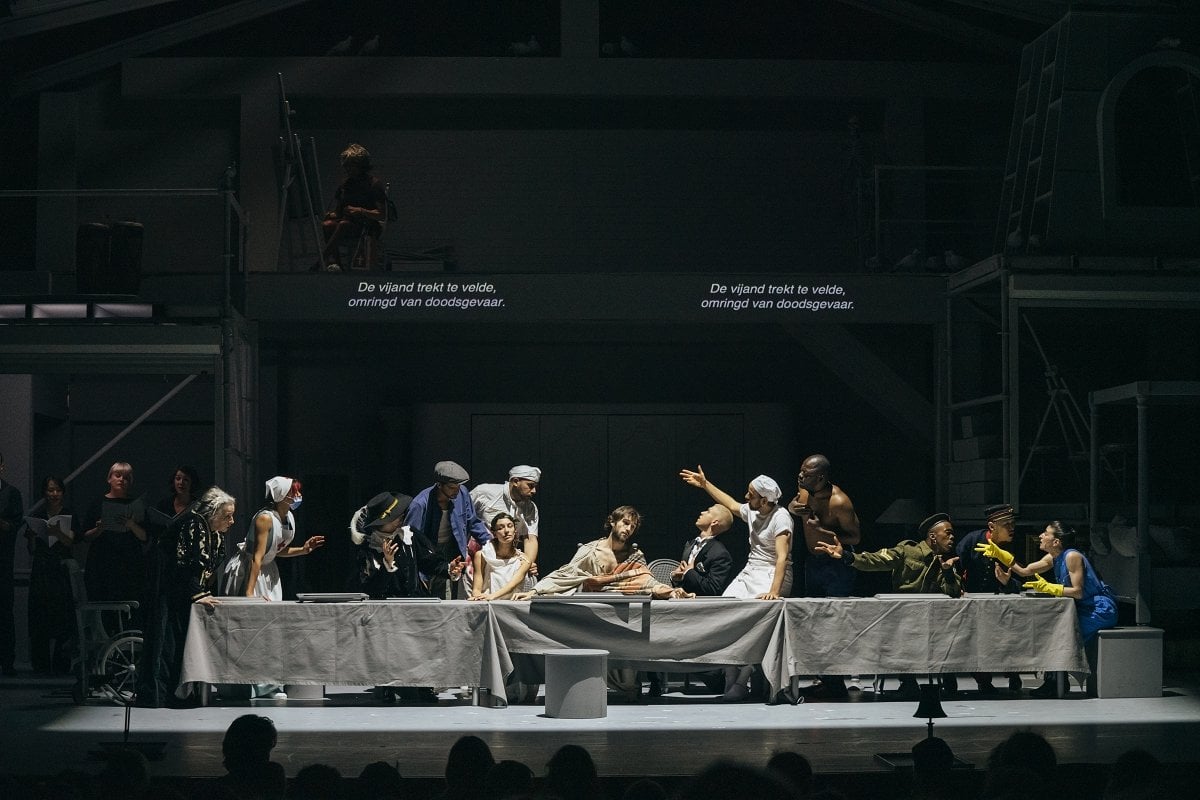
Cherkaoui, who has a Flemish mother and a Moroccan father, has worked collaboratively with three other contemporary Flemish creatives, visual artist, Hans Op de Beeck, musician, Floris de Rycker, and costume designer, Jan-Jan Van Essche, to make a work that seems abstractly to shake the essence of being Flemish over one hundred uninterrupted minutes like sprinkling salt over Moules-frites.
Songs, art and graffiti played important parts in the production with nine members of the musical group, Ratas Del Viejo Mundo (Rats of the Old World) intermingling with nine dancers (four performers are credited as both musicians and dancers). There are a considerable number of spoken and sung texts, both in Flemish and French, some dating back to the sixteenth century, an era of polyphonic music in which Ratas Del Viejo Mundo specialise.
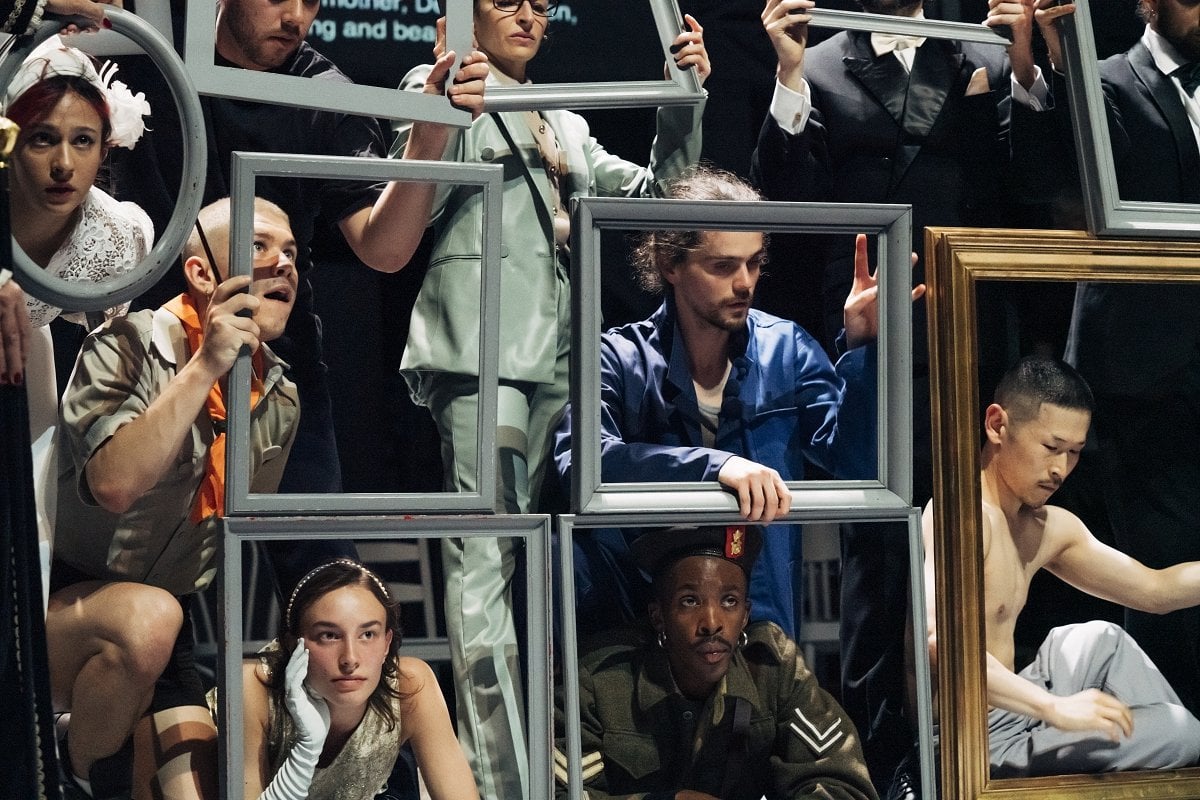
The work opens with the reminiscences of an elderly matriarch from her bed, portrayed by Cherkaoui regular, Christine Leboutte. The excellence of Flemish painting from the early fifteenth to the seventeenth century is thoroughly documented in the first half of the work with a Peter Paul Rubens lookalike seated by the skull and all the dancers framing themselves in a variety of picture frames, linking them together in a gallery of the matriarch’s relatives (although one was unknown to her) and then playing a strange version of a limbo game where all the players acrobatically weaved through all the frames held by the others. The faces-in-frames section also provided a sequence of a guided tour through pictures at an exhibition.
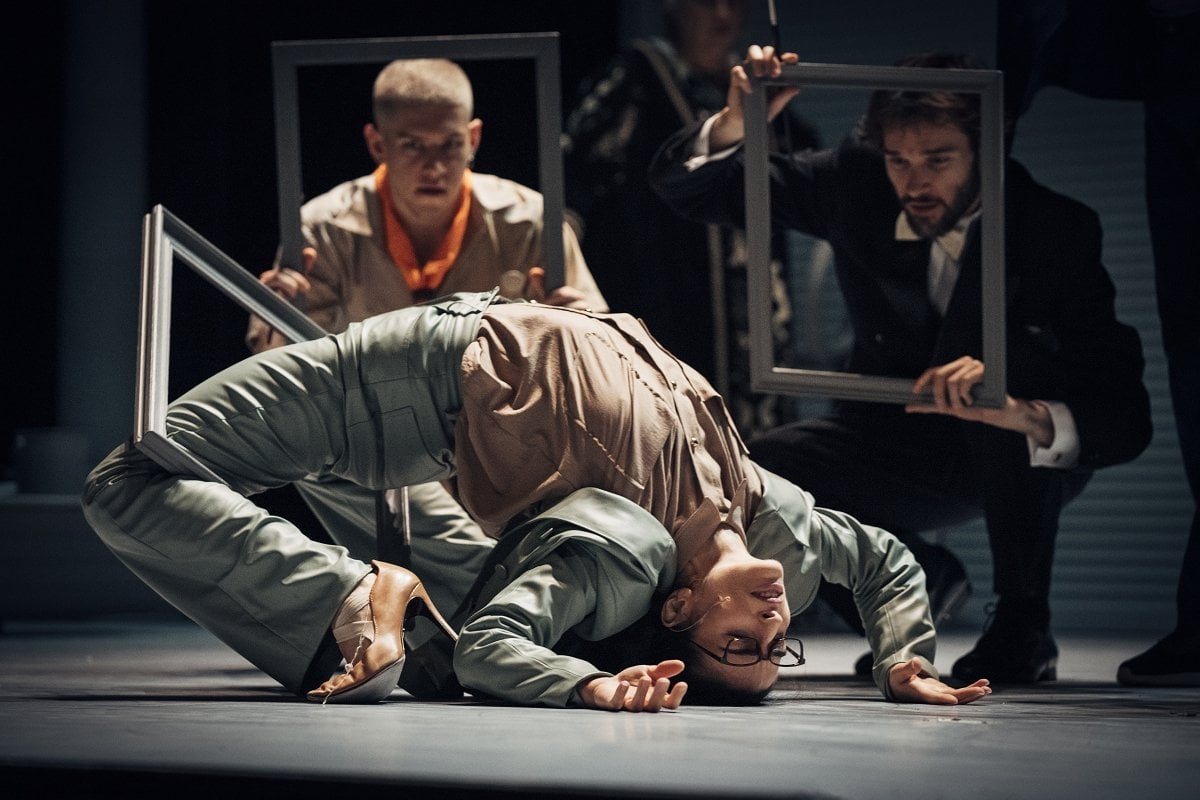
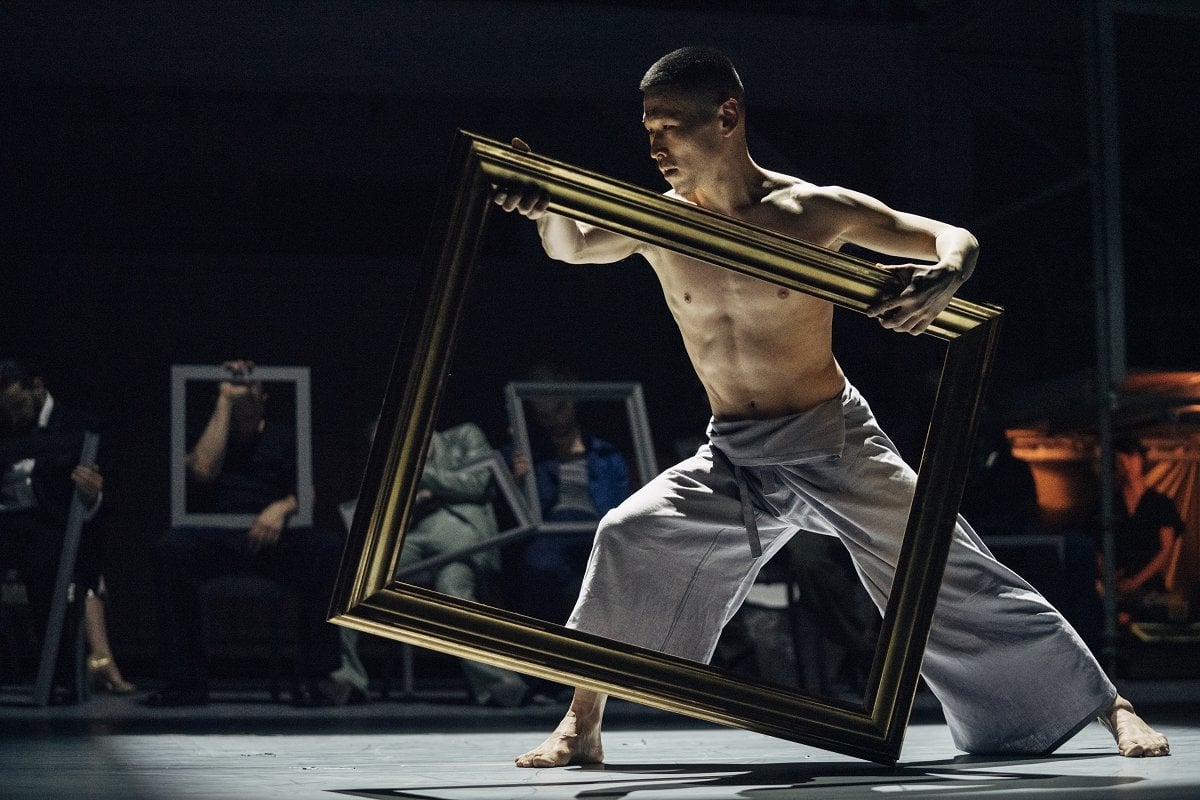
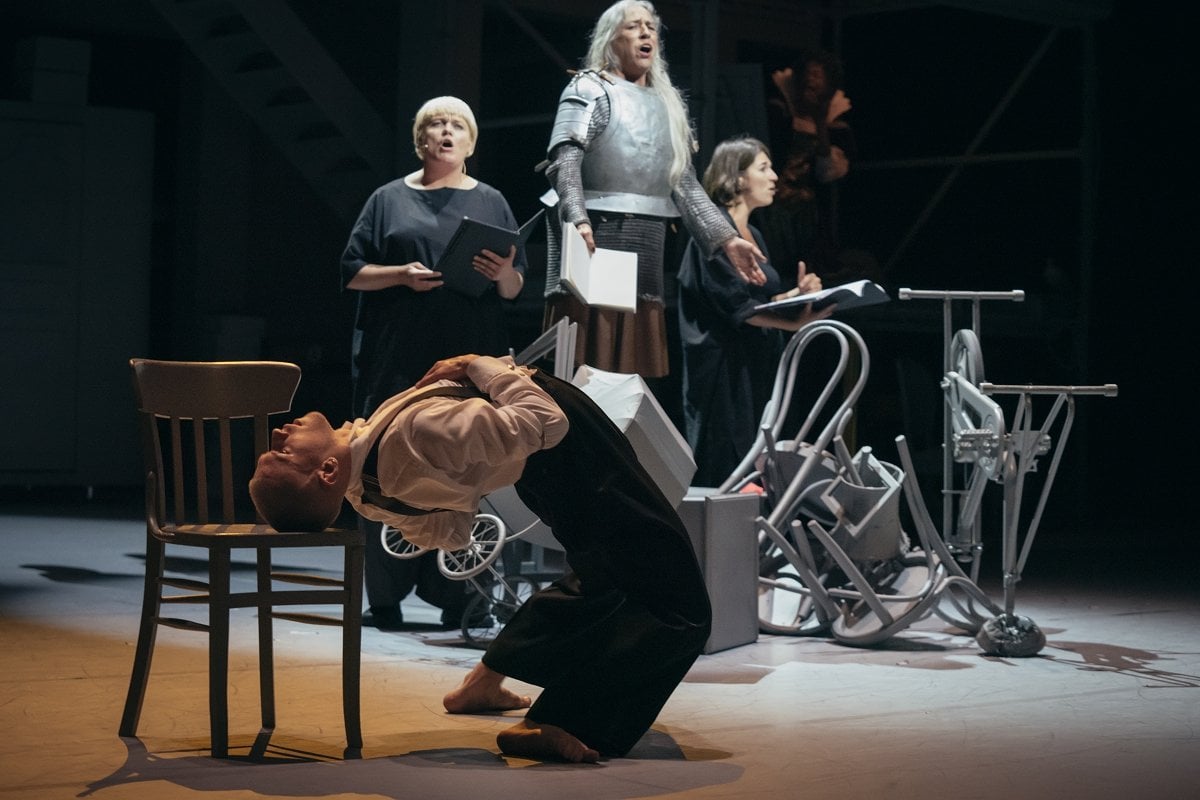
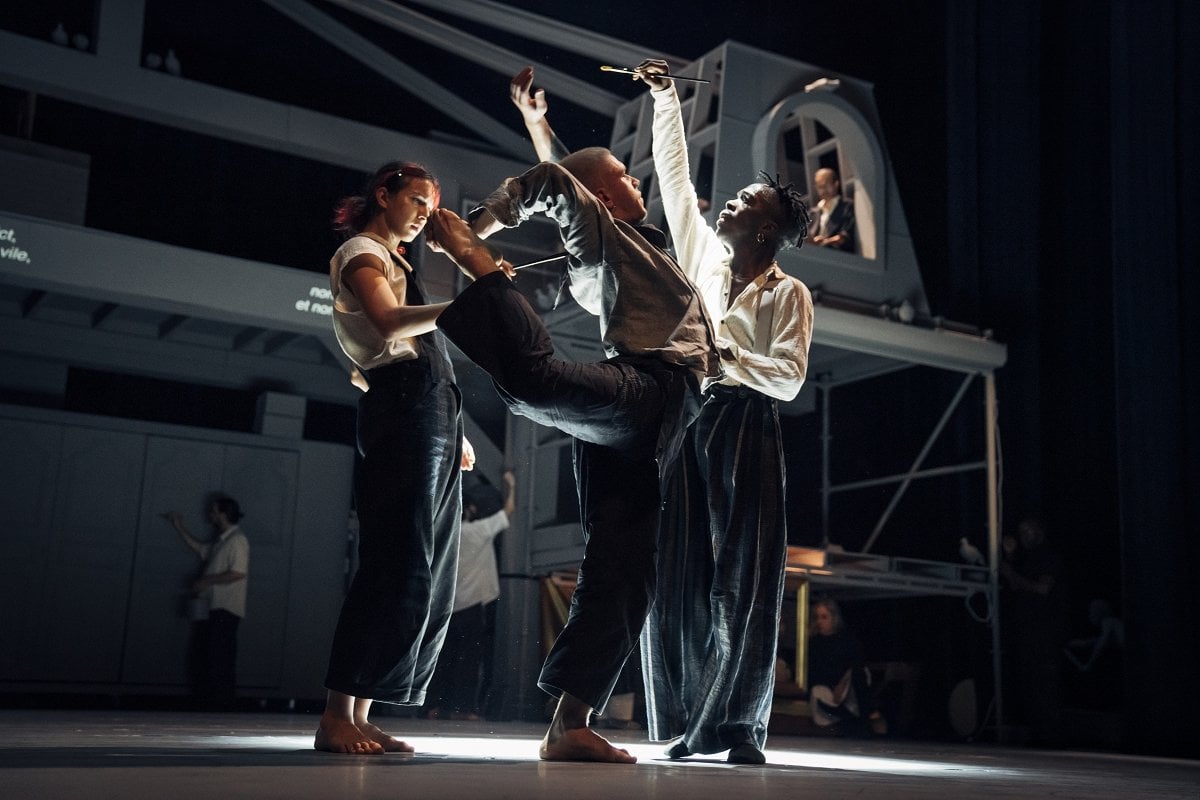
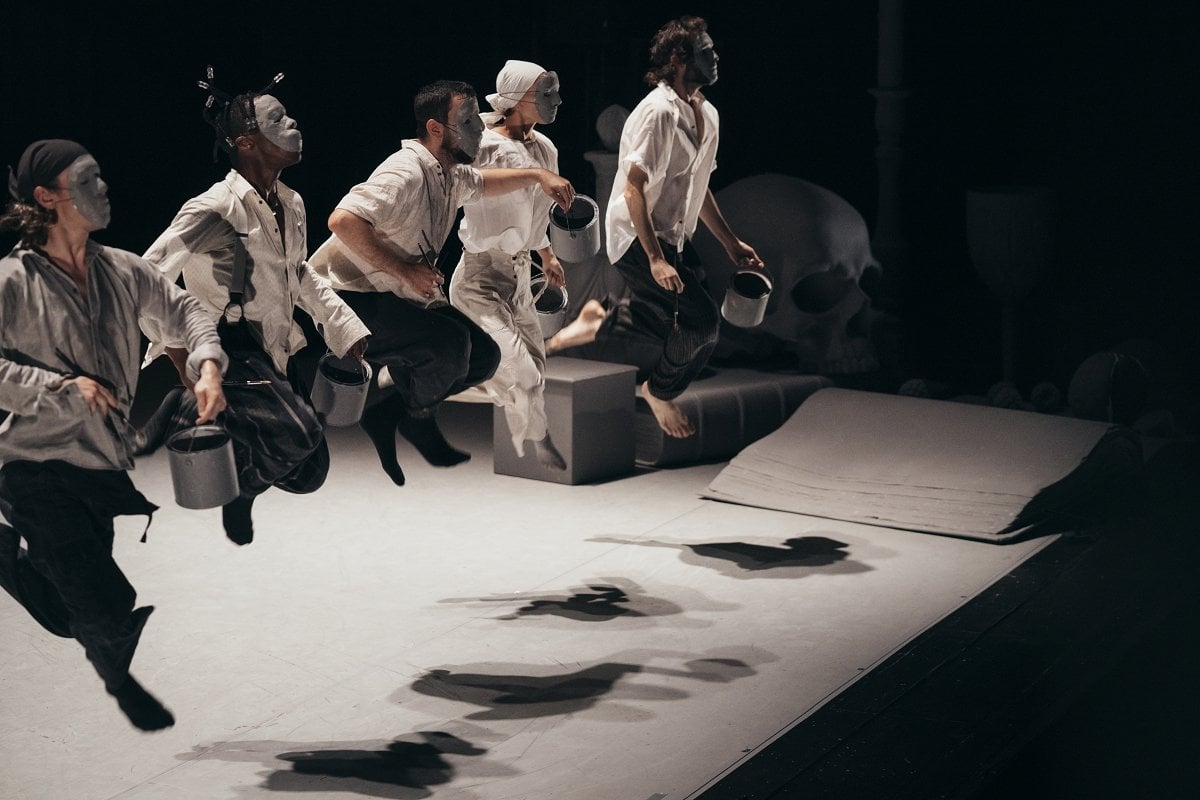
The outstanding ensemble of dancers dominated two sections at either end of the work, in which they all danced in an entirely unconnected way, moving sinuously in their own kinaesthetic worlds. All dancers were extraordinary, but my eye was continually drawn to Dayan Akhmedgaliev, whose body seemed to be composed of plasticine and wire. The eclectic mix of nationalities (the dancers come from five continents) found many different interfaces with Cherkaoui’s notion of Flemish culture.
As the work progressed, it became more political with several references to Flemish nationalism. One song had the oft-repeated chorus of “Don’t call me a Flemish Nationalist, being Flemish is already hard enough”, with a line that referenced fascists in Flanders. Another song spoke of “noble, free Flanders” once “famous in distant lands” but having “long been wronged” is now held back.
The work could do with a judicial edit, it is certainly 20 minutes too long for a show without an interval, and there are too many songs in Flemish (some are in French, respecting the dual languages) such that it became tiring to have to constantly refer to the surtitles to understand their meaning.
Vlaemsch is apparently an old form of spelling, and, in a sense, one felt that the work is a love letter to an old form of Flanders, skilfully deconstructing it’s cultural and political history with diverse golden threads of ancient and modern songs interpreted in dance that cascades idiosyncratically across the stage, the whole affair resonating with the same Flemish/Renaissance art influences of a Peter Greenaway film.


Graham Watts is a freelance writer and dance critic. He writes for The Spectator, Tanz, Shinshokan Dance Magazine (Japan), Ballet Magazine (Romania), BachTrack and the Hong Kong International Arts Festival and has previously written for the Sunday Express, Dancing Times, Dance Europe, DanceTabs, London Dance, the Edinburgh International Festival and Pointe magazine (USA). He has also written the biography of Daria Klimentová (The Agony and the Ecstasy) and contributed chapters about the work of Akram Khan to the Oxford Handbook of Contemporary Ballet and on Shobana Jeyasingh for the third edition of Routledge’s Fifty Contemporary Choreographers.
He is Chairman of the Dance Section of The Critics’ Circle and of the UK National Dance Awards and regularly lectures on dance writing and criticism at The Royal Academy of Dance, The Place and (until the war) for Balletristic in Kyiv. He was a nominee for the Dance Writing Award in the 2018 One Dance UK Awards and was appointed OBE in 2008.